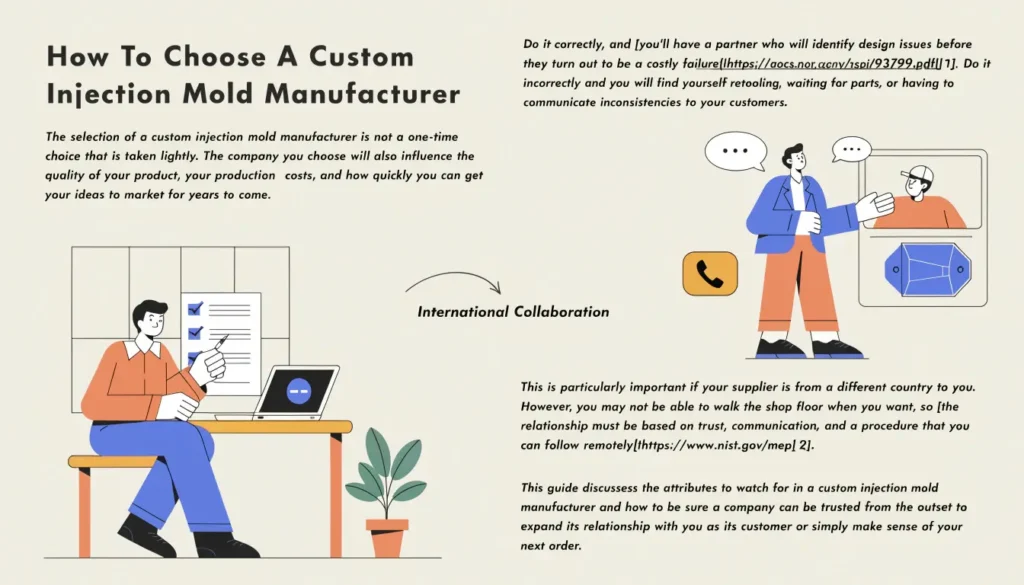
The selection of a custom injection mold manufacturer is not a one-time choice that is taken lightly. The company you choose will also influence the quality of your product, your production costs, and how quickly you can get your ideas to market for years to come. Do it correctly, and you’ll have a partner who will identify design issues before they turn out to be a costly failure1. Do it incorrectly and you will find yourself retooling, waiting for parts, or having to communicate inconsistencies to your customers.
This is particularly important if your supplier is from a different country to you. However, you may not be able to walk the shop floor when you want, so the relationship must be based on trust, communication, and a procedure that you can follow remotely2. This guide discusses the attributes to watch for in a custom injection mold manufacturer and how to be sure a company can be trusted from the outset to expand its relationship with you as its customer or simply make sense of your next order.
Why This Decision Carries More Weight Than It Seems
A mold is not merely a trivial, inexpensive item. It is a part of the tooling that your product relies on for the entire production run, and it may be for years. Poorly constructed molds result in flawed parts. When your supplier is unable to convey their message clearly, it becomes a missed deadline. When they don’t scale with you, you’ll be pricing your product once again and looking for a new manufacturer.
Think of this as making a long-term manufacturing arrangement, not a purchase order. From now on, it is no longer a name on an invoice, but the right manufacturer is part of the product development.
This is particularly the case when you’re creating more than one product. The first mold maker that gets you right is already familiar with your tolerances, your materials, and your way of communicating. Using a different supplier for each new product results in having to repeat all of it from the ground up and not reaping the efficiencies that a real partnership can provide.
Manufacturer or Broker? Know Who’s Actually Building Your Mold
First of all, determine who you are talking to before comparing quotes. Some companies will create and manufacture their own molds in their own mold shop and using their own mold makers. Others are brokers: they order it and deliver it to another factory to be made.
Of course, there is nothing wrong with brokers, but there is a buffer between you and the people who actually cut steel. Communication is more difficult, and if things go wrong, you can’t generally be held accountable because you don’t have a direct line to the engineers who know your part best.
You have a much shorter chain of communication if you work directly with a manufacturer that designs, has its own tooling, and can do its own molding. What if a design detail needs to be tweaked, or a trial sample is not the way it should be? You’re talking to the person who can help you, not going through an intermediary! When it comes to purchasing a mold, you will know a lot more about the company before placing your order if you ask just one question: Do you build the mold in-house, or does it get outsourced?
What to Check Before You Request a Quote
A Single Company Controls the Whole Process
Does the manufacturer provide all-in-one services from product design input, mold design, machining, and trial molding to production? With these steps occurring in different companies, each handoff presents an opportunity for data to fall through the cracks or timelines to slide. When faced with a problem, a manufacturer that performs the entire process in-house can respond more quickly by being able to assume responsibility for the problem, rather than pointing fingers at another supplier.
Early Design Feedback, Before Steel Gets Cut
A good manufacturer checks your design prior to tooling. It also can be called Design for Manufacturability, or DFM. Still, you don’t need the technical term to know its importance—before you pay for a set of tools based on a bad design, it’s a check that can alert you to costly problems, such as a wall that’s too thin, a shape that will trap air, or a feature that will make the mold difficult to eject cleanly.
When a manufacturer is willing to go right from your file to a quote without asking you any questions about your part, it’s a marker that should be noticed. A supplier that looks at your design and identifies possible problems before you begin building the mold is not only looking out for their own production schedule, but also their budget.
Industry Support from Prototype to Full Production
Some manufacturers can only do well one of the two, prototypes or high-volume runs. Inquire directly if they will be able to produce your project from a prototype mold to full production without having to change suppliers mid-project. A manufacturer who is able to support both stages can save you from having to re-qualify a new vendor when your product begins to sell.
Real-Life Experience with Products
Inquire about the sort of parts and industries they have actually produced. A company with experience creating molds for products in your general category (consumer goods, automotive parts, medical devices, industrial parts, etc.) will have more pertinent questions for you and will be able to find problems that a newer supplier may overlook.
How They Handle Problems, Not Just Successes
There’s generally at least one thing that goes wrong with every mold project: the first try is a slight miss, the material is slightly different than expected, or the shipping day drags on and on, and is not in anyone’s control. The difference between a good manufacturer and a mediocre one is not if the problem occurs. It’s how they react when they do.
Inquire from a prospective supplier, directly, what will happen if a trial sample fails to pass spec. Do they describe how they adapted their mold and retested their mold? Do they refer to the financial responsibility for that adjustment? If a manufacturer has a clear and practiced response, the manufacturer has been through it before and knows how to do this professionally. If a person is seemingly stumped by the question, they may not have a process at all.
Communication Is the Factor Overseas Buyers Underestimate
Many overseas buyers don’t consider communication to be a crucial part of the project.
If you are unable to visit the factory, the only way for you to get a feel for how the project is going is through communication. It is this area where a lot of the overseas sourcing relationships fail because of poor updates, not because of poor machinery.
Take note of a manufacturer’s communication from the initial contact. Are they responsive in a reasonable time? Do they reply with specifics to your project? A slow or unreliable supplier before you have even ordered is hardly likely to get on track after you order.
If there is a system in place by a manufacturer, there is no need for time zone differences to be a problem. Some suppliers designate one point of contact for your project, so you don’t have to write to a different individual every time you write in. Others define certain time frames for calls or notifications that fit your timetable. Any of these will do as long as it’s the same approach. What doesn’t work is a changing cast of contacts that answer only a portion of your question, and you must sort it all out for yourself.
How to Evaluate a Quote Without Getting Burned
It is not necessarily the cheapest one that is the most valuable. If it’s a low cost without any detail, you can bet that there’s one thing that’s being sacrificed – whether it’s the materials, the inspection process, or the time required to create the mold properly.
When comparing quotes, consider the actual services offered. Is the design review included in the price or an additional charge? What do you do if a change in the design is required once the mold is underway? When purchasing tools, ownership is clearly written, and there is no confusion later on about who owns the tool after paying for it.
If you get an itemized quote from a manufacturer within a day or two, it’s probably a good sign. It implies that you have an organized team that grasps your project rapidly, not one that requires weeks to determine what to bill you.
Request a realistic timeline, rather than a promised delivery date. A manufacturer that divides the process into phases—quotation, design, machining, trial molding, and shipment—is providing you with something that you can actually measure. The confusing “4-6 weeks” without a specific breakdown can make it difficult to determine if your project is ahead or behind schedule until the last minute comes.
Quality Control You Can Trust From a Distance
Quality checks at the end of production are risky. When a problem emerges in a completed part, you’ve already invested money and time in progressing to it.
Question the quality control procedures as well as those used at the end. Do drawings and mold design get reviewed prior to the machining? Are samples taken for trial and compared to your specifications? Do they provide dimensional reports in addition to just a message saying all is good?
International buyers are more interested in having the proof than a verbal promise. Images, measurement reports, and videos of test runs allow you to maintain your own quality assurance, rather than just taking someone’s word for it.
Considering More Than Just This Order
If you’re looking for a mold manufacturer to turn to, you should be thinking of something other than your order. Ask what happens once production has begun. Are they able to expand their operations if there is an increase in demand? Do they provide mold maintenance or repair services in the future, and do they not find themselves in a crisis of production a year from now because their mold is worn out?
The manufacturers who think ahead more to what they can make next, rather than just the one they’re making now, tend to build longer-lasting relationships. That’s what the distinction is between someone who you only use once and someone who you will keep using as you grow your business.
Warning Signs Worth Taking Seriously
There are a few signs to be alerted to when searching:
- When the answer is unclear and/or evasive regarding who constructs the mold.
- Lack of willingness to provide progress pictures, video footage, or insights into inspections.
- The desire to make a commitment before you view a sample or trial result.
- Low prices that come with very few details as to what is included.
- No question is offered regarding how your part will be used.
A lack of any of these isn’t the end of the world, but a combination of them is a good sign to continue your search.
A Checklist to Help You Think Through the Details of Your Decision
- Confirm if the design, tooling, and molding are done in-house or with subcontractors.
- Get early design input before tooling starts.
- Ensure they are able to assist you from prototype to production.
- Review actual project examples in the product category that you are investigating.
- Try them out, see how they respond and how much they say.
- When looking for quotes, do not settle for just one price. When comparing quotes, don’t accept a single price.
- Confirm the method of checking and reporting quality at each stage.
- Discuss how they contribute to scaling and molding over time.
Frequently Asked Questions
So, if I can’t be there in person, how do I know if a mold manufacturer is a reputable one?
Examine their process: Reputable manufacturers will provide photos, videos, and inspection reports at every step without needing to be asked twice. When a supplier is unwilling to provide this type of documentation or is unclear when asked to provide such documentation, it’s a red flag, not a mistake.
What’s a sensible initial response time from the manufacturer?
Most organized suppliers will respond to your query within a day or two, and in the event of a full quote, it may take somewhat longer. A reply that’s tailored to your project, referencing your files or needs, is a better sign than a quick reply that’s generic.
Is it generally better to take the quote with the lowest price from the manufacturer?
No, don’t just look at the price; consider the services you’re getting. A lower number that fails to include a design review, clear cut ownership, or realistic lead times can end up costing more in the long run, due to delays and rework.
Is it possible for one manufacturer to produce everything, from prototype to full production?
Some can, and it’s better to ask directly. A manufacturer that offers both phases of the process will spare you the hassle and expense of re-qualifying a new supplier at a time when your product is just picking up steam.
Final Thoughts
Selecting a custom injection mold manufacturer comes down to selecting the amount of risk that you’re willing to take on when developing the product. A manufacturer who can look at your design in its early stages, provide clear communication, clearly document the quality at all points, and plan for your development minimizes that risk. A person who fails to respond to simple questions about the work they do, or who simply doesn’t speak when your order is placed, is a red flag that shouldn’t be ignored in favor of low cost.
Before committing, read the questions in this guide and consider the answers. They will be welcomed by the right partner because a manufacturer who has faith in his process has nothing to hide from a buyer who is making an informed decision.