
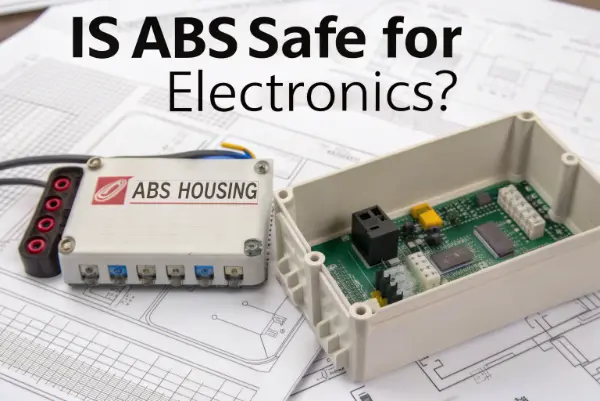
Does your latest electronics project rely on ABS plastic enclosures, and are you worried about fire safety regulations? You are not alone. Many business owners like you fear failing UL certification or facing product recalls because they didn’t understand material flammability. If you don’t choose the right grade of ABS, your entire product line could be at risk. Let’s make sure your enclosures are safe and compliant right now.
ABS electronics enclosures must be evaluated as part of an energized product, not as an isolated plastic shell. The correct material and tests depend on power, ignition sources, abnormal conditions, component spacing, wall and openings, intended environment and the governing product standard. A UL 94 classification can support the design, but it does not replace enclosure-level construction review or final-product certification.
Related engineering resources: mold design | mold testing and validation | production injection molding
ABS plastic is generally safe for electronics enclosures, but standard grades are not fireproof; they are flammable. For safety-critical applications, you must use Flame Retardant (FR) ABS grades that meet specific UL 94 standards (like V-0, V-1, or V-2)1. These materials contain additives that slow down combustion or self-extinguish when the flame source is removed2. Understanding these ratings is crucial for ensuring your product meets safety codes.
It is easy to assume all plastic is the same, but that mistake can cost you thousands of dollars. We need to look closely at what ABS actually is and how it behaves when things get hot.
What is an ABS enclosure?
You might see “ABS” on a spec sheet, but do you know what that actually means for your product’s durability? Many manufacturers choose materials based on price alone, only to find their enclosures cracking or warping later. This leads to customer complaints and a damaged reputation. You need to understand the base material before you can even think about fire safety.
An ABS enclosure is a protective housing made from Acrylonitrile Butadiene Styrene, a common thermoplastic polymer. It is widely used in consumer electronics, instruments, and project boxes because it offers a great balance of impact resistance, rigidity, and relatively low cost. It is easy to machine and mold, making it the go-to choice for generic housings, but standard ABS has limits regarding high heat and direct flame exposure.
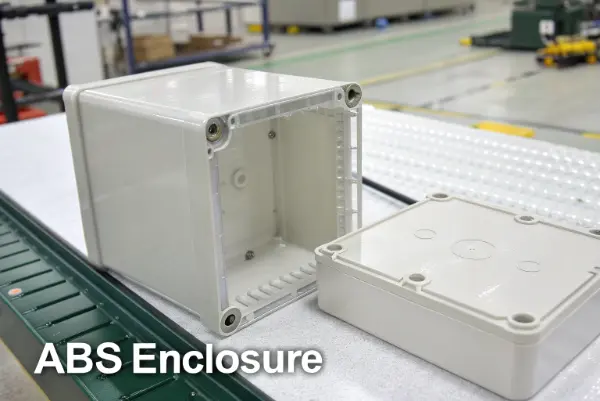
You need to know its physical properties to see why we worry about fire safety later.
Why We Use ABS (and Why We Worry)
ABS is a terpolymer. That means it is made of three different monomers.
- Acrylonitrile: Gives it chemical resistance and stability.
- Butadiene: Gives it toughness and impact strength.
- Styrene: Gives it a glossy finish and makes it easy to process.
However, none of these three components are naturally fire-resistant. In fact, they burn quite well. This creates a conflict. You want the toughness and price of ABS, but you need the safety of a high-performance material.
| Property | Standard ABS | Flame Retardant ABS |
|---|---|---|
| Impact Strength | High | Medium to High (Additives can lower this slightly) |
| Processing | Very Easy | Easy, but temperature control is critical |
| Cost | Low | Moderate to High |
| Flammability | Burns easily (HB Rating) | Resists burning (V-0, V-1, V-2) |
During project review, now, I ask them where the box will live. Is it sitting on a desk? Or is it inside a hot electrical cabinet? If it is just a simple housing for a low-voltage sensor, standard ABS is fine. But if it houses a power supply that generates heat, standard ABS becomes a fuel source. We have to treat the material differently based on the “risk profile” of the electronics inside.
Is ABS plastic fireproof?
Have you ever seen plastic melt and drip during a fire test? It is a terrifying sight for any product designer. If you believe the myth that “hard plastic won’t burn,” you are setting your business up for a disaster. Standard ABS burns rapidly, releases thick black smoke, and can spread a fire to other parts of a building. We need to separate fact from fiction immediately.
No, standard ABS plastic is not fireproof; it is inherently flammable and will burn if exposed to an open flame. However, special “Flame Retardant” (FR) grades of ABS are available. These grades have chemical additives (like halogenated or non-halogenated compounds) mixed in during manufacturing. These additives interrupt the combustion process, allowing the plastic to self-extinguish or resist ignition, but they are still not “fireproof” in the same way metal or ceramic is.
Let’s look deeper into how we measure this “fireproof” quality. In the plastics industry, we rely heavily on UL (Underwriters Laboratories) standards. Specifically, UL 94.
Understanding UL 94 Ratings
You cannot just ask for “safe ABS.” You have to specify the rating. Here is how the hierarchy works, from least safe to most safe.
- HB (Horizontal Burn): This is the lowest rating. It means the plastic burns slowly across a horizontal specimen. Most standard ABS falls here. It is fine for decorative parts but bad for electrical enclosures.
- V-2 (Vertical Burn): Burning stops within 30 seconds on a vertical specimen, but it allows flaming drips. Those drips can start other fires below.
- V-1 (Vertical Burn): Burning stops within 30 seconds. No flaming drips are allowed. This is better.
- V-0 (Vertical Burn): This is the gold standard for most electronics. Burning must stop within 10 seconds. No flaming drips.
The Trade-off
Why not use V-0 ABS for everything? Two reasons: Cost and Brittleness.
When you add flame retardants to ABS, you often weaken the “Butadiene” rubber part of the chain. The plastic becomes a bit more brittle. It might crack easier if dropped. Also, the additives are expensive. As a business owner, you have to balance the safety requirement against the mechanical requirement.
If your device plugs into a 110V/220V wall outlet, you almost certainly need V-0. If it is a battery-powered remote control, HB might be acceptable. Don’t guess. Check the UL standard for your specific device category.
Is ABS safe for electronics?
Are you worried that chemical outgassing or static electricity from ABS might damage your sensitive circuit boards? It is a valid concern. While fire is a major risk, other factors like ESD (Electrostatic Discharge) or thermal deformation can kill your electronics just as fast. You need to know if ABS is a friend or foe to your PCBs.
Yes, ABS is generally safe for housing electronics because it is an electrical insulator, meaning it does not conduct electricity. This protects the user from shock. However, standard ABS can generate static electricity, which can damage sensitive components. For sensitive electronics, you may need antistatic ABS grades or conductive coatings. Also, you must ensure the operating temperature of your electronics does not exceed the softening point of the ABS (around 105°C).
So, is it safe? Yes, but you have to engineer around its weaknesses.
Thermal Management
Electronics generate heat. ABS is a thermal insulator. This means it traps heat inside the box.
- The Problem: If your CPU or power regulator gets hot, the ABS box keeps that heat in like a winter coat.
- The Solution: You need to design vents. You need to use active cooling (fans). Or, you need to switch to a blend like PC/ABS (Polycarbonate + ABS) which handles heat better.
ESD (Electrostatic Discharge)
Since ABS is an insulator, it loves to build up static charge. If you walk across a carpet and touch a standard ABS box, nothing happens. But if that static jumps to the chip inside, the chip dies.
- Standard ABS: High surface resistivity. Holds charge.
- Antistatic ABS: Has additives to lower resistivity. The charge bleeds off slowly.
- Conductive ABS: Has carbon fibers or powder mixed in. It acts like a shield.
Chemical Safety
Safety Checklist for ABS:
- Heat Check: Is the internal temp under 80°C?
- Static Check: Do you need ESD protection?
- Chemical Check: Are your adhesives compatible with ABS?
What are the requirements for explosion proof enclosures?
Do you think a standard heavy-duty ABS box is enough to contain an internal explosion? This is a dangerous misconception. If your device is used in hazardous environments like oil refineries or flour mills, “fire resistant” is not enough. You are dealing with volatile gases and dust. Using the wrong enclosure here is not just a code violation; it is a life-threatening error.
Requirements for explosion-proof enclosures are extremely strict and generally exclude standard ABS plastic. These enclosures (often rated NEMA 7 or ATEX Ex d) must be able to contain an internal explosion without rupturing and without allowing flames or hot gases to escape and ignite the surrounding atmosphere. They are typically made of cast aluminum or stainless steel. ABS is rarely used for true explosion-proof ratings unless it is a highly specialized, thick, reinforced composite designed specifically for intrinsic safety.
This is where A common observation is a lot of confusion in the market. I get inquiries asking for “Explosion Proof ABS molds.” I have to stop the conversation right there and educate the client. There is a massive difference between “Flame Retardant” and “Explosion Proof.”
The Concept of Containment
“Explosion Proof” (Ex d) does not mean the box survives a bomb. It means if a spark inside the box ignites gas that leaked inside, the box will not blow apart. It contains the pressure.
- Pressure: An internal explosion creates massive pressure spikes. ABS acts like a balloon—it expands and bursts. Metal acts like a tank.
- Flame Path: The joints in an explosion-proof box are designed to cool down hot escaping gases before they reach the outside air. Plastic joints usually deform under heat, failing this requirement.
Where Plastics Fit in Hazardous Locations
While you rarely see ABS as an “Ex d” (flameproof) enclosure, you might see plastics used in “Intrinsic Safety” (Ex i) or “Increased Safety” (Ex e) applications.
- Intrinsic Safety: The electronics are designed so they simply don’t have enough energy to create a spark. In this case, the enclosure doesn’t need to contain an explosion, so tough plastics might be allowed.
- Static Risk: In hazardous zones, static electricity is a huge danger. A spark from a plastic box could ignite gas. Therefore, any plastic used in these zones must be static-dissipative. Standard ABS generates static, so it is banned in many ATEX zones unless treated with a conductive coating.
Material Standards for Hazardous Locations
If you absolutely must use plastic in a hazardous environment (perhaps for weight or corrosion reasons), you are looking at high-performance engineering plastics, not commodity ABS. You would look at:
- GRP (Glass Reinforced Polyester)
- Specialized Nylons
- Carbon-loaded materials
Summary Table: Environment vs. Material
| Environment | Requirement | Material Choice |
|---|---|---|
| Office / Home | UL 94 HB or V-0 | Standard ABS or FR-ABS |
| Outdoor / Industrial | UV Stable + Impact | ASA or PC/ABS |
| Hazardous (Gas/Dust) | Explosion Proof / Anti-static | Cast Aluminum / Stainless Steel (Avoid ABS) |
Do not try to force ABS into a role it wasn’t built for. It is great for consumer electronics, but it is not a bomb shelter.
Map Ignition Sources and Consequences
Identify batteries, power supplies, connectors, resistors, relays, motors and fault conditions that can create heat, arcs or glowing components. Consider whether burning particles can escape, whether a user can touch an energized part and what surfaces are mounted nearby. The risk map guides barriers, spacing, ventilation and the required polymer performance.
Confirm Exact Material Recognition
Verify the commercial ABS or blend, supplier, color and minimum wall thickness represented by its flammability information. Ratings can vary by thickness and pigmentation. Heat, impact, electrical, UV and chemical requirements must also be met. A material chosen solely for a high flame classification may crack at a fastener or deform beside a hot component.
Design Walls, Openings and Interfaces Together
Ventilation lowers operating temperature but can create paths for flame or debris. Snap joints, screw bosses, ribs and inserts influence wall continuity and stress. Maintain required creepage, clearance and accessibility through tolerance stack-up and aging. Avoid thinning the enclosure below the qualified construction at weld lines, texture or local coring.
Control Molding Variables That Affect Evidence
Grade mixing, excess regrind, color substitution or thermal degradation can compromise qualified material. Follow supplier drying and residence guidance, use effective venting and control deposits. Trace resin lot, masterbatch, cavity and process status for safety-critical enclosures. Supplier or manufacturing-site changes should enter formal approval rather than routine purchasing substitution.
Test Under Normal, Abnormal and Aged Conditions
The applicable product standard may require temperature, abnormal operation, impact, drop, strain, glow-wire or other tests in addition to material flammability. Conduct testing on representative assemblies after conditioning. Certification scope should name model variants, power configurations and construction differences so a cosmetic product change does not silently alter a safety barrier.
ABS Electronics Enclosures: Design and Validation Checklist
- Map heat, arc, battery and fault sources plus likely fire paths.
- Verify exact resin, color, thickness and recognized material information.
- Review vents, barriers, joints, inserts, spacing and wall tolerances as one system.
- Control resin mixing, regrind, degradation, pigment and cavity traceability.
- Validate representative products under the applicable normal and abnormal tests.
Authoritative Reference Points
Frequently Asked Questions
Is UL 94 V-0 required for every electronics enclosure?
No. The applicable product standard, power, construction and hazard analysis determine the needed material and tests.
Does a UL 94 rating certify the finished enclosure?
No. It classifies material specimens under defined conditions; the assembled product still requires its applicable construction and safety evaluation.
Can enclosure wall thickness be reduced after certification?
Only after engineering and certification review. Thickness can affect flammability, impact, heat and electrical-protection performance.
Conclusion
ABS is an incredible material for electronics, provided you respect its limits. It is safe for most housings if you manage heat and static. It can be made fire-resistant with the right additives to meet UL 94 V-0 standards. However, it is not truly “fireproof,” and it is certainly not suitable for explosion-proof applications. As a business owner, your job is to match the material grade to the safety risk of your product. Choose wisely, and your product will succeed.