
Have you ever opened a mold only to find your ABS parts warped, burnt, or filled with unsightly voids? It is frustrating when you think your design is suitable, but the machine settings ruin the final product. You spend hours troubleshooting, wasting material and time. Getting the temperature and pressure right is the biggest hurdle in processing ABS effectively.
Safe ABS processing cannot be reduced to one universal temperature and pressure table. Grade, color, moisture, machine size, screw, residence time, runner, gate and part geometry change the workable window. Parameter development should start with the current supplier datasheet and safety information, then use cavity evidence to establish the lowest-stress process that completely fills, packs and releases the part.
Related engineering resources: production injection molding | mold testing and validation | mold design
The safe processing temperature for ABS injection molding typically ranges from 200°C to 240°C (392°F to 464°F), with a mold temperature kept between 40°C and 80°C (104°F to 176°F).1 Proper pressure control is equally vital, usually requiring injection pressures between 60 and 100 MPa2. Staying within these ranges prevents degradation, ensuring strong mechanical properties and a high-quality surface finish for your plastic components.
What temperature is ABS injection molding?
You might be setting your barrel temperatures based on a generic data sheet, but are you still seeing inconsistent melt flow? Using the wrong temperature profile is a classic mistake. If the rear zone is too hot, you get premature melting; if the nozzle is too cold, you get blockages. This inconsistency leads to weak parts and rejected batches.
For standard ABS injection molding, you should set a graduated temperature profile. The rear zone (feed section) should be cooler, around 180°C–200°C, increasing to 210°C–230°C in the middle zone, and peaking at 230°C–240°C at the nozzle. This gradual increase ensures the material melts uniformly without thermal shock. Generally verify the specific grade of ABS you are using, as flame-retardant or glass-filled grades may require slight adjustments.
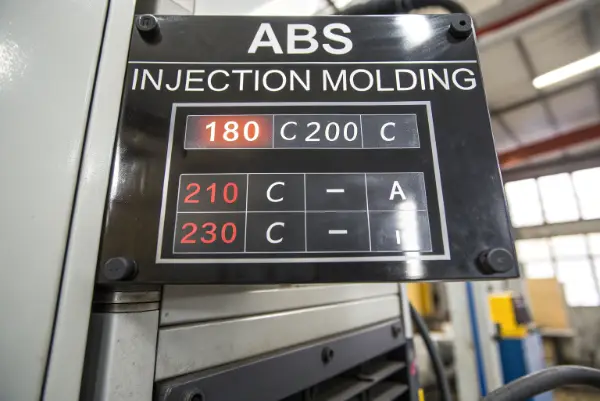
When we talk about the “temperature” of molding, we are actually managing three distinct heat sources: the barrel zones, the nozzle, and the shear heat generated by the screw.
If you set the rear zone too high immediately, the pellets can stick together before they are properly conveyed by the screw. This is often called “bridging,” and it stops production cold. By keeping the rear zone lower (around 180°C), you allow the pellets to move freely. As they move forward, the compression of the screw generates friction. This friction creates shear heat, which actually does a lot of the melting work for you.
Here is a typical breakdown for a standard ABS setup:
| Zone | Recommended Temp (°C) | Recommended Temp (°F) | Function |
|---|---|---|---|
| Rear Zone | 180 – 200 | 356 – 392 | Pre-heating, prevents bridging |
| Middle Zone | 210 – 230 | 410 – 446 | Plasticization and compression |
| Front Zone | 225 – 240 | 437 – 464 | Final melt homogenization |
| Nozzle | 220 – 235 | 428 – 455 | Prevents drooling or freezing |
You must also consider the mold temperature. It is not just about the plastic temperature. If you inject hot ABS into a cold mold (below 40°C), the material freezes too fast. This creates high internal stress. The part might look okay when it pops out, but it will warp later or crack under load. A practical approach is to keeping the mold between 50°C and 70°C for the best surface finish. A warmer mold allows the polymer chains to relax, resulting in a shinier, stronger part.
What are the critical process parameters for injection molding?
Are you focusing solely on temperature and ignoring the forces that actually push the plastic into the shape? Temperature is only half the battle. If your injection pressure is too low, you get short shots; if it is too high, you get flash and stuck parts. Ignoring the balance between speed, pressure, and time is the fastest way to damage your mold and your reputation.
Beyond temperature, the critical parameters for ABS are injection pressure, holding pressure, and injection speed. Injection pressure typically needs to be 70–100 MPa to fill the cavity. Holding pressure should be about 60–80% of the injection pressure to pack the part as it cools, preventing sink marks. Injection speed should be moderate—too fast causes burning (shear heating), and too slow causes flow lines.
First, look at Injection Speed. ABS is not like Nylon or Polypropylene; it is somewhat viscous. If you shoot it too fast, the friction against the mold walls creates excessive heat. This is shear heating again. It can actually burn the plastic inside the mold, leaving black streaks (diesel effect) near the gates. However, if you go too slow, the leading edge of the plastic cools down before the mold is full. This leaves you with ugly weld lines or ripples on the surface. You need a “moderate to high” speed, usually staged. Start fast to fill the runners, then slow down as the cavity fills to let the air escape.
Next is Back Pressure. This is the resistance on the screw as it recovers for the next shot. For ABS, you need back pressure to ensure the color is mixed well and the melt is uniform. A range of 5 to 15 bar is usually safe. If it is too low, you get air bubbles. If it is too high, you break the polymer chains, making the plastic weak.
Finally, consider the Cushion. This is the small amount of plastic left in the barrel after injection. You must have a cushion (usually 3-5mm). If the screw hits the bottom (zero cushion), you cannot transfer holding pressure to the part. The part will shrink away from the mold walls as it cools, creating sink marks. You need that cushion to “feed” the shrinkage.
| Parameter | Setting Guideline | Impact on ABS Part |
|---|---|---|
| Injection Speed | Moderate to Fast | Controls surface finish and weld lines |
| Back Pressure | 50 – 150 bar (specific) | Ensures mixing and melt consistency |
| Holding Pressure | 60-80% of Injection Pressure | Prevents sink marks and controls dimensions |
| Screw Speed | Moderate (40-60 RPM) | Affects material residence time |
How much temperature can ABS handle?
Are you pushing your machine to the limit to reduce cycle times, risking material degradation? It is tempting to crank up the heat to make the plastic flow faster, but ABS has a breaking point. Once you cross the thermal threshold, the chemical bonds break, releasing gas and ruining the structural integrity of the part.
ABS begins to degrade rapidly if exposed to temperatures above 250°C (482°F) or if it stays in the barrel too long at 240°C. Signs of overheating include yellowing, black specks, and a pungent smell. To handle this safely, ensure your maximum processing temperature stays below 250°C and check that the residence time (time the plastic sits in the heater) is less than 5–6 minutes.
Understanding the thermal ceiling of ABS is crucial for critical components, especially in consumer electronics where the project stakeholder works. When ABS degrades, it is not just a cosmetic issue; the molecular weight drops. This means the plastic becomes brittle. A snap-fit tab that should flex will snap off instead.
We need to talk about Residence Time. This is a factor many people ignore. You might set your barrel to a safe 230°C. But, if your machine is too big for the mold (meaning the shot size is very small compared to the barrel capacity), that plastic might sit in the heated barrel for 10 or 15 minutes waiting to be injected. Even at a “safe” temperature, long exposure to heat will cook the material. This is thermal degradation over time.
If you see splay marks (silver streaks) on the part, check two things. First, is the material dry? Wet ABS splays. Second, is it too hot? If the material is dry and you still see silver streaks, you are likely overheating the material, causing it to turn into gas.
Also, be aware of Hot Runner Systems. If you use a hot runner mold, the manifold temperature must be carefully controlled. Dead spots in a hot runner manifold are notorious for collecting material, cooking it, and then releasing black specks into your fresh parts days later.
To ensure you are not exceeding the limits:
- Purge regularly: If the machine stops for more than 15 minutes, purge the old material before restarting.
- Check the melt temp manually: Don’t just trust the machine display. Use a pyrometer on a purge pile to see the real temperature.
- Smell it: Degraded ABS smells like rubber or burning styrene. If you smell it, it is already too hot.
What is the temperature limit for ABS plastic?
Are you designing parts that will be used in high-heat environments without checking the deflection temperature? You might mold the part reliably, but if the end-use environment is too hot, the part will deform. Knowing the difference between processing temperature and service temperature is vital for product success.
While ABS is processed at over 200°C, its service temperature limit is much lower. The Heat Deflection Temperature (HDT) for standard ABS is typically between 85°C and 100°C (185°F to 212°F) under load. If your product is exposed to temperatures above this range, such as inside a car on a hot day, it will soften and lose its shape. For higher heat resistance, consider High-Heat ABS grades.
This section is for the designers. As a mold maker, Designs sometimes ABS is specified for parts that sit next to hot motors or lighting fixtures. You need to distinguish between the melt temperature (liquid state) and the glass transition temperature (solid performance).
Standard ABS is an amorphous polymer. It does not have a sharp melting point like nylon; it softens gradually. The Glass Transition Temperature (Tg) is around 105°C. As the part approaches this temperature, the polymer chains start to slide past each other. The modulus (stiffness) drops significantly.
If you are designing a housing for electronics that gets hot, you have options:
- High-Heat ABS: Manufacturers add alpha-methyl styrene to the mix to boost heat resistance up to 110°C–115°C.
- PC/ABS Blends: Mixing Polycarbonate with ABS is very common in the automotive industry. It gives you the processability of ABS but raises the heat resistance and toughness significantly, often pushing the HDT up to 120°C or higher.
When testing your design, use the HDT values found on the datasheet, but be careful. HDT is usually tested at two pressures: 0.45 MPa (66 psi) and 1.82 MPa (264 psi). If your part is under mechanical stress (like a screw boss or a clip), use the 1.82 MPa number. It will generally be lower.
Here is a quick comparison for material selection based on heat:
| Material Type | Heat Deflection Temp (1.82 MPa) | Typical Application |
|---|---|---|
| Standard ABS | ~80°C – 85°C | General housings, toys |
| High-Heat ABS | ~95°C – 105°C | Automotive interiors, appliance parts |
| PC/ABS | ~105°C – 125°C | Dashboards, laptop casings |
| Polycarbonate (PC) | ~130°C – 140°C | Structural high-heat components |
Do not rely solely on the data sheet. If possible, prototype the part and put it in an environmental chamber. Real-world stresses often cause failure at temperatures lower than the theoretical HDT.
Condition Material and Machine Before Setting Numbers
Confirm exact grade, lot, color, drying requirement and allowed regrind. Match shot size to barrel capacity so residence time remains controllable, and verify check-ring consistency, nozzle condition and actual temperature. Purge incompatible or degraded material according to the resin and equipment procedure. Local exhaust and guarding should be appropriate to hot polymer processing and plant risk assessment.
Control Melt History, Not Heater Setpoints Alone
Barrel zones, screw speed, back pressure and recovery time combine to create melt temperature. Measure or otherwise verify actual melt condition rather than assuming the display equals the polymer. Excessive temperature, shear or residence can cause yellowing, odor, gas, black specks and property loss; an overly cold melt can create poor fusion, stress and high pressure.
Use Velocity to Manage Filling and Pressure to Protect the System
Develop a repeatable fill profile that carries the flow front through changes in wall and geometry without hesitation or burning. Establish a safe machine pressure limit, but transfer from velocity control based on cavity fill or position before that limit becomes the process method. Peak pressure should be understood at the machine and, where instrumented, in the cavity.
Separate Packing From Cooling
After transfer, tune hold pressure and time using part weight, sink, dimensions and gate-freeze behavior. Mold temperature and cooling balance govern shrinkage, gloss and ejection stability. More pressure cannot correct a frozen gate or a hot core, and longer cooling cannot compensate efficiently for poor channel placement. Study these stages independently before optimizing cycle.
Approve a Window and Reaction Plan
Run designed process changes or boundary trials to understand sensitivity to material, temperature, velocity, transfer, hold and cooling. Link settings to cavity-specific dimensions and function. Document startup, shutdown, interruption, alarm and deviation procedures. Operators should know when to stop, quarantine material or call engineering rather than making unrecorded adjustments.
ABS Injection Molding Parameters and Process Safety: Design and Validation Checklist
- Use the current exact-grade processing and safety documentation as the starting boundary.
- Control moisture, regrind, shot utilization, actual melt and residence history.
- Develop fill velocity, transfer and pressure limits from cavity and part evidence.
- Optimize hold and cooling with gate-freeze, weight and dimensional studies.
- Release a validated window with alarms, ventilation and deviation procedures.
Frequently Asked Questions
What is the best melt temperature for ABS?
There is no single value for all grades. Use the resin supplier’s current range and verify actual melt, residence time, appearance and finished-part performance.
Should injection pressure be set as high as possible?
No. Pressure limit protects and enables velocity control; the required peak should come from stable filling, transfer and tool capability.
Why does ABS discolor in the barrel?
Excess temperature, shear, residence time, contamination, poor purging or interruptions can degrade material. Stop and investigate rather than masking the symptom.