
Eco-Friendly Alternatives to Standard ABS: Comparing Safety and Performance?

Every product designer knows the struggle of balancing performance with sustainability. You want the toughness of ABS, but your clients and the market are demanding greener choices, leaving you stuck between reliable quality and environmental responsibility. It is frustrating when "eco-friendly" often feels like code for "weaker and more expensive."

The best sustainable alternatives to standard ABS include bio-based ABS, PLA (Polylactic Acid) blends, and recycled ABS (rABS). While standard ABS is derived from petroleum, these alternatives offer similar impact resistance and thermal stability but with a significantly lower carbon footprint1. Specifically, impact-modified PLA and bio-based polyamides are gaining traction for applications requiring the rigidity of ABS2 without the environmental guilt.

It is time we stop viewing sustainability as a compromise. In my years running a mold factory and trading company, I have seen too many designers shy away from green materials because they fear failure in the injection molding process. Let’s break down exactly what works, what doesn’t, and how you can make the switch without sacrificing quality.

What is eco-friendly ABS?

You hear the term "eco-friendly" thrown around a lot in our industry, but often it is just marketing fluff. You might wonder if a material that is still technically a plastic can ever truly be good for the planet. The confusion is real, especially when suppliers use vague terms to sell you expensive resins.

Eco-friendly ABS usually refers to bio-based ABS or chemically recycled ABS. Unlike traditional ABS, which comes entirely from fossil fuels, bio-based ABS replaces the acrylonitrile or butadiene components with renewable resources like lignin or vegetable oils. It maintains the core chemical structure of ABS, meaning you get the same impact resistance and surface finish, but with a carbon footprint reduced by up to 50% or more.

Let’s look closer at what makes this material different on a molecular and practical level. When I first started testing bio-ABS for a client in the consumer electronics sector, I was skeptical. I assumed the shrinkage rates would be unpredictable. However, the chemistry has advanced significantly.

To understand eco-friendly ABS, we need to break it down into two main categories:

1. Bio-Attributed ABS

This is often produced using a "mass balance approach." The manufacturer mixes renewable feedstock (like used cooking oil) with fossil feedstock in the cracker. The final output is chemically identical to standard ABS.

  • Pros: Drop-in solution. You do not need to change your mold steel or cooling lines.
  • Cons: It is still partly fossil-based, just offset by the input.

2. Lignin-Based Blends

Some researchers and companies are mixing ABS with lignin (a byproduct of the paper industry).

  • Pros: Very cheap filler material that is biodegradable.
  • Cons: Can affect the colorability. It is usually dark, so if you need a white casing, this is hard to use.

Here is a quick comparison table of properties I have observed:

Property Standard ABS Bio-Attributed ABS Lignin-ABS Blend
Tensile Strength 40-50 MPa 40-50 MPa 35-45 MPa
Impact Strength High High Medium-High
Heat Deflection ~95°C ~95°C ~90°C
Mold Shrinkage 0.4% – 0.7% 0.4% – 0.7% 0.5% – 0.8%
Price Point Low High Medium

For a designer like you, Jacky, the key takeaway is "drop-in replacement." If you choose bio-attributed ABS, you likely won’t need to re-cut your mold tools.

What is a good alternative to ABS?

Sometimes you do not just want a greener version of ABS; you want to move away from styrene-based plastics entirely. The smell of ABS during processing is bad enough, and the safety concerns regarding styrene monomers are real. You need a material that mimics the toughness of ABS but is fundamentally safer and cleaner.

The strongest contender for a direct non-styrene alternative to ABS is Impact-Modified PLA or High-Heat PLA. While standard PLA is brittle and melts easily, new engineering-grade blends use additives to match the Izod impact strength of ABS. Another excellent option is PETG (Polyethylene Terephthalate Glycol), which offers comparable strength and better chemical resistance, though it behaves differently under heat.

High Heat PLA injection molded part

Switching from ABS to a completely different polymer family is a big decision. It changes how you design your gates, your runners, and your cooling channels. I remember helping a startup that insisted on using standard PLA for a router casing. The product warped in the delivery truck before it even reached the customer. That is why we must talk about engineered alternatives, not just basic bioplastics.

We need to look critically at three specific alternatives that I frequently recommend to clients who want to ditch ABS:

1. Impact-Modified PLA (Polylactic Acid)

Standard PLA is too weak for industrial parts. But "Tough PLA" or blends with acrylics change the game.

  • Critical Analysis: It is stiffer than ABS. However, its heat deflection temperature (HDT) is the Achilles’ heel. Unless you anneal (bake) the parts after molding, they soften at 60°C.
  • Design Tip: If you use this, you must design ribs to prevent warping during that annealing process.

2. PETG (Polyethylene Terephthalate Glycol)

You see this a lot in 3D printing, but it is great for molding too.

  • Critical Analysis: It is actually tougher than ABS in many cases and has great layer adhesion. It does not release toxic styrene fumes.
  • Trade-off: It is denser. Your part will be heavier. If weight is a constraint for your electronic device, check the density: ABS is ~1.04 g/cm³, while PETG is ~1.27 g/cm³.

3. Polypropylene (PP) with Talc Filler

This is the "old school" alternative.

  • Critical Analysis: It is cheap and chemically resistant. By adding talc, you increase stiffness to near-ABS levels.
  • Trade-off: It is notoriously hard to glue or paint. If your design needs post-processing or beautiful surface finishes, PP is a nightmare compared to ABS.

Here is how the processing differs:

Feature ABS Impact PLA PETG
Bed/Mold Temp 80°C – 100°C 20°C – 50°C 20°C – 60°C
Fumes Strong (Styrene) Sweet/Low Low/None
Density Low Medium High
Warping Risk High Low (unless annealing) Very Low

What is a sustainable alternative to ABS?

Perhaps your client does not care about "bio-based" as much as they care about the "circular economy." They want to tell a story about recycling. Using virgin material, even if it is bio-based, might not fit their marketing narrative. They ask, "Why create new plastic when there is so much waste already?"

Recycled ABS (rABS) is the most practical sustainable alternative for mass production within the circular economy. Post-Consumer Recycled (PCR) ABS is harvested from old electronics and appliances, cleaned, and re-pelletized. It reduces energy consumption by over 70% compared to virgin ABS production and prevents plastic waste from entering landfills, all while maintaining about 80-90% of the original mechanical properties.

Working with recycled materials is tricky. As a mold maker, I often warn my clients about consistency. Virgin material is predictable; recycled material has a history. I once had a batch of rABS that contained trace amounts of other polymers, which caused silver streaks on the final parts. It was a disaster for the cosmetic appearance.

However, if you source from high-quality compounders, rABS is a powerful tool. Here is a deep dive into how to successfully design for rABS:

Understanding the "Variability Factor"

When you spec virgin ABS, you know the Melt Flow Index (MFI) is exactly what the datasheet says. With rABS, the MFI can fluctuate batch to batch.

  • Design Solution: Do not design gates that are on the lower limit of size. Open up your gates and runners slightly. This makes the molding window wider and more forgiving if a stiffer batch of plastic comes in.

The Color Constraint

You cannot easily turn black rABS into a white product.

  • Strategy: rABS is best for internal structural parts or parts that will be painted. If you need a cosmetic housing in a light color, you generally have to stick to "Post-Industrial Recycled" (PIR) ABS, which is cleaner but harder to find, or accept a dark grey/black color palette.

Mechanical Property Degradation

Every time plastic is melted, polymer chains get shorter. This makes the material slightly more brittle.

  • Impact on Snap Fits: Jacky, since you design consumer electronics, you use snap fits constantly. With rABS, you should decrease the strain on your snap fits. Make the cantilever beams slightly longer or the deflection depth slightly shallower to prevent snapping during assembly.
Feature Virgin ABS Recycled ABS (PCR)
Purity 100% 95-99%
Impact Strength Baseline -10% to -20%
Color Options Unlimited Limited (mostly dark)
Cost Market Price Often Cheaper
Eco-Story Poor Excellent

Using rABS shows you are serious about the waste stream, not just the carbon footprint.

What is the most eco-friendly alternative to plastic?

Sometimes the question goes beyond just replacing ABS. You might face a radical redesign where the goal is to eliminate synthetic plastic entirely. Clients might ask for something that disappears into the earth if thrown away. This is the extreme end of the spectrum, moving away from durable goods to biodegradable solutions.

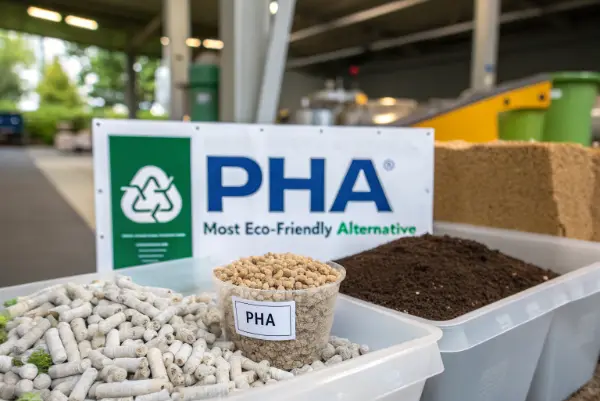
PHA (Polyhydroxyalkanoates) is widely considered the most eco-friendly alternative because it is created by bacteria fermentation and is fully biodegradable in marine and soil environments. Unlike PLA, which requires industrial composting facilities, PHA breaks down naturally like wood or paper. While expensive and harder to process than ABS, it represents the holy grail of true biological cycles in manufacturing.

I have to be honest with you here. While PHA is the "most" eco-friendly in theory, using it for durable consumer electronics is incredibly difficult right now. I have tried molding PHA test bars, and the process window is very narrow. If the temperature is too high by just a few degrees, the material degrades in the barrel.

But as a designer who looks at the future, you need to understand where the technology is going. PHA and other natural fiber composites are the future of "high-end green."

The Reality of "Plastic-Free" Plastics

PHA acts like a plastic, but it is made by microorganisms.

  • The Challenge: It crystallizes slowly. This means your cycle times (cooling times) in the mold will be much longer than ABS. Longer cycle times mean higher unit costs.
  • The Opportunity: For disposable parts or packaging components of your electronic device, this is a huge selling point.

Natural Fiber Composites (NFC)

This involves mixing a polymer matrix (like PP or PLA) with fibers like hemp, flax, or bamboo.

  • Performance: These fibers add immense stiffness. A Bamboo-PP composite can actually be stiffer than ABS.
  • Aesthetic: It looks natural. You can see the fibers. For some brands, this "organic look" is exactly what they want to signal sustainability to the user.
  • Mold Wear: Be careful. Natural fibers are abrasive. They will wear down your mold steel faster than neat ABS. I always recommend using hardened steel (like H13) rather than P20 if you plan to run glass or natural fibers.

Why not just use Metal or Wood?

You might ask, "Why not switch to aluminum?"

  • Energy Cost: The energy required to mine and refine aluminum is massive compared to producing bioplastic. Unless that aluminum is recycled and the product lasts for decades, a bioplastic often has a lower Lifecycle Assessment (LCA) score.

The Hierarchy of Sustainability:

  1. Reduce: Use less material (thin walling).
  2. Reuse: Design for disassembly.
  3. Recycle: Use rABS or PETG.
  4. Recover: Bio-based or Biodegradable (PHA/PLA).

For your work in electronics, rABS or Bio-ABS is usually the sweet spot. PHA is currently better suited for single-use items, but keep an eye on it. The tech is moving fast.

Conclusion

Choosing an alternative to ABS is no longer about accepting a worse product; it is about selecting the right material for the specific lifecycle of your device. Whether you choose bio-attributed ABS for a seamless transition, impact-modified PLA to remove styrene, or recycled ABS to support the circular economy, the options are ready for production. Start small, test your shrinkage, and do not be afraid to push your molders to try these new resins.


  1. "The Life Cycle Assessment for Polylactic Acid (PLA) to Make It …", https://pmc.ncbi.nlm.nih.gov/articles/PMC8199738/. Lifecycle assessment studies indicate that bio-based and recycled thermoplastics can achieve carbon footprint reductions of 20-70% compared to virgin petroleum-based polymers, though mechanical property equivalence varies by formulation and processing conditions. Evidence role: statistic; source type: research. Supports: comparative carbon footprint and mechanical properties of bio-based and recycled alternatives to petroleum-based ABS. Scope note: Performance parity depends on specific material grades, additives, and manufacturing parameters rather than being universal across all alternative formulations. 

  2. "Polylactic Acid Market Size And Share Report, 2026-2033", https://www.grandviewresearch.com/industry-analysis/polylactic-acid-pla-market. Market analyses show bio-based engineering plastics, including modified PLA and bio-polyamides, have experienced compound annual growth rates of 10-15% in durable goods sectors since 2020, driven by automotive and consumer electronics applications seeking petroleum alternatives. Evidence role: general_support; source type: research. Supports: growing commercial adoption of impact-modified PLA and bio-based polyamides in engineering applications. Scope note: Market growth reflects overall category trends rather than direct one-to-one ABS replacement rates, as adoption varies significantly by specific application requirements. 

Facebook
Twitter
LinkedIn

Request A Quote for Your Projects!

Hi there! I’m Jerry, a proud dad and passionate at CKMOLD. With years of hands-on experience in the injection mold and CNC industry, I’ve grown from managing the smallest details on the shop floor to leading international projects with clients across Europe and the U.S.

At CKMOLD, we specialize in precision molds, plastic parts, and CNC solutions that help bring bold product ideas to life. I love solving complex challenges, building long-term partnerships, and pushing the limits of what great manufacturing can do.

Let’s connect, exchange ideas, and grow together—whether you’re looking for a reliable manufacturing partner or just want to talk shop!

Request a Quick Quote

Send your drawings and detailed requirements via:
Email: jerry@ckmold.com

Or fill out the contact form below:

We will contact you within one working day. Please pay attention to the email with the suffix “@ckmold.com”

Wait, We Have Something Special for You!

Join our mailing list and receive a 10% discount on your next mold or CNC project.