
One of the most popular and safest thermoplastics in the world is high-density polyethylene (HDPE). In almost every industry, from milk jugs and water pipes to fuel tanks, chemical drums, medical trays, and industrial pallets, HDPE plays a silent but vital role in the supply chain.
But an important question that is continually posed by manufacturers, product designers, and procurement teams is: How safe is HDPE, and what is responsible HDPE safety in a manufacturing application really like on the factory floor?
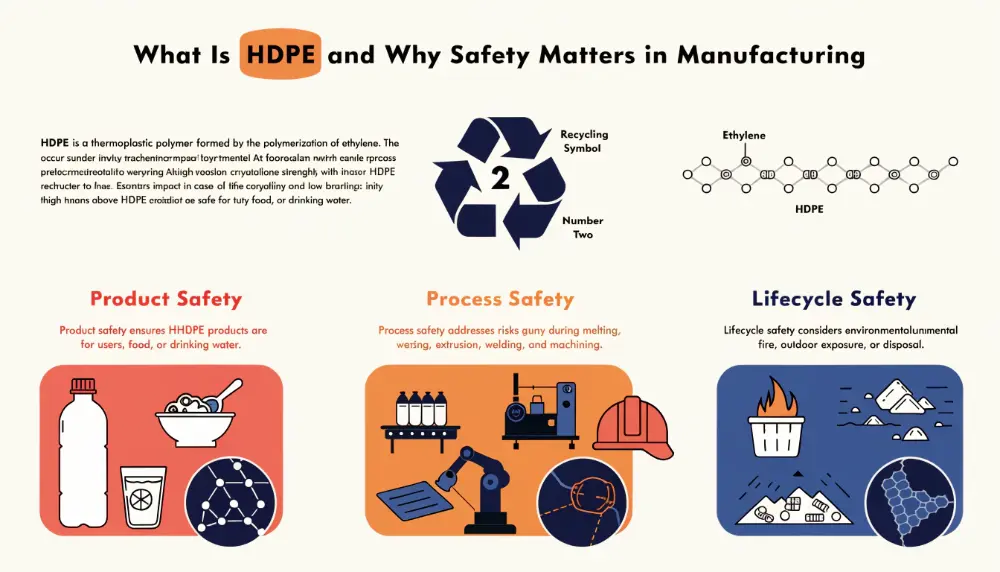
What Is HDPE and Why Safety Matters in Manufacturing
HDPE is the thermoplastic polymer formed from the polymerization reaction of ethylene at low pressure using catalysts1 that form long chains with low amounts of branching. That linear structure packs tightly, giving the material a density above roughly 0.941 g/cm³2, high crystallinity, and an unusually strong balance of stiffness, toughness, and chemical inertness. It’s the number two stamped inside the recycling triangle that’s on countless bottles and containers.
There are three reasons for safety here, and the common error that companies make is mixing them up.
The first is product safety: will the finished product be hazardous to the end user, food, or drinking water?
The second is process safety, and what are the risks that HDPE presents to operators while they melt, mold, extrude, weld, and machine it?
The third one is lifecycle safety, which is what happens to the material in the event of a fire, long-term exposure to the outdoors, or the end of life.
A product can be flawless on the first count and still create hazards on the second, which is why a comprehensive analysis has to address all three.
Key Material Properties Behind HDPE’s Safety Profile
Several properties make HDPE the material of choice for sensitive applications. It resists acids, alkalis, alcohols, salts, and most solvents at ambient temperature, so it does not readily react with the substances it contains.
It absorbs virtually no moisture, resulting in reduced microbial growth within the polymer matrix and ease of cleaning. It contains no plasticizers, so there is nothing equivalent to the phthalate concerns raised by flexible PVC, and bisphenol A is not used in standard HDPE formulations, which is why BPA-free labeling is standard practice for HDPE packaging.
The material also possesses a convenient working range. HDPE has a melting point of 120-135 degrees Celsius, can be used continuously around 80 degrees, and is impact-resistant well below freezing. Its high impact strength protects it from shattering into sharp fragments, an often-overlooked safety feature over glass and brittle plastics in food service, lab, and industrial applications.
Is HDPE Safe? Toxicity, Contamination, and Food Contact
The simple answer is pure HDPE is one of the safest plastics for consumer and industrial applications, and this is backed by decades of regulatory testing. The polymer is chemically stable and biologically inert, so it is not metabolized, and it does not off-gas meaningfully at room temperature. Under normal conditions of use, migration levels into foods and liquids from HDPE have been consistently low.
However, saying that HDPE is safe describes a material, not a guarantee about a specific part. Real-world safety depends on the full formulation and the conditions of use, and every additive must be approved for the intended contact application. Color masterbatches, slip agents, antioxidants, UV stabilizers, and processing aids are all additives.
If the HDPE is recycled, a second variable is added, as residues from previous contents may be present in recycled streams. This is why food-contact products and medical products generally use virgin resin or closed-loop recycled material that is traced.
The other practical limit is temperature. Thin-wall HDPE containers are not intended to be used for extended periods of time at high temperatures of contact; repeated exposure to boiling liquids, steam, or microwave heating can cause stress in the polymer, lead to oxidation, and cause migration to occur more easily. Responsible design involves specifying the right grade and providing labels with explicit temperature instructions.
Compliance Standards That Define HDPE Safety
Credible safety claims rest on documented compliance rather than marketing language. In the USA, olefin polymers used for food contact are regulated by FDA 21 CFR 177.1520, and suppliers can supply a letter of compliance that references the code. NSF/ANSI 61 certification is for products that come into contact with drinking water, and NSF/ANSI 51 is for food equipment materials.
The European Union has established migration limits and allowed lists of permitted substances in the framework Regulation 1935/2004 and the plastics-specific Regulation 10/2011. Medical devices include ISO 10993 biocompatibility testing, and toys being sold internationally are subject to a number of standards including, for the US, CPSIA requirements, and EN 71.
The benchmarks for pressure pipe and geomembrane are different again, and include long-term hydrostatic strength, stress-crack resistance and material classification (PE100). If someone is claiming the safety of an HDPE product, they should be able to tell you the standard, provide a test report and demonstrate the current certification dates.
HDPE Safety in Injection Molding and Extrusion
Processing is where most of the genuine occupational hazards appear, and it is the part of HDPE safety in manufacturing applications that gets the least attention.
Thermal Decomposition, Fumes and Ventilationis
The molding temperature of HDPE is usually in the range of 200 to 260 degrees Celsius. Held within that window and with reasonable residence time, the polymer is stable and emits very little. Once temperatures are pushed up, material is left in a hot barrel, or there is a buildup of degraded resin; thermal decomposition starts and releases the volatile organic compounds and aldehyde and organic acids, which can irritate the eyes, nose, throat, and airways.
A distinctive, waxy smell is sometimes reported by operators – this is generally a signal and not a normal circumstance.
The simple rules to follow for controls are as follows: maintain barrel and nozzle temperatures within the profile recommended by the resin supplier, avoid long dwell at temperature, purge properly when shutting down and starting up, and provide local exhaust ventilation over the nozzle, hot runner and extrusion die.
Ventilation is most important during purging and color changes when the maximum amount of hot material is exposed to open air. Equivalent emissions occur during welding and hot-plate joining of HDPE pipe and sheet, and the emissions from these processes should be treated similarly.
Machine, Burn and Ergonomic Hazards
The bigger day-to-day risks around HDPE production are mechanical rather than chemical. Injection molding machines close with great force, and guards, light curtains, interlocks and lockout-tagout discipline are mandatory. Molten polymer causes severe burns and sticks to skin, so heat-resistant gloves, sleeves, face shields and eye protection are essential during purging, nozzle work and mold changes.
Granulators and regrind systems add noise, dust and entanglement hazards, so acoustic enclosures, interlocked feed throats and dust extraction should be standard. Housekeeping is a fire-prevention measure, not just tidiness – fine dust from grinding or machining is combustible if it is present in sufficient concentration. When repetitive lifting of heavy molds, drums and pallets are added to the mix, it is easy to see that ergonomics and mechanical handling aids can be part of any serious HDPE process safety program.
HDPE Safety Across Key Industrial Applications
Every industry puts its own emphasis on the material, and each industry has its own perception of what constitutes an acceptable risk.
- Food and Beverage: HDPE is used for its properties of being non-porous, cleanable, and resistant to fats, oils, and cleaning chemicals. It is used in cutting boards, crates, bulk bins, closures and bottles. The safety priorities are food-grade certification, color-coded parts to avoid cross-contamination, and smooth radii that leave no crevices where bacteria could survive sanitation.
- Water and Gas Distribution: HDPE pipe has replaced metal pipes in many water and gas distribution systems, where it is not affected by corrosion and can be joined to form continuous pipe with no leaks. Here, safety is defined as pressure rating, slow crack growth resistance, proper fusion procedure, and potable water certification.
- Chemical Handling and Storage: HDPE drums, tanks and secondary containment structures are resistant to a wide variety of aggressive media. The critical discipline is to ensure chemical compatibility for the specific concentration and temperature, since a material that is safe in ambient conditions can swell or cause environmental stress cracking when hot.
- Medical and Laboratory: HDPE is used for medical and laboratory applications such as sharps containers, closures, tubing components and single-use labware. Safety discussions include biocompatibility documentation, compatibility of sterilization methods, and contamination-controlled molding environments.
- Automotive Equipment: Blow-molded HDPE fuel tanks, fluid reservoirs, ducting and wear components are selected for impact resistance. Safety-critical factors are barrier treatment of hydrocarbons and long-term thermal aging performance.
Fire, Environmental and Long-Term Safety Considerations
An objective analysis must include the limitations that come with HDPE. As a hydrocarbon-based polymer, HDPE is flammable. HDPE will burn at high temperatures with an intense flame, melt, drip, and spread fire via flaming droplets.
Complete combustion of HDPE is mostly carbon dioxide and water; however, incomplete combustion results in carbon monoxide and soot, which is a serious hazard when burning in an enclosed space. HDPE comes in flame-retardant grades if necessary, and the warehouse storage of HDPE stockpiles needs to be looked at against the local fire codes with emphasis on sprinkler system and stack height.
Ultraviolet radiation damage is the second long-term limitation for HDPE. HDPE that is not UV stabilized will chalk, become brittle, and lose its impact resistance over time in the open air, making an engineering success into a structural failure in just a couple of years. A carbon black and Hindered Amine Light Stabilizer package solves the problem, and specifying the correct one is a safety consideration for every outdoor tank, pipe, geomembrane, or street furniture project.
Environmental stress cracking is the last item on the list. HDPE under tensile stresses and some surfactants or wetting agents can crack way below its normal strength. Good design avoids sharp internal corners, reduces residual stress, and validates the material against the actual service environment rather than a generic datasheet.
Best Practices OF Design and Manufacturing for Safe HDPE Parts
Safety is part of the design, before the first resin shot. Many practices are associated with reliable HDPE products, which are never associated with problem products.
- Prioritize application over price in selecting grade. The differences in the melt flow index and the molecular weight distribution of blow-molding and injection, pipe and sheet grades are common causes of failure when the wrong convenient grade is used instead of the correct one. Use all additives that are registered for the category of contact for which the product is intended.
- Design with even thicknesses and generous radii. When the thick section is formed, voids and sink will form, and internal stress will occur during the formation, which can be released as cracks when the HDPE shrinks significantly (around one and a half to three per cent). Ribs, gussets and cored-out bosses provide strength with a minimum of weight.
- Build traceability. Recall containment is made possible by the identification of cavities, date stamps, lot records and certificates of analysis, and is evidence of diligence in the event of a claim.
HDPE Compared With Other Common Plastics
When it comes to determining whether HDPE is truly the safest option, it’s important to put it in its proper perspective. HDPE doesn’t use chlorine chemistry or plasticizers in its manufacturing process and also doesn’t have corrosive hydrogen chloride gas released when PVC is burned. With high heat resistance, HDPE does not present any problems associated with BPA, while polycarbonate is transparent but has a much higher heat resistance.
Both are comparable for safety and food contact against polypropylene, with polypropylene being better at higher temperatures and having superior moisture barrier and living hinge performance; however, HDPE has superior low-temperature impact strength.
PET has better chemical resistance and fusing ability than HDPE, and PET has better carbonated product gas barrier than HDPE. When paired with metals, HDPE outlasts them in corrosion, galvanic corrosion, and heavy metal contamination, conceding in strength, stiffness, and temperature capability.
Testing and Quality Control That Verify HDPE Safety
Claims require evidence, and evidence comes from a defined test regime. Any resin received should be confirmed by certificates of analysis and, if considered necessary based on the risk, melt flow index and density testing. Mechanical validation is usually conducted for tensile and impact testing, hydrostatic or burst testing for pressure applications, and environmental stress crack resistance testing on finished containers.
Contact safety is confirmed with overall and specific migration testing against the relevant regulation, extractables and leachables studies for medical and pharmaceutical use, and organoleptic assessment where taste and odor transfer matter.
Accelerated UV weathering, thermal aging, and oxidative induction time measurement are used to estimate the behavior of the component over the long term. Wrapping this in a quality system such as ISO 9001 and other certifications is necessary and provides a documented chain of accountability for customers and regulators.
Sustainability and End-of-Life Safety
HDPE is among the most recyclable plastics in commercial use. Bottles and containers become pipe, lumber, crates, and non-food packaging as they return to the stream, and mechanical recycling of clean HDPE is helpful in maintaining the properties of the material in subsequent cycles. That recyclability is a component of its safety narrative, as it helps to lower the volume of virgin material and disposal burden.
Frequently Asked Questions About HDPE Safety
What personal protective equipment (PPE) should be utilized when handling HDPE?
Hearing, eye, and face protection, long-sleeved clothing, and heat-resistant gloves must be worn when working near granulators with local exhaust ventilation at nozzles and dies.Is it safe to use recycled HDPE for industrial applications?
Yes, for industrial applications and for many consumer goods applications. Certified closed loop or approved recycled grade could be utilized for food, water, and medical contact applications.Is HDPE toxic to humans?
The pure form of HDPE is biologically inactive and non-toxic; it is certified safe to be used in food and water applications as long as it has been processed using certified additives. The danger lies in the decomposition gases produced during overheating rather than the solid component.Is HDPE BPA-free?
Yes. Bisphenol A is absent in HDPE products but present in polycarbonate and some epoxy resins.Can HDPE bottles be used for hot drinks?
Only partially. HDPE may be able to tolerate warm beverages but not boiling ones.
Conclusion
HDPE lives up to its credibility. Chemically inert, additive-light, tough, recyclable, and supported by a proven, worldwide compliance system. It is a standard setting that is appropriate for applications where contact safety is important.
However, material safety is not a sign of product safety, and a safe outcome relies on grade selection, addition compliance, controlled processing temperatures, work cells that are ventilated, stress aware design, UV/chemical testing and documentation.
The manufacturers who consider these elements as a system, rather than a checklist of tasks to check off, will make products that meet the auditing standard, remain in the field, and keep operators and end users safe. With a unified HDPE safety strategy in manufacturing applications, that is what you will ultimately receive.
Working with a Trusted Manufacturing Partner
Custom mold making and plastic manufacturing with components that are designed to meet the standards your market demands, with CK Mold’s components.
If you’re designing an HDPE part, are you analyzing an existing part for stress or compliance concerns, or just want a supplier to be able to provide documentation of material certification and process control, we can help you. Contact CKMold to talk about your project and request a quote.
-
"The Influence of Ziegler-Natta and Metallocene Catalysts on …", https://pmc.ncbi.nlm.nih.gov/articles/PMC5455813/. HDPE is produced through low-pressure polymerization of ethylene using Ziegler-Natta or metallocene catalysts, a process that contrasts with the high-pressure free-radical polymerization used for LDPE and yields the linear chains characteristic of HDPE. Evidence role: mechanism; source type: research. Supports: the low-pressure catalytic process used to manufacture HDPE. ↩
-
"High-density polyethylene", https://en.wikipedia.org/wiki/High-density_polyethylene. Industry standards typically define high-density polyethylene (HDPE) as polyethylene with a density of 0.941 g/cm³ or greater, distinguishing it from medium- and low-density variants. Evidence role: definition; source type: research. Supports: the minimum density threshold that defines HDPE. ↩