
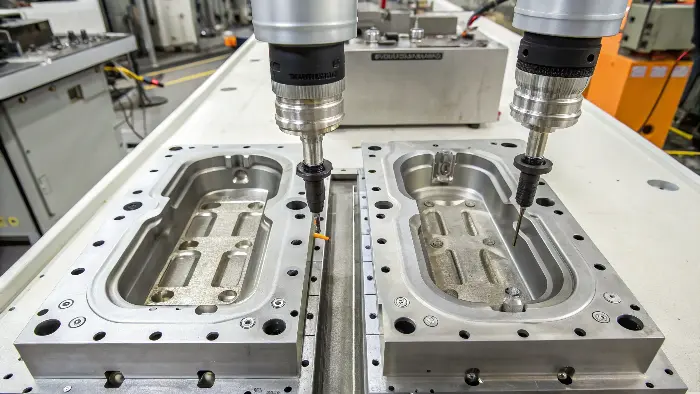
Quick answer: Digital toolroom control connects the released mold design to programs, setups, electrodes, steel, measurements, nonconformance and as-built records. The objective is not paperless marketing; it is preventing the wrong revision, offset, material or disposition from reaching the tool while preserving evidence for repair and duplicate builds.
Establish One Released Design Source
Control mold assembly, component drawings, BOM, product revision and shrinkage basis. Use released, superseded and work-in-progress status clearly. Shop-floor viewers should prevent accidental use of obsolete files while preserving revision history.
Link approved DFM and mold-review decisions to the design. An email attachment or local copy should not quietly become the production master.
Control CAM Programs and Setups
Identify machine, program revision, coordinate system, stock, datum, tools, holders and setup sheet. Use simulation and collision review appropriate to the operation. Record approved postprocessor and offset handling.
At the machine, verify program and component identity before cutting. Protect transfer paths and access. A program that made a similar insert is not automatically approved for the current revision.
Process Control Map
| Digital object | Required identity | Control purpose |
|---|---|---|
| CAD/drawing | Part, component, revision, status and approval | One authorized design basis |
| CAM/EDM data | Program, setup, tool/electrode, offset and simulation | Repeatable material removal |
| Inspection result | Feature, datum, method, machine and operator | Traceable conformity and correction |
| As-built record | Final steel, repairs, deviations and configuration | Service, export and duplicate-tool continuity |
Trace Electrodes and EDM Conditions
Assign electrode IDs tied to CAD, material, undersize, rough/finish use and component location. Record manufacture, measurement, wear strategy and EDM program. Prevent swapped or repeated electrodes from creating hidden geometry error.
Store relevant surface, orbit, flushing and finish conditions. Inspection should confirm critical electrodes before the cavity becomes expensive to repair.
Connect In-Process Inspection
Create inspection hold points after material receipt, heat treatment, datum finishing and inaccessible features. Measurement results should reference feature, datum, method, unit and revision. Importing data is useful only when context remains intact.
Trend repeatable processes where it supports prevention. Do not substitute dashboard counts for engineering review of form, fit, hardness, surface and circuit integrity.
Control Nonconformance and Rework
When steel is outside requirement, stop dependent work and document actual condition, affected features, cause, proposed disposition and authority. Link weld, re-machine, new insert or accept decisions to revised drawings and inspection.
Preserve before/after evidence. Inform schedule and trial plans when rework changes heat treatment, polish, texture, cooling or tool-life assumptions.
Complete the As-Built History
Before shipment or production release, update assembly, component drawings, BOM, programs, electrode records, circuit maps, spares, inspection and repairs. Make the package searchable by mold serial and component identity.
Back up and control access according to company policy. The useful outcome is a maintainable physical tool whose history can be understood without the memory of one programmer or fitter.
Process Control Checklist
- Maintain one released CAD, drawing and BOM source.
- Identify programs by component, revision, machine and setup.
- Control tools, holders, coordinates, offsets and simulation evidence.
- Trace electrodes through CAD, manufacture, measurement and EDM use.
- Link inspection to feature, datum, method, unit and revision.
- Stop and authorize nonconformance before dependent work continues.
- Return approved shop changes to controlled design data.
- Complete searchable as-built, repair, circuit and spare records.
Illustrative Digital Control Failure
Illustrative engineering example—not a claimed CKMOLD customer result: A cavity insert is reworked from an emailed STEP file, while the released drawing contains a later steel-safe change. The mismatch is caught only at assembly. A controlled workflow then requires revision status, component ID and program approval at transfer, with the as-built record updated after disposition.
Implementation Questions
What should be digitally controlled in mold manufacturing?
At minimum control design revisions, BOM, programs, setups, electrodes, material, inspection, nonconformance and as-built records.
Does digital control eliminate human review?
No. It protects identity and traceability while engineers still decide meaning, risk, fit and disposition.
Why trace electrodes?
Electrode geometry, undersize, wear and sequence directly affect cavity dimensions and surface; a swap can create expensive hidden error.
What belongs in the as-built package?
Final designs, BOM, steel, programs as required, circuits, inspections, repairs, approved deviations, spares and configuration records.
Implementation Resources
Apply the Digital Process Control in Injection Mold Manufacturing review to your released design. Share the function, exact resin, annual volume, CTQs, cosmetic limits and launch timing through the CKMOLD project form. If CAD is relevant, send it directly to jerry@ckmold.com; the form does not require an upload.