
Choose TPE hardness from the function and molded geometry, then verify it on the finished part. A Shore value does not directly define stiffness, grip, sealing force, compression set or abrasion resistance, and a thin overmold can feel harder than a thick test plaque made from the same grade.
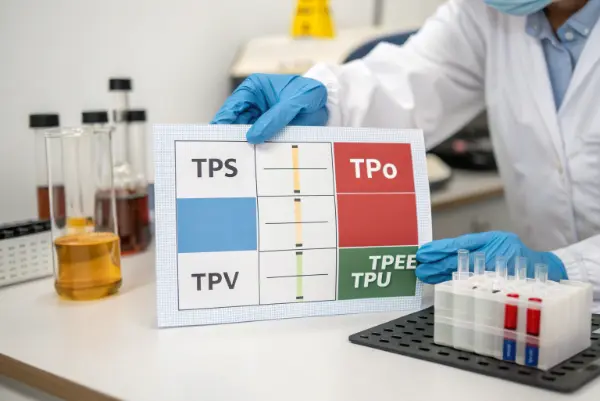
What Shore hardness measures
A durometer measures resistance to indentation under specified conditions. Shore A is common for flexible TPEs; Shore D may be used for harder materials, and Shore OO for very soft gels. Values from different scales are not interchangeable. The drawing or specification should identify the scale, test method, conditioning and tolerance.
Avient’s hardness guidance explains the indentation principle and warns against treating hardness as the only property.
Start with the job the flexible feature must do
| Function | Hardness-related trade-off | Properties to evaluate with hardness |
|---|---|---|
| Grip or soft touch | Softer may improve comfort but can increase tack or deformation | Thickness, friction, abrasion, stain resistance and support geometry |
| Static seal | Soft material can conform, but excessive compression may increase set | Compression set, sealing load, gap, temperature and fluid |
| Button or membrane | Hardness changes actuation feel but does not set force alone | Geometry, modulus, fatigue, travel and temperature |
| Impact bumper | Softness can cushion, but bottoming out defeats the feature | Thickness, energy, strain rate, temperature and tear strength |
| Cable strain relief | Harder supports the cable; softer permits a tighter bend | Flex fatigue, jacket bond, radius and tear propagation |
| Wear surface | Harder can improve load support, but family/grade dominate abrasion | Abrasion, tear, friction, heat buildup and chemical exposure |
Account for apparent hardness and thickness
The rigid substrate beneath an overmold affects indentation. As the TPE layer becomes thinner, the assembly can feel harder than the material’s plaque durometer. Do not solve this automatically by choosing a softer grade: that may worsen tear, compression set, demolding or surface tack. Evaluate thickness and grade together using molded samples.
A six-step selection method
- Define load, travel, contact area and environmental conditions.
- Select the relevant TPE family based on heat, chemicals, wear and substrate bond.
- Choose two or three hardness candidates within that family.
- Review tool risks: draft, texture, thin flow paths, undercuts and ejection.
- Mold the intended thickness on the actual substrate.
- Measure functional force, sealing, bond, fatigue and conditioned performance before freezing the grade.
Specify hardness without creating a false precision
Use a tolerance that reflects the supplier’s production capability, the test method and the product function. Testing a small, curved or thin finished part may not meet the specimen requirements of a standard plaque method. If the geometry prevents a reliable durometer reading, control the incoming resin certificate and use a functional part test such as compression force, button force or sealing leakage.
Common selection errors
- Calling a Shore number “flexibility” without defining geometry
- Comparing Shore A and Shore D values as if the scales were linear
- Choosing the softest grade before checking flow, ejection and tear
- Ignoring temperature: elastomer response changes across the service range
- Assuming equal hardness means equal compression set, abrasion or bond
- Approving a hand-feel plaque while the production wall is much thinner
For project selection, send the part model, function, load/deflection target, overmold thickness, rigid substrate, environmental exposure and candidate grades. CKMOLD can review geometry through DFM analysis and plan representative samples through prototype injection molding. Use request a quote for specific tooling feedback.