
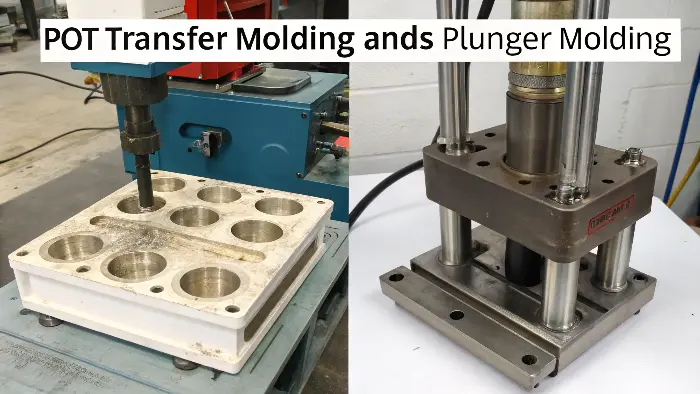
To produce complex components containing sensitive inserts out of thermoset plastics may be a tasking assignment. Those, although fragile, can be easily broken or out of position in the case of a standard compression molding but might not be ideal using other techniques with the material used. This can result into disappointed redraws, redraw rates, and compromises you want to avoid. Transfer molding gives another intelligent answer, it is accurate and delicate on these very occasions.
A transfer mold forms parts by loading a measured material charge into a transfer pot or chamber and forcing it through gates into closed cavities. It is commonly associated with thermosets, rubber-like materials and electrical encapsulation, although the exact equipment and material depend on the application. Transfer molding sits between compression and injection in the way material is metered and distributed.
Related CKMOLD resources: mold design, mold testing and validation, production injection molding.
Transfer mold is an apparatus used in a manufacturing process where a thermoset plastic or rubber part is first softened with heat in a separate chamber known as a “pot.” Then the softened part is forced by a plunger through channels, referred to as sprues and runners, into a completely closed mold cavity. This is a blend of the closed-mold advantage of injection molding and the pressure application of compression molding and is particularly suited to the manufacture of intricate parts and to plasticating plastic around delicate inserts such as metal pins or electrical parts.
Material used for Transfer Molding
A thermoset polymer is the most frequently used material in transfer molding. This kind of polymer can be molded and manipulated easily, but when it is cured, it becomes permanent.In simple homogeneous transfer molded parts, the part itself is just this plastic substrate.
Conversely, resin transfer molding enables the creation of a composite material by inserting a fiber in the mold and then injecting the thermosetting polymer

The first step would be in having the basic understanding of this definition. However to really utilize this process, you must venture further. What is its step by step process? What is its comparison with more popular compression molding? It is the answer to these questions which makes a good designer a great designer. Here is what we are going to discuss, and you can be very comfortable in making the decision to use or not to use transfer molding in your next project.
Transfer Molding Versus Compression Molding
Transfer molding and compression molding are both commonly used with thermosetting compounds and rubber, but they move material differently. Compression molding places the charge in the heated cavity before the mold closes; transfer molding closes the cavity first and forces the prepared charge from a pot through runners and gates. The latter can feed intricate cavities and inserts, but creates transfer-pad/runner waste and adds pressure, temperature and maintenance variables.
| Decision | Compression molding | Transfer molding |
|---|---|---|
| material path | charge compressed in cavity | charge displaced from pot through feed system |
| insert/feature risk | charge placement and closing flow can disturb inserts | closed-cavity flow may improve control but can still move or damage inserts |
| waste | flash and charge allowance | transfer pad, runners/gates and flash |
| evidence | charge, cure, vent and cavity-temperature record | same, plus pot/runner pressure, balance and residual material |
DuPont’s public rubber-to-substrate bonding guide describes compression, transfer and injection routes within its stated in-mold bonding scope; it does not establish one process as universally better.

Transfer-Molding Trade-Offs to Quote Explicitly
Potential advantages include controlled feed into a closed cavity, multiple small features and insert encapsulation. Potential disadvantages include pot/runner waste, longer residence or cure exposure, pressure drop, feed-system cleaning, flash, material remaining in the pot and more complex thermal/vent control. Which dominates depends on compound, part, cavities and equipment.
Ask the supplier to state charge preparation, preheat, pot and runner design, cavity balance, venting, cure basis, insert location, waste disposition and acceptance tests. Compare cost per accepted part—including lost compound and secondary trimming—rather than calling one route inherently cheaper or faster.

How Transfer-Press Arrangements Are Described
Terms such as pot transfer, plunger/ram transfer and auxiliary-ram transfer describe where the charge is held and how pressure is applied. Supplier terminology varies, so a name alone is not enough. Review a section drawing that shows the pot, plunger, runners, gates, vents, cavity, inserts, heating and ejection.
The design review should identify residual material, cleanout, pressure-loaded area, press stroke/force, heating uniformity and cure control. No arrangement should be described as needing less pressure or producing better parts without a compound- and geometry-specific study.

How the Transfer Cycle Works
A charge is placed in the transfer pot, the mold closes or reaches its forming position, and a plunger pushes material through sprues, runners and gates into the cavities. Heat and pressure cure or form the material. After cure, the mold opens and the part, runner and flash are removed or processed.
Main Mold Elements
The tool includes cavity and core surfaces, pot, plunger, sprue, runners, gates, vents, inserts and ejection or deflashing features. Gate balance, venting, cure, insert support and flash control influence part quality and cycle.
Materials and Applications
Transfer molding may suit thermosets, elastomers, rubber compounds and encapsulation materials that need controlled filling around inserts or into detailed cavities. Electrical components, seals, connectors, gaskets and technical molded parts are examples, but the grade and cure system determine the actual route.
Transfer Versus Compression and Injection
Compression places material directly in the cavity, while transfer meters it through a runner system; injection plasticizes and injects a melt continuously from a machine unit. Compare material chemistry, tooling, pressure, cycle, flash, scrap, insert handling, volume and automation.
Design and Validation Considerations
Review material charge, flow length, cure or cooling, vents, inserts, shrinkage, flash, mold release, surface, post-cure and inspection. Validate mechanical, sealing, electrical, thermal and aging performance for the final application.
a Transfer Mold and How Does It Work: Buyer Review Checklist
- Define material chemistry, cure, charge, flow, inserts, volume and surface requirements.
- Review pot, plunger, runner, gate, venting, flash, ejection and deflashing.
- Compare transfer with compression and injection based on total process requirements.
- Control temperature, pressure, cure or cooling and insert positioning.
- Validate dimensional, mechanical, sealing, electrical, thermal and aging performance.
FAQ
What materials are used in transfer molding?
Thermosets, elastomers, rubber-like compounds and some encapsulation materials may use transfer molding, depending on the application and grade.
Is transfer molding the same as injection molding?
No. Transfer molding uses a charge and transfer pot, while injection molding plasticizes and injects material from a machine unit; the materials and tooling differ.
Conclusion
Transfer molding is a very strong process that intelligently fills the gap between compression moulding and injection moulding. It is the ultimate method to produce intricate thermoset/rubber components, particularly those that need the careful inlay of inserts that need the process of encapsulating inserts. Now that you know the essence of its process, its key factors of differences with compression molding, the possible drawbacks attached with it such as, wasting of material, and its specific types such as, pot and plunger molding, you now have a complete set of knowledge needed to help you make more knowledgeable design and production decisions.