
What is the plastic injection molding process?

Have you designed a perfect plastic part on your computer, only to feel a gap in your knowledge about how it actually gets made? This uncertainty can lead to costly design flaws that only appear during manufacturing, causing delays and budget issues. Understanding the fundamentals of plastic injection molding bridges this gap. It empowers you to create designs that are not just innovative but also highly manufacturable, saving you time and resources.

Plastic injection molding is a high-volume manufacturing method used to create identical plastic parts. The process involves melting plastic pellets and injecting the molten material under high pressure into a custom-made metal mold. Inside the mold, the plastic cools and solidifies, taking the shape of the mold’s cavity. Once hardened, the mold opens, and the finished part is ejected. This cycle repeats thousands of times, making it an incredibly efficient way to produce complex parts with high precision.

A diagram showing the main components of an injection molding machine.

I remember the first time I stood next to an injection molding machine. The sheer power and speed were incredible. In a matter of seconds, a handful of plastic pellets became a complex, finished product. It looked like magic. But it’s not magic; it’s a precise, repeatable engineering process. Understanding this process is the key to mastering product design. Let’s peel back the curtain and look at each step in detail.

What is the process of injection molding plastic?

You know the basic definition, but do you understand the rhythm of the machine itself? Not grasping the full cycle can lead to design choices that cause production headaches like short shots or flash. Your design might look good in CAD, but it could fail in the real world. By visualizing the entire journey from raw material to final part, you can anticipate these issues and design parts that run smoothly and efficiently from the very first cycle.

The process of injection molding plastic is a cyclical operation. It starts with feeding plastic granules from a hopper into a heated barrel. A reciprocating screw inside the barrel melts and mixes the plastic, then pushes it forward. This molten plastic is then injected through a nozzle into a clamped mold, filling the cavity completely. The plastic is held under pressure as it cools and solidifies. Finally, the mold opens, ejector pins push the finished part out, and the cycle begins again.

An animated GIF showing the complete injection molding cycle.

To truly get it, you have to think about the three critical variables: time, temperature, and pressure. These three elements work together in a delicate dance. Getting them right is what separates a perfect part from a reject.

The Core Elements of the Process

The entire process happens within the injection molding machine, which has two main parts: the injection unit and the clamping unit.

  • The Injection Unit: This is where the plastic gets melted and prepared. It consists of the hopper, barrel, and reciprocating screw. Plastic pellets are gravity-fed from the hopper into the barrel. Heaters wrapped around the barrel start melting the plastic. The real work is done by the screw, which rotates and moves backward, both melting the plastic through friction (shear heat) and moving it towards the front of the barrel. This ensures the plastic is a consistent temperature and viscosity.
  • The Clamping Unit: This part holds the two halves of the mold together. It has to apply enormous force to keep the mold shut against the intense pressure of the injected plastic. If the clamp force is too low, the molten plastic can seep out, creating a flaw called "flash."

The magic happens when these two units work in perfect sync. The screw prepares a "shot" of molten plastic while the clamping unit holds the mold securely. Then, the injection happens, followed by cooling, and finally ejection. Every single parameter, from the barrel temperature to the clamp tonnage, is programmed and controlled to ensure perfect repetition.

What are the 5 steps of injection molding?

You’ve designed a part, but now the factory is asking about cycle time. You realize that a few seconds saved on each part can mean thousands of dollars over a production run. If you don’t understand the distinct steps that make up that cycle time, you can’t optimize your design for it. Small changes to wall thickness or draft angles can dramatically affect these steps. Let’s break down the cycle so you can design for speed and efficiency.

The five primary steps of the injection molding cycle are clamping, injection, dwelling (or packing), cooling, and ejection. First, the two halves of the mold are securely closed by the clamping unit. Second, molten plastic is injected into the mold cavity. Third, pressure is maintained during the dwelling phase to pack out the part. Fourth, the part cools and solidifies inside the mold. Finally, the mold opens, and the part is pushed out by ejector pins, completing the cycle.

An infographic illustrating the five steps of the injection molding process.

When I was just starting out, I learned a tough lesson about the cooling step. I designed a part with a very thick section, thinking it would make it stronger. But that thick section took forever to cool. The cycle time was nearly double what we projected, which completely threw off the project’s budget. It taught me that in injection molding, every single design feature impacts the manufacturing process. The 5 steps are not separate events; they are all interconnected.

Here is a more detailed look at each step:

Step Description Key Considerations for Designers
1. Clamping The two halves of the mold tool are securely closed by the hydraulic or electric clamping unit. Enough force must be applied to withstand the pressure of the injection phase and prevent the mold from opening. The size of your part determines the size of the mold, which in turn determines the required clamp tonnage of the machine. A larger part requires a larger, more expensive machine.
2. Injection The reciprocating screw moves forward, pushing the accumulated molten plastic from the barrel into the mold cavity. This happens very quickly, usually in a matter of seconds. The complexity and wall thickness of your part affect how easily the plastic flows. You need to design for uniform wall thickness and add features like ribs for strength instead of just making walls thicker.
3. Dwelling / Packing After the cavity is filled, pressure is maintained for a short period. This "packing" pressure forces more material into the mold to compensate for shrinkage as the plastic cools. This step is critical for preventing sink marks and voids. Designing with ribs and avoiding thick sections helps ensure the part is packed out properly without defects.
4. Cooling The plastic part solidifies inside the mold. The mold has internal cooling channels with circulating water or oil to carry heat away. This is often the longest part of the cycle. Wall thickness is the single biggest factor affecting cooling time. A 2mm wall will cool much faster than a 4mm wall. Keeping walls thin and uniform is key to a short cycle time.
5. Ejection Once the part is solid enough, the clamping unit opens the mold. Ejector pins then push the part out of the cavity. The machine is now ready for the next cycle. Your design must include draft angles (a slight taper on vertical walls) so the part can be easily released from the mold. Without proper draft, the part can get stuck, damaged, or warped during ejection.

What type of plastic is used in injection molding?

You’re ready to select a material for your new product, but the options are overwhelming. Do you need something strong, flexible, cheap, or heat-resistant? Choosing the wrong plastic can mean your product fails in the field, leading to unhappy customers and expensive recalls. Understanding the main categories of plastics and their properties is the first step to making an informed decision that ensures your product’s success and durability.

The vast majority of plastics used in injection molding are thermoplastics. These materials, like Polypropylene (PP), Acrylonitrile Butadiene Styrene (ABS), and Polycarbonate (PC), can be repeatedly melted and solidified without significant degradation. This makes them perfect for the cyclical process of injection molding. The specific plastic chosen depends entirely on the part’s requirements, such as strength, flexibility, chemical resistance, and cost. A much smaller category, thermosets, can also be molded, but they undergo an irreversible chemical change and cannot be remelted.

A collection of colorful plastic pellets used for injection molding.

I often tell designers to think of material selection like casting an actor for a movie. You wouldn’t cast a comedian in a serious drama, right? It’s the same with plastics. You need to match the material’s "personality" or properties to the role the part has to play. I’ve seen projects fail because a team chose a cheap plastic for a part that needed to withstand high temperatures. The parts warped on the first day of use. A little more investment upfront in the right material would have saved them a fortune.

Let’s break down some of the most common thermoplastics:

Common Thermoplastics in Injection Molding

Each material has a unique profile. You have to balance performance with cost. A high-performance material like PEEK is amazing, but it’s also incredibly expensive. For a simple disposable item, a commodity plastic like PP is the obvious choice.

Here’s a simple table of some of the plastics I work with most often:

Plastic Name Abbreviation Key Properties Common Applications
Polypropylene PP Very flexible, good chemical resistance, low cost, lightweight. Food containers, car bumpers, living hinges, packaging.
Acrylonitrile Butadiene Styrene ABS Strong, rigid, good impact resistance, easily finished (painted/plated). LEGO bricks, keyboard caps, electronic housings, automotive trim.
Polycarbonate PC Very high impact strength, transparent, good temperature resistance. Eyeglass lenses, safety goggles, CDs/DVDs, machine guards.
Nylon (Polyamide) PA Strong, tough, excellent wear and chemical resistance. Gears, bearings, zip ties, engine components.
Polyethylene PE Comes in different densities (LDPE, HDPE). Flexible to rigid, low cost, good chemical resistance. Plastic bags (LDPE), milk jugs (HDPE), buckets, pipes.
Polystyrene PS Can be brittle and clear (GPPS) or tough and opaque (HIPS). Low cost, easy to process. Disposable cups, cutlery, CD jewel cases, model kits.

Choosing the right material is a critical design decision. Always consult a material data sheet and, if possible, work with your mold maker or a material specialist to validate your choice.

What are the 5 types of plastic molding?

You’ve become comfortable with injection molding, but then a client asks about making a large hollow part, like a water tank. Suddenly, you realize injection molding isn’t the only game in town. Sticking to only one process limits your design possibilities and could mean you’re using a slow, expensive method when a better one exists. Knowing the other major plastic molding processes opens up new design solutions and makes you a more versatile and valuable designer.

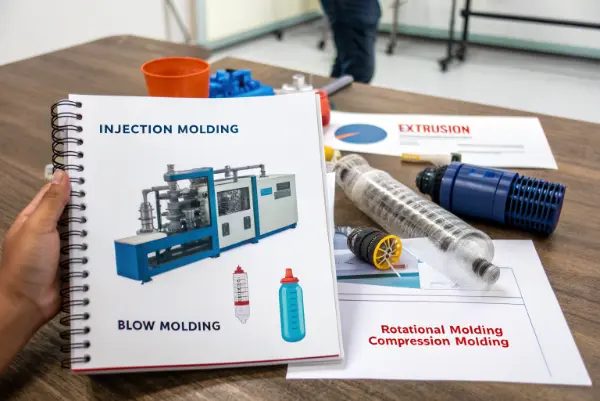
While injection molding is dominant, there are several other key types of plastic molding. The five most common types are injection molding, extrusion, blow molding, rotational molding, and compression molding. Each process is suited for different part geometries, production volumes, and plastic types. For example, extrusion creates long continuous shapes like pipes, while blow molding is used to make hollow containers like bottles. Understanding these different methods allows you to choose the most efficient process for your specific product.

An infographic comparing the five main types of plastic molding processes.

Early in my career, a client wanted me to design a large, hollow kayak. My first instinct was to design it in two halves to be made with injection molding and then welded together. An experienced engineer kindly pulled me aside and introduced me to rotational molding. It was a revelation! Rotational molding was perfect for creating a large, seamless, and durable hollow part in one piece. It was a far better, stronger, and more cost-effective solution. That experience taught me to always consider the full range of manufacturing options, not just the one I know best.

Let’s look at how these processes differ:

A Comparison of Molding Processes

Each method has its own strengths and is designed for a specific purpose. There is no single "best" process; there is only the best process for your particular part.

Here’s how they stack up against each other:

Molding Type How It Works Best For Pros Cons
Injection Molding Molten plastic is forced into a closed mold cavity under high pressure. Complex, solid parts with high precision in high volumes. (e.g., electronic casings, caps) High speed, excellent detail, low part cost at high volume. High initial tool cost, not ideal for very large or hollow parts.
Extrusion Molten plastic is pushed through a die to create a continuous linear shape. Long parts with a consistent cross-section. (e.g., pipes, window frames, straws) Low tooling cost, very high production speed for continuous products. Limited to 2D shapes, secondary operations needed to cut to length.
Blow Molding A hollow tube of heated plastic (a parison) is inflated inside a mold, like blowing up a balloon. Hollow parts with thin walls. (e.g., bottles, fuel tanks, containers) Excellent for producing hollow objects quickly and cheaply. Limited to hollow shapes, precision is lower than injection molding.
Rotational Molding Plastic powder is placed in a mold, which is then heated and rotated on two axes to coat the inside walls. Very large, hollow, and complex parts in low to medium volumes. (e.g., kayaks, water tanks, playground equipment) Low tooling cost, creates stress-free parts with uniform walls. Very slow cycle times, limited material options.
Compression Molding A pre-measured amount of plastic (a "charge") is placed in a heated mold, which is then closed to press the material into shape. Flat or moderately curved parts, often with thermoset plastics. (e.g., electrical outlets, dinnerware) Low tooling cost, good for very large parts and thermosets. Slower process, less intricate detail possible.

Conclusion

Understanding the plastic injection molding process, from its five core steps to the materials used, is essential for any product designer. It transforms you from someone who simply draws shapes to a creator who understands how things are truly made. Knowing the different types of molding processes further expands your toolkit, allowing you to choose the most effective method for any challenge. This knowledge is the bridge between a great idea and a successful, profitable product.

Facebook
Twitter
LinkedIn

Request A Quote for Your Projects!

Hi there! I’m Jerry, a proud dad and passionate at CKMOLD. With years of hands-on experience in the injection mold and CNC industry, I’ve grown from managing the smallest details on the shop floor to leading international projects with clients across Europe and the U.S.

At CKMOLD, we specialize in precision molds, plastic parts, and CNC solutions that help bring bold product ideas to life. I love solving complex challenges, building long-term partnerships, and pushing the limits of what great manufacturing can do.

Let’s connect, exchange ideas, and grow together—whether you’re looking for a reliable manufacturing partner or just want to talk shop!

Request a Quick Quote

Send your drawings and detailed requirements via:
Email: jerry@ckmold.com

Or fill out the contact form below:

We will contact you within one working day. Please pay attention to the email with the suffix “@ckmold.com”

Wait, We Have Something Special for You!

Join our mailing list and receive a 10% discount on your next mold or CNC project.