
Tempted to cut costs by choosing the cheapest mold base option? It’s an easy target for savings, but skimping here can lead to expensive problems like production delays, higher scrap rates, and frequent maintenance down the road.
Choosing a mold base involves balancing the initial purchase price against long-term performance and operating costs. A cheaper base might save money upfront but could cost more over the mold’s lifetime due to lower efficiency, increased maintenance, potential quality issues, and shorter lifespan.
From my years running CKMOLD and seeing countless projects, I’ve learned that the mold base isn’t just a passive holder; it’s an active part of the manufacturing system. For designers like the buyer focusing on precision electronics, the base’s stability and durability directly impact part quality and production yield. Thinking only about the initial invoice is a common trap.
How Much Does a Standard Mold Base Typically Cost?
Looking at quotes and wondering about the price range? A standard mold base is often the starting point, but even “standard” covers a wide spectrum depending on size and basic features, making it hard to budget accurately without context.
A comparable mold-base quotation needs the assembly drawing, dimensions, component materials and supply condition, machining scope, tolerances and delivery terms. There is no reliable universal price range for an unspecified “standard” base.
It’s tough to give an exact number because “standard” isn’t a single product. Think of it like buying a car – a standard compact car costs much less than a standard pickup truck. Here’s what drives the cost within the “standard” category:
- Size: This is the biggest factor. A small 8×8 inch base will naturally cost much less than a large 24×36 inch base simply due to the amount of steel, machining time, and handling involved.
- Plates and Assembly: Compare the actual series drawing and plate stack. Additional support, stripper or ejector plates add material and machining. Do not confuse a supplier steel-type number with a mold-base assembly series.
- Basic Features: Even standard bases can have options. Added water lines, specific pocket sizes milled, or non-standard guide pin locations will add to the cost compared to a completely off-the-shelf configuration.
- Material Grade (within Standard): While P20 is common, there are variations. Some suppliers might offer slightly lower-cost carbon steels (like 1045/S50C) for less demanding applications, while others might use a slightly better grade of pre-hardened steel as their standard, affecting the price point.
Request dated quotations for the same drawing revision and quantity. Separate the base assembly, customized machining, inspection, packing and freight so that a low headline price is not compared with a more complete scope.
| Base Size Category | Typical Plate Configuration | Common Steel Grade | Pricing Basis | Notes |
|---|---|---|---|---|
| Small (e.g., < 10″x12″) | A/B Plates | 1045 / P20 | Project-specific quotation | Simple parts, prototype molds |
| Medium (e.g., 12″x15″ – 18″x24″) | A/B + Support | P20 | Project-specific quotation | Consumer goods, electronics housings |
| Large (e.g., > 20″x30″) | Multi-plate, Complex | P20 / Higher Grade | Project-specific quotation | Automotive parts, large appliances |
The size examples are illustrative; they do not prescribe a steel grade or a production-volume limit.
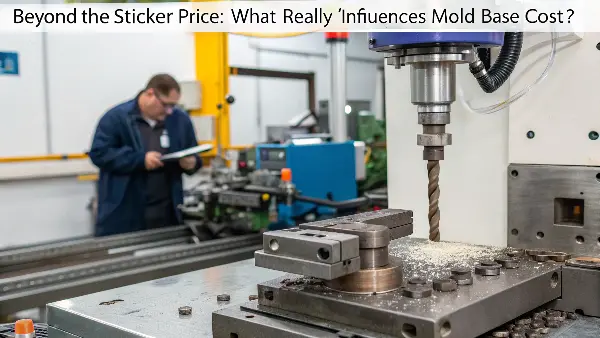
Beyond the Sticker Price: What Really Influences Mold Base Cost?
Saw a quote that seemed high, or one that seemed too good to be true? The base price is just the start. Several factors beyond just size dramatically influence the final cost, especially when moving from standard to specialized options needed for precision work.
Key cost drivers include material (standard steel vs. stainless vs. tool steel), required manufacturing tolerances (tighter tolerances demand more precise machining), complexity (extra features like cooling, guided ejection), surface treatments/coatings, and the supplier’s reputation/quality standards.
Understanding these factors helps explain price differences and allows for a more informed cost-benefit analysis:
- Material Selection: This is often the most significant cost driver after size.
- Standard Pre-Hardened Steels (P20, etc.): Baseline cost. Good balance for many applications.
- Carbon Steels: A specified carbon-steel condition can be appropriate for structural plates in production molds. Assess load, geometry and local wear interfaces rather than excluding it by production volume alone.
- Corrosion-Resistant Steels: Compare the exact holder or insert grade and machining scope. Medical or food-related use does not automatically require a stainless mold base, and tooling material does not establish finished-product compliance.
- Higher Hardness/Tool Steels: Used occasionally for specific plates or inserts within the base for extreme wear resistance, adding considerable cost.
- Manufacturing Tolerances: Quote the specified limits for each feature and datum relationship. Flatness and parallelism are geometric tolerances, not interchangeable with a generic bilateral ± dimension. Tighter justified requirements can increase machining and inspection effort.
- Complexity and Features: Every addition increases cost:
- Guided Ejection Systems: Add complexity and require precise alignment.
- Custom Cooling Circuits: More intricate machining.
- Stripper Plates: Additional plates and alignment needs.
- Specific Pocketing or Modifications: Any deviation from the standard block requires extra programming and machining time.
- Surface Treatments/Coatings:
- Nickel Plating: Adds corrosion resistance to non-stainless steels but adds cost.
- Hard Chrome or Nitriding: Increases wear resistance on specific components, adding cost.
Supplier Standards & Quality Control: Reputable suppliers known for high quality (like established brands such as DME or HASCO, or specialized precision base makers) often invest more in quality control processes, better machinery, and potentially better raw materials, which is reflected in their pricing. They stand behind their product’s specifications.
When the buyer specifies a stainless steel base with tighter-than-standard tolerances for a medical part, the cost increase compared to a standard P20 base is justified by the application’s demands, not just arbitrary pricing.
| Cost Factor | Standard Base Example | Specialized Base Example (Medical/Electronics) | Impact on Cost |
|---|---|---|---|
| Material | P20 Steel | 420 Stainless Steel | Significant Increase (Material & Machining) |
| Tolerances | Limits on selected catalog drawing | Project-specific feature/datum limits | Moderate to Significant Increase (Machining QC) |
| Complexity | Basic A/B plates, std cooling | Guided Ejection, Enhanced Cooling | Moderate Increase (Machining & Assembly) |
| Surface Treatment | None | Maybe Electroless Nickel (if not SS) | Moderate Increase (if applied) |
| Supplier Reputation | Standard Supplier | High-Precision Specialist / Major Brand | Slight to Moderate Increase (Quality Assurance) |
How Does Mold Base Choice Impact Long-Term Production Costs?
Focusing only on the initial purchase price overlooks the bigger picture. A cheap mold base can become surprisingly expensive during production through hidden costs that eat into profitability over time. How does the foundation affect the ongoing operation?
A lower-quality or poorly chosen mold base directly increases long-term costs through higher scrap rates (due to instability/wear), increased maintenance needs (worn components), potential for more frequent downtime, shorter overall mold lifespan, and potentially slower cycle times if cooling or ejection isn’t optimal.
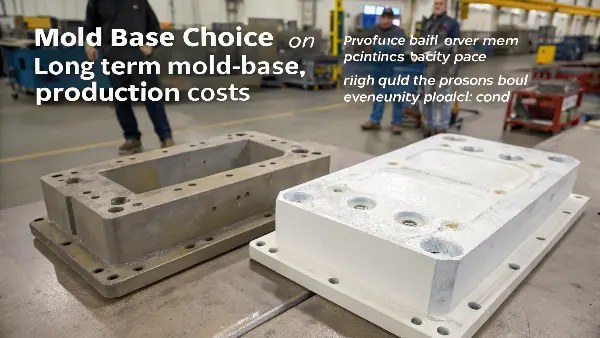
Here’s how a seemingly cheaper base can cost you more in the long run:
- Increased Scrap Rates:
- Instability/Flex: A base with inadequate plate thickness, pockets or support can deflect under injection pressure, leading to flash, dimensional inconsistency, and higher scrap.
- Wear: Faster wear on guide pins, bushings, or plate surfaces due to lower hardness materials or looser tolerances leads to misalignment, causing flash or part damage over time.
- Higher Maintenance Frequency & Cost:
- Component Wear: Cheaper components (pins, bushings, leader pins) made from softer materials or with looser fits will wear out faster, requiring more frequent replacement. This means buying more parts and paying for the labor/downtime to install them.
- Plate Damage: Softer plates are more susceptible to damage (dings, hobbing) requiring repairs like welding and re-machining, or even premature plate replacement.
- Increased Downtime: Every time a mold needs unscheduled maintenance due to base component failure, the press is idle. This lost production time is a significant hidden cost, especially in high-volume scenarios. A robust, high-quality base minimizes unexpected failures.
- Shorter Mold Lifespan: A base that wears quickly or lacks the durability for the required production volume forces a major refurbishment or complete replacement sooner than anticipated, destroying the initial cost savings. Stainless steel bases, for instance, resist corrosion far better, extending life in relevant environments.
- Potential for Slower Cycle Times:
- Poor Cooling: Inefficient cooling channels in the base can limit how fast you can run the cycle while maintaining part quality.
A cost comparison should include recorded guide-component replacement, parting-line repair, rejected parts and lost production hours. Treat an assumed improvement as a sensitivity scenario until trial or operating data verifies it.
| Cost Factor | Lower Quality Base Impact | Higher Quality Base Benefit | Long-Term Cost Implication |
|---|---|---|---|
| Scrap Rate | Higher (Flex, Wear -> Flash, Dimensional Issues) | Lower (Stability, Precision -> Consistency) | Significant Savings with Quality |
| Maintenance | More Frequent (Component Wear, Damage) | Less Frequent (Durable Materials, Tighter Tolerances) | Reduced Parts & Labor Costs |
| Downtime | Higher (Unexpected Failures, Frequent Maintenance) | Lower (Reliability, Predictable Wear) | Increased Production Output |
| Mold Lifespan | Shorter (Faster Wear, Corrosion Susceptibility) | Longer (Durability, Corrosion Resistance) | Better Return on Investment |
| Cycle Time | Potentially Slower (Inefficient Cooling/Ejection) | Potentially Faster (Optimized Design) | Higher Throughput Potential |
When is Investing in a Higher-Performance Mold Base Justified?
Knowing the long-term costs helps, but how do you decide when to spend more upfront? It feels counterintuitive to choose the more expensive option, but sometimes it’s the smartest financial move, especially for demanding applications like medical or electronics.
Investing in a higher-performance (and higher-cost) mold base is justified when dealing with high production volumes, abrasive materials, tight part tolerances, corrosive environments (requiring stainless steel), cleanroom requirements, or when maximum reliability and minimal downtime are critical operational priorities.
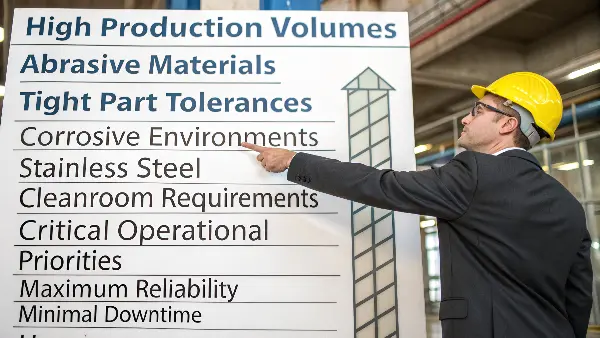
It comes down to evaluating the risks and requirements of the specific project. Here are key scenarios where the extra investment pays off:
- High Production Volumes: If a mold needs to run millions of cycles, the durability and wear resistance of higher-quality steel (like P20 vs. 1045) and precision components become essential. The cost per part for the base becomes negligible, while reliability is paramount. Paying more upfront prevents costly failures deep into the production run.
- Abrasive Resins: Prioritize melt-contact gates, runners and cavity/core inserts. Structural base plates may not contact the resin; specify their steel and guidance separately rather than applying the resin-abrasion requirement to the whole assembly.
- Tight Part Tolerances: For precision medical components or intricate electronic connectors like the buyer designs, the stability and precision of the mold base are non-negotiable. Tighter manufacturing tolerances on the base itself (flatness, parallelism, alignment features) directly contribute to achieving and holding tight part tolerances. Reduced base flex and precise alignment minimize sources of variation.
- Corrosive Environments or Materials:
- Medical Sterilization: Autoclaving or other sterilization methods require stainless steel bases (like 420SS) to prevent rust and contamination. Standard steel is simply not an option.
- Corrosive Resins: Some plastics (like PVC) release corrosive byproducts during molding. Stainless steel or appropriate plating on standard steel bases is necessary to prevent damage.
- Cleanroom Requirements: Medical molding often requires cleanroom environments. Stainless steel bases are preferred as they don’t require rust-preventative coatings (which can flake) and are easier to clean. Some specialized bases also offer features like sealed ejector systems to minimize lubricant contamination.
-
Critical Reliability Needs: For applications where production stoppages are extremely costly (e.g., just-in-time supply chains, high-value parts), the enhanced reliability of a premium mold base provides insurance against unexpected downtime. The slightly higher upfront cost is easily offset by avoiding even one major production halt.
In essence, if the risks associated with base failure (scrap, downtime, tolerance loss, contamination) are high, or if the operational demands (volume, material) are severe, investing more in the mold base is a sound economic decision, not an expense. It’s about mitigating risk and ensuring long-term operational efficiency.
Conclusion
Choosing a mold base isn’t just about fitting the cavity and core. It’s a crucial economic decision. Balancing the initial price against material, tolerances, expected lifespan, and production demands ensures you select a base that delivers true value, not just upfront savings.
Compare Mold-Base Savings on Total Program Cost
Use the mold cost estimator only for an early budget range. A defensible comparison also needs the mold architecture, expected maintenance, downtime risk, component replacements and planned production volume.
CKMOLD Practical Engineering Update: mold base cost
A cheaper mold base can look attractive during purchasing, but the real economics appear during trial, production, maintenance and repeat orders. If the base lacks support, alignment, cooling access or serviceability, the initial savings can be lost through downtime and corrections.
The Cost You See vs the Cost You Run
The quoted mold base cost is visible. The hidden cost is trial delay, flash correction, broken components, long cycle time, difficult maintenance and production instability. Buyers should evaluate total project cost, not only the purchase price.
When Cheaper Is Reasonable
A lower-cost base may be reasonable for prototypes, very low volume or simple parts with limited mold life expectations. The key is honesty: the mold should be priced and designed for its real purpose, not presented as a high-volume production tool.
When Cheaper Becomes Risky
High-volume production, tight tolerances, abrasive resins, complex actions, export tooling or frequent repeat orders usually need more robust mold base decisions. Saving money in the wrong place can create quality and maintenance cost later.
How to Compare Mold Base Value
Compare steel, support, guide components, waterline access, ejection structure, standard components, spare parts and mold life. A stronger quote explains why each choice is appropriate for the part and quantity.
Project-Specific Buyer Checklist
- Tool purpose defined
- Expected mold life stated
- Maintenance access considered
- Downtime risk included
- Quote scope compared fairly
What Makes This Different From a Generic Quote?
A generic quote may give a price and lead time, but it often hides the engineering assumptions. A better quote explains what was checked, what remains uncertain, and which choices affect cost, sample timing or mold life. This is where professional mold sourcing becomes different from simple price shopping.
How CKMOLD Would Review the Project
Send the assembly drawing, production machine, annual volume, proposed resin and supplier quote breakdown. Compare the same base, custom machining and acceptance scope before choosing a lower invoice.
Illustrative decision: if an upgraded assembly costs USD 2,000 more and verified avoidable downtime costs USD 200 per hour, it must prevent 10 such hours to recover that premium before other costs. These are assumptions, not CKMOLD pricing or a reliability promise. Track whether the failure mode is actually addressed.
Use the component-level base-steel guide for material decisions. Uddeholm’s Holder specification demonstrates that a supply condition belongs with the grade. Ask for the same certificate and inspection scope in both quotations.
FAQ
Is a cheaper mold base generally bad?
No. It can be suitable for low-volume or prototype work if expectations are clear.
What hidden costs come from weak mold bases?
Downtime, repairs, flash, poor cooling, dimensional drift and shorter mold life are common costs.
How should mold base quotes be compared?
Compare steel, structure, components, maintenance access, mold life and trial support.
Does mold base affect cycle time?
Yes. Cooling layout and structural design can influence cycle stability and time.
Can CKMOLD advise cost-effective mold base choices?
Yes. CKMOLD can match mold base scope to part risk and production volume.