
Are you struggling to turn your product designs into high-quality physical parts? The world of injection molding can feel complex, filled with technical jargon and potential pitfalls that lead to costly delays and rework. This guide is here to cut through the noise, providing you with the clear, practical knowledge you need to navigate the process with confidence and ensure your project’s success from the start.
This complete guide to injection molding provides a roadmap for manufacturing and design success. It covers the fundamental manufacturing process of injecting molten plastic into a mold to create parts at scale. The guide explains crucial design principles like Design for Manufacturability (DFM) to prevent costly errors. It also breaks down key international quality standards, including ISO and specific DIN standards like 16742, ensuring your parts meet precise tolerance and quality requirements for a smooth and predictable production run.
I’ve spent my entire career in the mold industry, from working on the factory floor to running my own company. I’ve seen firsthand how a solid understanding of the fundamentals can prevent massive headaches and save thousands of dollars. The key is to build your knowledge from the ground up, starting with the core process itself. Once you grasp how it works, everything else falls into place. Let’s begin this journey together.
What is injection molding in manufacturing?
You hear "injection molding" mentioned all the time, but what does that term actually mean for your production line? For many business owners, it can feel like a black box where designs go in and parts come out. Without a clear understanding of the process, you can’t properly evaluate suppliers or communicate your project needs, which can lead to critical misunderstandings and expensive mistakes down the road. Let’s open that box and look inside.
Injection molding is a high-volume manufacturing process used to produce identical plastic parts with speed and precision. The process involves melting plastic pellets and injecting the molten material under high pressure into a custom-made metal mold, or "tool." The plastic then cools and solidifies inside the mold’s cavity, taking on its exact shape. Once hardened, the mold opens, and the finished part is ejected. This method is the backbone of modern manufacturing for its efficiency and repeatability.
The beauty of injection molding lies in its cyclical and highly automated nature. Understanding this cycle is key to understanding the entire process. It’s a precise dance of mechanics and thermodynamics that happens in seconds.
The Four Main Stages of the Molding Cycle
- Clamping: The machine firmly presses the two halves of the mold together with immense force. This ensures the mold stays shut against the pressure of the injected plastic, preventing any material from leaking out.
- Injection: Plastic pellets from a hopper are fed into a heated barrel, where a large rotating screw melts and mixes them into a molten state. The screw then plunges forward, acting like a piston to inject the molten plastic into the mold’s cavity.
- Cooling: This is often the longest part of the cycle. Water or another coolant circulates through channels in the mold to draw heat away from the plastic. The plastic solidifies, hardening into the shape of the cavity. Proper cooling is critical for part stability and avoiding defects.
- Ejection: Once the part is sufficiently cool, the mold opens. Ejector pins, which are part of the mold, push forward to release the finished part, which then falls into a collection bin. The cycle is now complete and ready to begin again.
This process is incredibly versatile, but its high initial cost for the mold tool makes it best suited for certain applications.
| Feature | Injection Molding | CNC Machining | 3D Printing (FDM) |
|---|---|---|---|
| Best For | High-volume production (1,000s to millions) | Prototypes, low-volume, complex geometries | Single prototypes, design verification |
| Unit Cost | Extremely low at scale | High | High |
| Initial Cost | Very high (for the mold tool) | Medium (setup and programming) | Very low |
| Cycle Time | Very fast (seconds per part) | Slow (minutes to hours per part) | Slow (hours per part) |
| Materials | Huge range of thermoplastic polymers | Metals, plastics, wood | Limited range of plastics |
What is DFM in injection molding?
Have you ever finalized a product design, feeling confident it was perfect, only to find out it was a manufacturing nightmare? This is a common and costly problem. When a design isn’t optimized for the production process, it can lead to weak parts, ugly surface defects, or even molds that simply don’t work. This forces you back to the drawing board, wasting valuable time and money on redesigns and mold rework.
Design for Manufacturability (DFM) is the critical practice of designing a product specifically to be easy and efficient to produce. In injection molding, DFM focuses on optimizing the part’s geometry to prevent common molding defects. Key principles include ensuring uniform wall thickness to prevent sink marks, adding draft angles for smooth ejection from the mold, using radii on sharp corners to improve plastic flow and reduce stress, and carefully planning the location of gates and ejector pins.
I can’t stress this enough: DFM is not an optional step. It is the single most important factor in ensuring a smooth, cost-effective, and successful injection molding project. It’s the bridge between a great idea and a great product. Investing time in DFM before a single piece of steel is cut for the mold will pay for itself many times over.
Let’s break down some of the core principles I always check for.
Essential DFM Principles
- Uniform Wall Thickness: This is the golden rule. Molten plastic flows like water and will cool at different rates in thick and thin sections. If a wall is too thick, the inside will cool much slower than the outside, causing the surface to shrink and pull inward, creating an ugly defect called a "sink mark." Keeping walls as uniform as possible ensures consistent cooling and a stable, high-quality part.
- Draft Angles: Imagine trying to pull a perfectly straight-sided cup out of a bucket of hardened concrete. It would be stuck. The same principle applies here. A draft angle is a slight taper, typically 1-2 degrees, applied to the vertical walls of a part. This tiny angle prevents the part from scraping against the mold surface during ejection, reducing friction and preventing damage.
-
- Radii and Fillets: Sharp internal corners are a major problem. They create high-stress points in the final part, making it prone to cracking under load. They also disrupt the flow of molten plastic, which can lead to incomplete parts. Adding a rounded edge, or radius, to both internal and external corners strengthens the part and improves plastic flow significantly.
- Avoiding Undercuts: An undercut is any feature that would prevent the part from being directly ejected from the mold, like a side hole or a snap-fit clip. These features require complex and expensive mold actions, like side-cores or lifters, to create. While sometimes necessary, DFM aims to eliminate or simplify undercuts whenever possible to reduce mold cost and complexity.
By focusing on these elements early in the design phase, you can prevent over 90% of common molding problems.
What are the ISO standards for injection molding?
You’ve designed your part and are ready for production, but how do you ensure it will be made to the quality level you expect, especially when working with a supplier overseas? Simply sending a 3D file isn’t enough. Without a shared language for quality and precision, you’re opening the door to misunderstandings, inconsistent results, and parts that don’t meet your requirements. This uncertainty can be a major source of stress and risk for any business owner.
ISO standards for injection molding provide a globally recognized framework for quality, safety, and consistency. While there isn’t one single standard for the entire process, several key standards apply. ISO 9001 defines the requirements for a Quality Management System, ensuring your supplier has robust processes. ISO 294 series covers specifics like material testing and molding parameters, while ISO 20457 (which superseded DIN 16742) provides a standardized system for defining general dimensional and geometrical tolerances for molded parts.
Think of ISO standards as a universal rulebook that everyone in the industry agrees to follow. When your supplier is ISO 9001 certified, it’s a strong signal that they take quality seriously. It means their processes are documented, controlled, and consistently reviewed for improvement. This certification isn’t just a piece of paper; it’s your assurance of their commitment to reliable and repeatable manufacturing.
But general quality management is just the starting point. The real value comes from the technical standards that define the tangible aspects of your parts.
Key ISO Standards in Practice
- ISO 9001 – Quality Management Systems: This is the foundation. It ensures the manufacturer has a system in place for everything from handling customer orders and purchasing raw materials to calibrating machinery and handling non-conforming products. It’s your first and most important checkpoint when vetting a new supplier.
- ISO 294 – Plastics — Injection moulding of test specimens: This series of standards is crucial for material integrity. It outlines the precise procedures for molding test bars from a specific plastic resin. These bars are then used to test physical properties like tensile strength and impact resistance, ensuring the raw material you specified is what you’re actually getting and that it performs as expected.
- ISO 20457 – General tolerances for moulded parts: This is the modern standard for defining acceptable dimensional variation. It provides a clear, numerical system to specify how much a part’s final dimensions can deviate from the design. By referencing a specific tolerance grade from this standard on your technical drawings, you remove all ambiguity. Your supplier knows exactly how precise the part needs to be, which is critical for parts that need to fit together perfectly in an assembly.
Using these standards transforms your conversation with a manufacturer from a vague discussion about "good quality" into a precise, data-driven set of instructions.
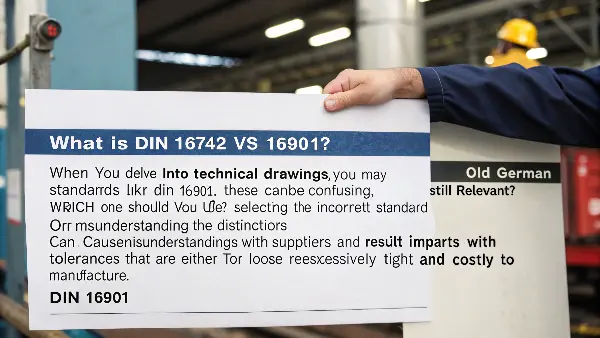
What is DIN 16742 vs 16901?
When you get into the details of technical drawings, you might see references to old German standards like DIN 16901 or DIN 16742. This can be confusing. Are they still relevant? Which one should you use? Choosing the wrong standard or not understanding the difference can lead to confusion with your supplier and result in parts with tolerances that are either too loose for your needs or unnecessarily tight and expensive to produce.
DIN 16742 is a more modern German standard that establishes a comprehensive system for general tolerances on plastic molded parts, linking them to the part’s material and production process. It has largely replaced the older DIN 16901 standard. While DIN 16901 provided a simpler tolerance grouping, DIN 16742 is more detailed and aligns better with modern manufacturing capabilities and international practices. As of 2021, DIN 16742 itself has been superseded by the international standard ISO 20457, which is now the preferred global standard.
For years, these DIN standards were the backbone of precision engineering in Europe, and their influence is still seen today. I’ve worked with countless drawings that reference them. The key takeaway is that the industry is always evolving toward a more unified, global language for quality. The move from DIN 16901 to 16742, and now to ISO 20457, is part of that important trend.
So, what does this mean for you today? While you might encounter old drawings with these standards, all new projects should reference the current international standard, ISO 20457.
Understanding the Evolution of Tolerance Standards
- The Old Way (DIN 16901): This was an early attempt to group plastics and assign general tolerances. It was a good start, but it was relatively simplistic. It didn’t fully account for the wide variety of modern plastics and the nuances of the molding process. You will mostly find this on legacy designs from 20-30 years ago.
- The Better Way (DIN 16742): This standard was a major improvement. It introduced a more sophisticated system with Tolerance Groups (TG) that considered the manufacturing process and the specific type of plastic being used. For example, a stable plastic like ABS would be in a different, tighter tolerance group than a flexible plastic like polypropylene, which shrinks more. This allowed for more realistic and achievable tolerances.
- The Global Way (ISO 20457): This is the current international standard. It builds upon the principles of DIN 16742 but harmonizes them into a single, global framework that can be understood by engineers and manufacturers in the US, Europe, and Asia. For all new projects, this is the standard you should have on your technical drawings.
Here is a simplified table to show the progression:
| Standard | Era of Prominence | Key Feature | Current Status |
|---|---|---|---|
| DIN 16901 | Pre-1990s | Basic tolerance groups | Obsolete, Replaced |
| DIN 16742 | 1990s – 2021 | Detailed Tolerance Groups (TG) based on material/process | Superseded by ISO 20457 |
| ISO 20457 | 2021 – Present | Global harmonization of general tolerance principles | Current & Recommended Standard |
If a supplier asks you to choose a tolerance group from an old DIN standard, it’s a good opportunity to have a conversation and update the project specifications to the modern ISO 20457. This ensures everyone is working from the same, globally understood rulebook.
Conclusion
Mastering injection molding is about understanding the fundamentals. It begins with the core manufacturing cycle, moves to intelligent DFM principles to prevent problems before they start, and is guided by international standards like ISO 20457 that ensure quality and precision. By building on this foundation, you can make informed decisions, communicate effectively with suppliers, and consistently turn your ideas into high-quality, cost-effective products.