
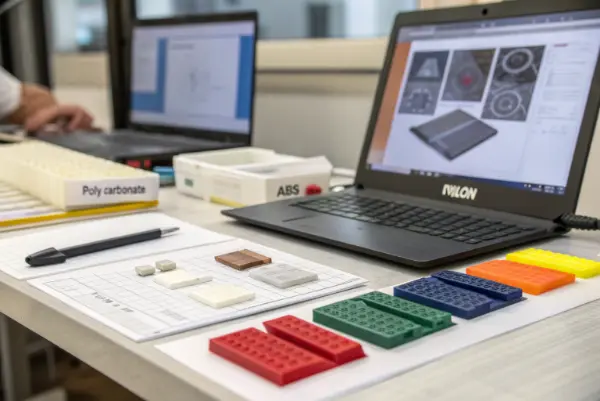
As a designer, you know your CAD software inside and out, but does the sheer scope of the injection molding process feel overwhelming? This gap can lead to designs that look great on screen but cause major headaches and costly errors on the production floor. Mastering the complete outline, from the machine to the material to the final part, is the only way to bridge that gap and design with true confidence.
An injection molding outline is most useful when it shows how the disciplines connect. Product design creates the geometry, resin supplies the material behavior, the mold creates the cavity and thermal system, the machine executes the cycle, and quality verifies the result. This roadmap helps a new team organize questions without reducing molding to a list of machine settings.
Related engineering resources: injection molding services | DFM analysis | mold testing and validation
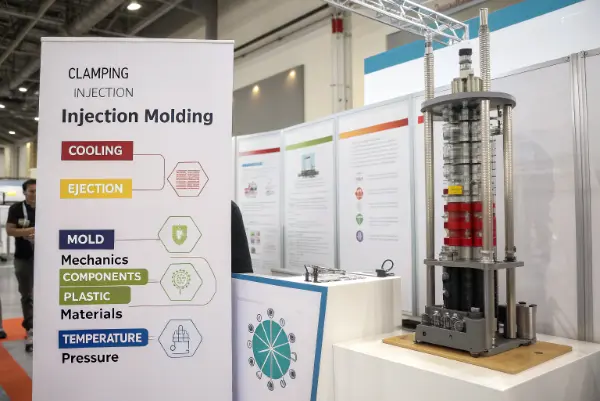
Mastering the outline of injection molding means understanding its five core pillars: the step-by-step process (clamping, injection, cooling, ejection), the mechanics of the molding machine, the intricate components of the mold itself, the properties of different plastic materials, and the critical processing parameters like temperature and pressure. Getting a firm grasp on how these five elements interact is the foundation for designing successful, manufacturable parts and troubleshooting any issues that arise during production.
What Are the Core Stages of the Injection Molding Process?
You hold a finished plastic part, but the journey from a simple pellet to a complex shape can seem like a black box. If you don’t understand the fundamental stages, it’s nearly impossible to design for manufacturability or figure out why a part might have defects like warp or sink marks. The good news is that this seemingly complex process can be broken down into a simple, logical, and repeatable four-stage cycle.
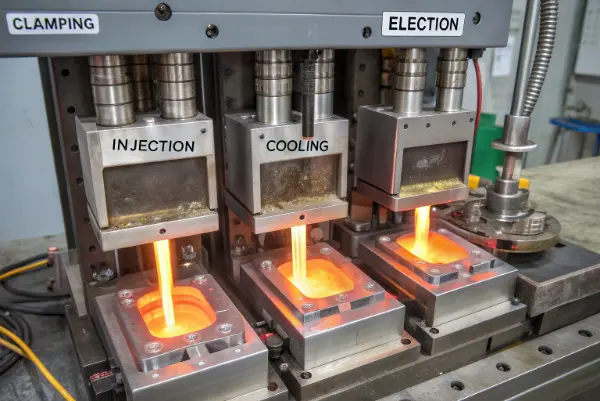
The injection molding process consists of four main stages: Clamping, Injection, Cooling, and Ejection. First, the two halves of the mold are securely closed under high pressure. Next, molten plastic is injected into the mold cavity. Then, the plastic cools and solidifies, taking the shape of the mold. Finally, the mold opens, and the finished part is pushed out by ejector pins. This entire cycle repeats to produce parts in high volumes.
Stage 1: Clamping
Before any plastic is injected, the two halves of the mold—the cavity and the core—must be pressed together with immense force. This is done by the clamping unit of the molding machine. The force has to be strong enough to resist the pressure of the molten plastic that will be injected. If the clamp force is too low, the mold can flash, meaning plastic seeps out of the parting line, creating unwanted, thin sheets of material on the part. Your design’s projected area (the shadow it would cast) directly influences the required clamp force.
Stage 2: Injection
Once the mold is clamped, the injection stage begins. Plastic pellets are melted in a barrel and forced into the mold cavity by a reciprocating screw. This stage has two phases: filling and packing. The screw pushes the molten plastic forward to fill the cavity. Once it’s about 95-99% full, the process switches to the packing phase, where pressure is maintained to pack in more material to compensate for shrinkage as the plastic cools.
Stage 3: Cooling
This is often the longest part of the cycle and has the biggest impact on cycle time and profitability. The plastic inside the mold cools and solidifies by transferring its heat to the mold, which has cooling channels running through it. The wall thickness of your part is the single most important factor here. Thicker walls take exponentially longer to cool, which can lead to sink marks and warping.
Stage 4: Ejection
After the part is sufficiently cool, the mold opens, and the ejector system—usually a series of pins—pushes the part out of the mold. Your design needs to have a slight angle, called a draft angle, on its vertical walls so it can be released easily without being damaged or getting stuck. This is a non-negotiable part of designing for injection molding.
How Does an Injection Molding Machine Actually Work?
You’ve designed a part, but have you ever thought about the machine that brings it to life? It’s easy to see it as a big, noisy piece of equipment, but not understanding its basic components can limit your design thinking. If you don’t know the machine’s capabilities and limitations, you might design features that are difficult or even impossible to produce, leading to frustrating and expensive revisions down the line.
An injection molding machine has two main parts: the injection unit and the clamping unit. The injection unit is responsible for melting and injecting the plastic material into the mold. It consists of a hopper, a barrel with a reciprocating screw, and a nozzle. The clamping unit holds the mold, closes it during injection and cooling, and opens it for part ejection. Its power is measured in tonnage, which indicates the amount of force it can apply to keep the mold closed.
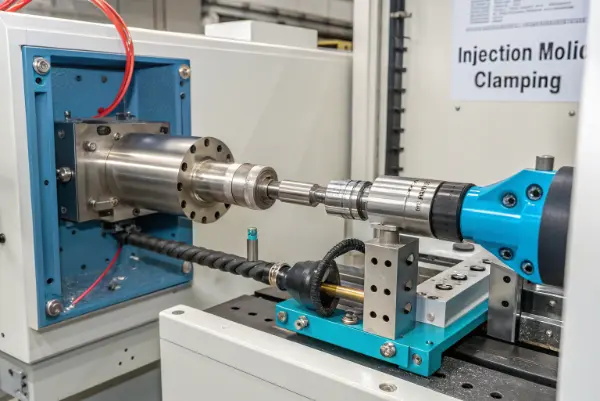
I spent countless hours next to these machines, listening to their rhythms. Each one has its own personality, but they all operate on the same core principles. Understanding them isn’t just for the machine operator; it’s for you, the designer. Knowing how the screw plasticizes material or how the clamp tonnage is calculated gives you a massive advantage. It helps you speak the same language as the manufacturers and create designs that work in harmony with the machine, not against it.
The Injection Unit: The Heart of Melting
This is where the magic starts. Think of it as the part of the machine that prepares and delivers the raw material.
- Hopper: This is a large funnel on top of the unit where raw plastic pellets are loaded. Gravity feeds them down into the barrel.
- Barrel and Screw: The barrel is a heated cylinder, and inside it is a reciprocating screw. As the screw rotates, it does two things: it moves the pellets forward from the hopper, and it heats and melts them through both friction (shear heat) and external heating bands on the barrel. The result is a consistent, molten plastic “shot” ready at the front of the barrel.
- Nozzle: This is the exit point for the molten plastic, which connects to the mold’s sprue bushing to deliver the material into the mold.
The Clamping Unit: The Muscle
This unit provides the force needed to handle the immense pressures of the injection process.
- Platens: There are three platens: a fixed platen (where the cavity half of the mold is mounted), a movable platen (where the core half is mounted), and a rear platen. The movable platen slides along tie bars.
- Tie Bars: These are large steel rods that connect the platens and provide structural support. The distance between them determines the maximum size of the mold that can be used.
- Clamping Mechanism: This is typically either a hydraulic system or a mechanical toggle system that pushes the movable platen to close the mold and apply the clamping force. The strength of this system is rated in tons (e.g., a 200-ton press).
Understanding these parts helps you appreciate the constraints. For example, the shot size of the injection unit limits the volume of your part, and the tie bar spacing limits its overall footprint.
What Key Components Make Up an Injection Mold?
You’ve designed the suitable part, but the part itself is only half the story. The real engineering marvel is the mold, a custom tool built to produce your part thousands or even millions of times. Not understanding the basic anatomy of a mold is a major blind spot for a designer. It’s like an architect not knowing how foundations or support beams work. This lack of knowledge can lead to designs that are unnecessarily complex and expensive to tool.
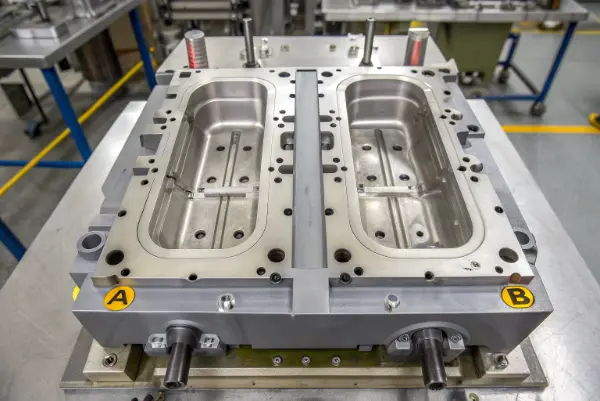
An injection mold is primarily made of two halves: the “A” side (cavity side), which attaches to the stationary platen, and the “B” side (core side), which attaches to the moving platen. Key components include the mold base, the cavity and core inserts that form the part’s shape, the runner system that guides plastic to the cavity, the cooling system to solidify the part, and the ejector system to push the finished part out. Each component plays a critical role in the mold’s function and the quality of the final product.
The A-Side (Cavity Half)
This is typically the “show” surface of your part. It’s mounted on the fixed platen of the machine.
- Sprue Bushing: A hardened steel bushing with a tapered hole. The machine’s nozzle seats against it, and it’s the first entry point for the molten plastic into the mold.
- Locating Ring: This ring fits into a recess on the fixed platen to align the mold correctly with the machine’s nozzle.
- Cavity Inserts: These are the custom-machined blocks of steel that form the external geometry of your plastic part.
The B-Side (Core Half)
This side contains the mechanisms for ejection and often forms the internal geometry of the part.
- Core Inserts: These blocks form the internal features of your part. The part shrinks onto the core as it cools, which is why the ejector system is housed on this side.
- Runner and Gate System: This is a channel machined into the mold surface that transports the molten plastic from the sprue to the cavity. The gate is the small opening where the plastic actually enters the cavity.
- Ejector System: This is a whole subsystem. It includes ejector pins, an ejector plate, and a return mechanism. When the mold opens, this system activates to push the part off the core.
- Cooling Channels: These are holes drilled through the mold plates and inserts through which a fluid (usually water) is circulated to control the mold’s temperature and cool the plastic part efficiently.
| Component Group | Location | Primary Function | Design Implication |
|---|---|---|---|
| Mold Base | A & B Sides | Provides the foundation and structure for all other components. | Determines the overall size and cost of the tool. |
| Forming System | A & B Sides | Cavity and Core inserts that define the part’s shape. | Your part’s geometry directly dictates the complexity here. |
| Feed System | A & B Sides | Sprue, Runner, and Gates that deliver the plastic. | Gate location affects part cosmetics and strength. |
| Ejection System | B-Side | Ejector pins and plates that remove the finished part. | Your part needs draft angles to allow for easy ejection. |
| Cooling System | A & B Sides | Channels that regulate mold temperature. | Wall thickness in your design controls the required cooling time. |
How Do You Choose the Right Plastic Material for Your Project?
You have a design, a process, and a machine, but what is the part actually made of? Choosing the right plastic is one of the most critical decisions you will make, and it’s often overwhelming. Selecting the wrong material can lead to product failure, whether it’s a part that breaks under stress, deforms in the heat, or doesn’t meet regulatory requirements. It’s a choice that directly impacts performance, cost, and manufacturability.
To choose the right plastic, you must balance four key factors: functional requirements, aesthetic requirements, cost, and processability. First, define the mechanical, thermal, and chemical performance needed for the part’s application. Then, consider its look and feel. Next, evaluate the material cost per kilogram against the project budget. Finally, ensure the material’s molding characteristics, like its flow rate and shrinkage, are compatible with your part’s design and the chosen manufacturing process.
Step 1: Define Functional and Environmental Needs
This is the most important step. You need to ask the hard questions about what the part has to do and what it has to survive.
- Mechanical Properties: Does it need to be strong (Tensile Strength)? Stiff (Flexural Modulus)? Impact-resistant (Izod Impact)? Will it be under constant load (Creep Resistance)?
- Thermal Properties: What is the maximum continuous service temperature it will see? Will it be exposed to extreme cold?
- Chemical Resistance: Will the part come into contact with oils, acids, cleaning agents, or other chemicals?
- Regulatory Requirements: Does it need to be food-grade (FDA), medical-grade (USP Class VI), or flame retardant (UL94)?
Step 2: Consider Aesthetics and Finish
How the part looks and feels is often just as important as how it performs, especially for consumer products.
- Color: Can the material be easily colored to match your brand’s specifications?
- Transparency: Does the part need to be clear like glass (PC, Acrylic) or just translucent (PP)?
- Surface Finish: Some materials, like ABS, provide a high-gloss finish easily, while others, like glass-filled nylon, have a more matte, fibrous texture.
Step 3: Balance Performance with Cost
There’s often a high-performance, high-cost material that will work. The challenge is finding the most affordable material that meets all your requirements.
- Commodity Plastics (e.g., PP, PE, PS): Inexpensive and easy to process, but offer lower performance. Great for disposable items, packaging, and simple enclosures.
- Engineering Plastics (e.g., ABS, PC, Nylon): Offer a better balance of performance and cost. They are the workhorses for automotive, electronics, and durable consumer goods.
- High-Performance Plastics (e.g., PEEK, Ultem): Very expensive with exceptional thermal and chemical resistance. Used in demanding aerospace, medical, and industrial applications.
Remember to consider the material’s density. You buy plastic by weight but sell parts by volume, so a lower-density material can sometimes be more cost-effective even if its price per kilogram is slightly higher.
What Are the Critical Parameters in Injection Molding?
Your design is done, the mold is built, and the material is chosen. Now, it’s time to actually make the part. But the final quality is not supported yet. It all comes down to the process parameters set on the injection molding machine. Getting these settings wrong can turn a suitable design into a batch of scrap parts with defects like sink marks, flash, or short shots. Understanding these parameters helps you communicate effectively with your manufacturing partner and troubleshoot issues.
The most critical parameters in injection molding are temperature, pressure, and time. Specifically, this includes melt temperature, mold temperature, injection pressure, holding pressure, injection speed, and cooling time. Each parameter must be carefully controlled and optimized for the specific material and part geometry. They are all interconnected; changing one will almost certainly require adjustments to the others to maintain part quality and consistency.
Walking onto a factory floor, you’ll see technicians constantly fine-tuning these settings. It’s a science, but there’s also an art to it that comes from experience. I learned that as a designer, you don’t need to be an expert in setting these parameters, but you absolutely need to understand what they are and how they affect your part. Knowing that a thin wall in your design will require higher injection pressure and speed can make you a much smarter designer and a better collaborator.
The “Big Three”: Temperature, Pressure, and Time
Almost every setting on the machine falls into one of these three categories.
1. Temperature Control
- Melt Temperature: This is the temperature of the plastic as it’s injected. It’s set via the heating bands on the barrel. Too low, and the plastic is too viscous and won’t fill the part (a “short shot”). Too high, and you can degrade the material or increase cycle time.
- Mold Temperature: This is controlled by the cooling channels in the mold. A warmer mold can improve surface finish and reduce weld lines, but it increases the cooling time. A cooler mold speeds up the cycle but can cause cosmetic defects.
2. Pressure Control
- Injection Pressure: The force used to push the molten plastic into the cavity. This is directly related to the material’s viscosity and the complexity of the part geometry (e.g., long, thin flow paths require higher pressure).
- Holding (or Packing) Pressure: After the initial fill, a lower, constant pressure is applied to pack more material into the cavity to compensate for shrinkage as the part cools. This is critical for preventing sink marks and voids.
3. Time and Speed Control
- Injection Speed: The rate at which the screw pushes the plastic into the mold. A fast injection can be necessary for thin-walled parts but can also cause issues like “jetting” or burn marks if air can’t escape the cavity fast enough.
- Cooling Time: The amount of time the mold stays closed after injection to allow the part to solidify. This is usually the largest portion of the total cycle time and is heavily dependent on the part’s thickest wall section.
Understanding the interplay of these parameters is key. For example, if a part is showing sink marks, the solution could be to increase holding pressure, increase holding time, or decrease the melt temperature. Knowing these relationships empowers you to participate in solving manufacturing problems.
1. Define the Product
Document use environment, load, life, assembly, appearance, tolerance, quantity and failure consequence. Convert vague goals into measurable CTQs. These requirements determine whether injection molding is suitable and what evidence the program must create.
2. Design the Part and Select Resin
Coordinate walls, ribs, bosses, radii, draft, clips, seals and interfaces with the exact resin grade. Consider shrinkage, moisture, creep, temperature, chemicals, wear, color and supply. Product geometry and material cannot be finalized independently.
3. Design and Build the Mold
Select parting, gates, runners, vents, cooling, ejection, cavities, steel and mechanisms. Review flow, balance, release, maintenance and tool life. Build and inspect the tool with datums and surface standards tied to the product drawing.
4. Establish the Process
Set material handling, melt and mold temperatures, fill profile, transfer, hold, cooling, recovery and ejection. Use trial evidence to find a stable center and practical limits. Process development should explain why the settings work.
5. Control Production
Use first-off approval, cavity identification, SPC, inspection fixtures, preventive maintenance, traceability, packaging and change control. Analyze defects by evidence and improve accepted output without weakening CTQs.
Injection Molding Outline: Buyer Review Checklist
- Define product CTQs, environment, life, assembly, appearance and volume.
- Link part geometry to exact resin behavior and supply risk.
- Design parting, flow, cooling, ejection, cavities, steel and maintenance.
- Develop a documented process center, limits and reaction plan.
- Control cavity, inspection, maintenance, traceability, packaging and changes.
Frequently Asked Questions
What should a beginner learn first about injection molding?
Start with the relationship among part requirements, resin, mold and cycle. Settings make more sense once the complete system is understood.
Where do most expensive molding problems begin?
Often in unclear requirements, late DFM, inappropriate material assumptions or tool architecture decisions made before risks were visible.
Conclusion
Mastering the outline of injection molding isn’t about memorizing every detail. It’s about understanding the core system: the four-stage process, the machine’s function, the mold’s components, the material’s properties, and the key processing parameters. When you see how these pieces connect, you move beyond just being a product designer. You become a creator of successful, manufacturable products, ready to collaborate and innovate with confidence in this incredible industry.