
Are you struggling to pick the right flexible material for your new product? Making the wrong choice can lead to toxic chemical leaks, failed tests, and angry customers. I have seen this happen too many times in the mold industry. Today, I will help you solve this problem by looking closely at TPE, TPU, and silicone safety.
TPE, TPU, and silicone are all flexible materials, but their safety levels differ. Silicone is generally the safest and most heat-resistant, making it perfect for medical and food products. TPU is very tough and resists oils, making it safe for wearable tech and phone cases. TPE is soft, affordable, and safe for most everyday consumer goods. Your choice depends on how the product is used and what safety tests it must pass.
You might think that any soft plastic will work for your design. But if you stop reading now, you might miss key safety facts that could make or break your next big project. Let us dive into the details.
What is the difference between TPE, TPU, and silicone?
Do you feel confused by all these plastic acronyms? It is easy to mix them up. But if you do not know the basics, your mold design will fail. Let us clear up the confusion right now.
The main difference lies in their chemistry and heat resistance. TPE (Thermoplastic Elastomer) is a blend of plastic and rubber, making it soft and easy to mold. TPU (Thermoplastic Polyurethane) is a specific type of TPE that is much harder and resists wear. Silicone is a synthetic rubber made from silicon, carbon, hydrogen, and oxygen, which gives it extreme heat resistance and high safety levels.
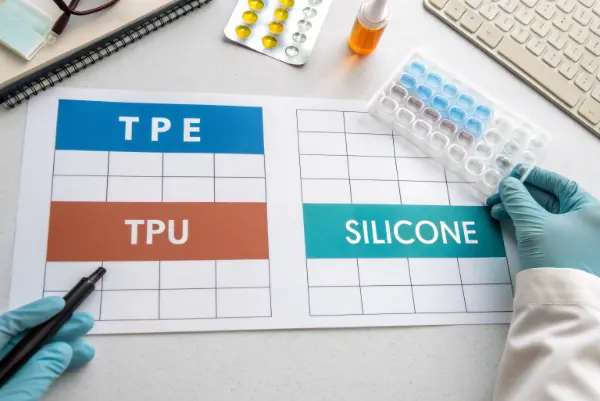
When I first started working in a mold factory, I often mixed up these three materials. Over time, I learned that knowing their differences is key to making good products. I have helped many clients at CKMOLD choose the right one. Let us look at them one by one in simple terms.
Understanding TPE Basics
TPE stands for Thermoplastic Elastomer. It is like a sponge. It feels soft and grips well. We use it a lot for toothbrush handles and tool grips. It is very easy to melt and shape in a mold. This saves time and money. But it cannot handle high heat. If you put it in a hot oven, it will melt. TPE is great for basic consumer goods that stay at room temperature. It is cheap and does a good job for simple things.
Understanding TPU Basics
TPU stands for Thermoplastic Polyurethane. Think of it as the tough older brother of TPE. It does not scratch easily. It can handle oil and grease. We often use it for tough phone cases and shoe soles. It is harder to mold than TPE because it needs exact heat control. It is stronger and lasts longer. But it is also a bit more expensive.
Understanding Silicone Basics
Silicone is totally different. It is not a normal plastic. It comes from sand. You have to bake it to cure it, rather than just cooling it down like TPE or TPU. It can survive boiling water and freezing cold. It is very safe.
Here is a simple table to show the main differences:
| Material | Heat Resistance | Toughness | Common Use |
|---|---|---|---|
| TPE | Low | Medium | Grips, soft toys |
| TPU | Medium | High | Phone cases, shoes |
| Silicone | Very High | Low | Kitchen tools, baby pacifiers |
As a product designer, you must look at these facts. If your product needs to go in a dishwasher, you must pick silicone. If it needs to survive a drop on hard concrete, pick TPU. If it just needs a cheap, soft grip, pick TPE. It really is that simple. Knowing this helps you save money and avoid bad mold designs.
Is silicone safer than TPU?
Are you worried about skin rashes or allergies from your wearable product? A bad material choice can hurt your users. You must pick the safest option. Let us see if silicone beats TPU in safety.
Yes, silicone is generally safer than TPU for direct human contact. Silicone is hypoallergenic, meaning it rarely causes allergic reactions. It does not break down easily in harsh environments, so it does not release bad chemicals. TPU is also safe for many uses, but it can sometimes cause mild skin irritation if worn tightly for a long time, especially when sweat is involved.
I always tell my clients at CKMOLD to think about the end user first. When you design a product that touches human skin, safety is the number one rule. I have seen companies lose a lot of money because they used the wrong plastic.
The Safety Profile of Silicone
Silicone is amazing for safety. Hospitals use it all the time. Medical tubes are made of silicone. Baby bottle nipples are made of silicone. Why? Because the human body ignores it. It does not react with our skin. It does not hold onto bacteria. You can boil it to kill germs, and it will not melt or change shape. This makes it the top choice for any food or medical design. It is very pure. It does not have bad chemicals inside it.
The Safety Profile of TPU
TPU is also a safe material, but in a different way. It is great for things you touch but do not put in your mouth. Smartwatch bands are a great example. TPU is safe enough for a watch band. But if a person sweats a lot, trapped sweat under a tight TPU band can cause a rash. TPU does not let air pass through easily. Also, some cheap TPUs might have leftover chemicals from the factory. You have to be careful when you buy cheap TPU.
Let us look at a safety comparison:
| Feature | Silicone | TPU |
|---|---|---|
| Skin Allergy Risk | Very low | Low to medium |
| Food Safe | Yes | Usually no |
| High Heat Safe | Yes | No |
| Medical Grade | Yes | Rare |
So, if you are designing a kitchen tool or a baby toy, silicone wins easily. If you are making a tough protective gear item, TPU is fine. You just have to know where the product will live. Always think about the people who will buy your product.
Is TPE or TPU better?
Do you find yourself stuck choosing between TPE and TPU? Picking the wrong one can make your product too soft or too hard. This wastes money and ruins the design. Let us figure out which one is better for you.
Neither material is universally better; it depends on your product needs. TPE is better if you need a soft, rubbery feel and want to keep costs low. It is great for overmolding grips. TPU is better if you need extreme durability, scratch resistance, and the ability to hold a clear, transparent shape. Your choice depends on the specific function of the product.
Many designers ask me, "Jerry, should I use TPE or TPU?" I always smile and ask them what they are making. There is no simple winner. It is all about the right tool for the job. In my years running a mold trading company, I have made molds for both materials. Both are good.
When TPE Wins
TPE is a joy to work with if you want softness. Think about a toothbrush handle. The hard plastic gives it strength, but the soft part gives you a good grip. That soft part is usually TPE. It bonds very well to hard plastics in the mold. It is also cheaper. If you are making a lot of simple consumer items and want to save money, TPE is your best friend. But do not use it if the item will get scratched a lot. It is too soft for heavy work.
When TPU Wins
TPU is a beast. It is tough. If you take a sharp key and scratch a piece of TPE, it will leave a deep mark. If you scratch TPU, it might not leave a mark at all. That is why inline skate wheels and heavy-duty phone cases use TPU. It can take a beating. It also looks great if you want a clear, see-through product. TPE is hard to make crystal clear, but TPU does this very well.
Here is a quick guide to help you choose:
| Need | Winner | Reason |
|---|---|---|
| Soft grip | TPE | Feels more like natural rubber |
| Scratch resist | TPU | Very hard surface |
| Low cost | TPE | Raw material is cheaper |
| Clear look | TPU | Highly transparent |
Look at your design requirements. Pick the one that matches your main goal. Do you want it cheap and soft? Pick TPE. Do you want it tough and clear? Pick TPU. It is a simple choice if you know the facts.
Does TPE leach chemicals?
Are you scared that your new plastic product will leak bad chemicals? This fear keeps many designers awake at night. If your product harms someone, your brand is dead. Let us look at the facts about TPE and chemicals.
Generally, high-quality TPE does not leach harmful chemicals under normal use. It is free from BPA, phthalates, and PVC, making it safe for many consumer goods. However, if TPE is exposed to extreme heat or strong solvents, it can break down and potentially release plasticizers. You must always use food-grade or medical-grade TPE if the product touches food or the human mouth.
Chemical leaching is a huge topic in the mold industry today. Everyone wants clean, safe products. When I started my trading company, I saw many buyers reject products because they failed chemical tests. You must pay attention to this.
The Good News About TPE
The good news is that standard TPE is quite safe. Many older plastics used bad chemicals called phthalates to make them soft. TPE does not need these. It is soft by nature. It also does not have BPA. Because of this, TPE is often used for things like baby teething rings and water bottle seals. As long as you use the product normally, it will not leak anything harmful. The human body is safe around good TPE.
The Risks with TPE
But TPE has limits. You have to be careful with heat and oil. If you put a TPE food container in a very hot microwave, the material might get too soft. When it breaks down, some of the base oils used to make it can come out. Also, cheap TPE from bad factories might have fillers in it. These cheap fillers can leach out over time. You get what you pay for in the plastic world.
Here is how you can keep your TPE products safe:
| Action | Result |
|---|---|
| Buy food-grade TPE | Safe for food contact |
| Ask factory for testing | Proves no bad chemicals exist |
| Avoid high heat | Stops the plastic from breaking down |
| Keep away from strong oils | Prevents the TPE from melting |
Always ask your material supplier for data sheets. Make sure they prove the TPE is clean. Do not just trust them. Test the product yourself to be safe. It is your job as a designer to protect the people who use your product.
Conclusion
Choosing between TPE, TPU, and silicone is a big step in product design. Silicone offers the highest safety and heat resistance. TPU provides great toughness and scratch protection. TPE gives you a soft, cheap grip. Always think about your end user and how they will use the product. Pick the right material, and your design will be a huge success.