
Choosing the right material for your product can be a big headache. You might worry about your parts melting under high heat. Or worse, you might pick a material that is not safe for food contact, putting users at risk. But do not worry, I will help you solve this problem today by looking at TPE, PP, and silicone.
TPE, PP, and silicone all have different strengths for heat resistance and food safety. TPE (Thermoplastic Elastomer) is soft and easy to mold but has lower heat resistance. PP (Polypropylene) is a hard plastic, very cheap, and safe for food, with good heat limits. Silicone is a soft rubber that handles extreme heat the best and is top-rated for food safety. Your choice depends on whether you need a soft or hard part, your budget, and the exact heat your product will face.
We need to look closely at these three materials. If you make the wrong choice, your product might fail during use. Let us dive into the details so you can make the best choice for your next mold design project.
What is the difference between TPE and silicone?
Many designers get confused when choosing between TPE and silicone. Both feel soft and rubbery, so picking the wrong one can ruin your project timeline. If the part fails in testing, you will lose time and money. Let us clear up this confusion right now.
The main difference between TPE and silicone is how they react to heat and how they are made. TPE is a plastic that acts like rubber. You can melt it and shape it easily in standard injection molding machines. Silicone is a true rubber. It is much better at surviving high heat, but it needs special liquid injection molding or compression molding processes, which usually cost more.
A Closer Look at Production and Cost
When I started my mold and CNC trading company, I saw many clients struggle with this choice. TPE stands for Thermoplastic Elastomer. This means it gets soft when you heat it. You can push it into a mold easily. When it cools down, it holds its shape. Because of this, making TPE parts is very fast. You can also recycle the scrap material. This keeps your costs down. Silicone is totally different. Once you heat and cure silicone, it sets permanently. You cannot melt it down again. This means you cannot recycle the scrap. Making silicone parts takes more time and uses special machines. So, silicone usually costs more than TPE.
Performance in Real Life
Let us think about how these parts work in real life. Silicone can handle very hot and very cold temperatures without changing. It stays soft and stretchy. TPE will start to get sticky or melt if it gets too hot. But TPE is great for overmolding. For example, if you want a soft grip on a hard plastic tool, TPE bonds very well to other plastics. Silicone does not stick to other plastics easily.
Material Comparison Table
| Feature | TPE Material | Silicone Material |
|---|---|---|
| Material Type | Plastic that acts like rubber | Thermoset rubber |
| Heat Resistance | Low to medium (up to 100°C – 120°C) | Very high (up to 250°C – 300°C) |
| Recyclable | Yes, very easy to melt again | No, it cures permanently |
| Molding Process | Standard injection molding | Liquid or compression molding |
| Cost | Lower cost for large runs | Higher cost due to slow cycle times |
What is the difference between TPE and PP?
Sometimes you need to decide if your product should be soft or hard. If you pick a soft material when you need a rigid one, the product will bend and fail. This causes bad user reviews. Let us look at TPE and PP to see how they differ.
TPE is a soft, flexible material that feels like rubber, while PP (Polypropylene) is a hard, rigid plastic. TPE is great for making soft grips, seals, and flexible parts. PP is perfect for making strong, solid shapes like food containers, bottle caps, and hard toys. Often, designers use both together by molding soft TPE over a hard PP base.
Understanding Hardness and Strength
When Jacky, a product designer, works on a new consumer electronic device, he has to think about strength. PP is a tough plastic. It can handle impacts well. It also blocks moisture very well. When you make a box or a hard case, PP is a top choice. TPE has no rigid strength. You can bend it and stretch it. You cannot use TPE to make the main frame of a product because it will just flop over. I always tell my clients at CKMOLD to use PP for the skeleton and TPE for the skin.
How They Work Together in Molding
One of the best tricks in mold design is overmolding. TPE and PP are like best friends in the factory. Because their melting temperatures are somewhat close, TPE bonds perfectly to PP. You first mold the hard PP part. Then, you put that part into another mold and inject the TPE over it. The TPE melts slightly into the PP surface. When it cools, they are locked together. You do not need any glue. This is how you make toothbrushes with hard handles and soft grips.
Material Comparison Table
| Feature | TPE (Thermoplastic Elastomer) | PP (Polypropylene) |
|---|---|---|
| Feel and Texture | Soft, flexible, rubber-like | Hard, rigid, smooth plastic |
| Structural Strength | Very low, bends easily | High, holds shape well |
| Common Uses | Soft grips, seals, buttons | Containers, caps, living hinges |
| Overmolding | Used as the soft outer layer | Used as the hard inner core |
| Bonding | Bonds easily to PP | Base material for TPE |
What is the heat resistance of TPE material?
Heat is a big enemy for many plastics. If you do not check the heat limits of your material, your product might melt in the dishwasher or in a hot car. This will make your customers very angry. We need to know exactly how much heat TPE can take.
The heat resistance of TPE depends on the specific grade, but generally, it can safely handle temperatures up to 80°C to 120°C (176°F to 248°F). It is not meant for extreme heat. If the temperature goes higher than this limit, the TPE will become very soft, lose its shape, and eventually melt. It is safe for warm water, but not for baking ovens.
The Melting Problem
TPE is a thermoplastic. This word means it changes with heat. In the mold factory, we use this to our advantage. We heat the TPE pellets until they are liquid, and then inject them into the mold. But this same feature limits the product in real life. If you leave a TPE part in a hot car on a summer day, the temperature can get very high. The TPE might start to feel sticky. If you wash a TPE part in a heavy-duty dishwasher, the hot water and steam might warp the part. You must check the exact data sheet of the TPE grade you buy.
How to Deal with Heat Limits
As a designer, you have to plan for this. If you know your product will face boiling water (100°C), standard TPE might be risky. You might need a special high-heat grade of TPE. Or, you might need to switch to silicone. I remember a client who wanted to make a soft spatula for cooking. They wanted to use TPE to save money. I told them this was a bad idea because a hot frying pan can reach 200°C. The TPE would melt right into the food. We changed the design to use silicone instead. Knowing these limits is how you master molding right.
Temperature Guide Table
| Condition | TPE Reaction | Advice for Designers |
|---|---|---|
| Room Temperature (25°C) | Stays firm and flexible | Perfect working condition |
| Hot Car in Summer (60°C) | Might get slightly softer | Usually safe, but test first |
| Boiling Water (100°C) | Gets very soft, might warp | Use high-heat TPE grades only |
| Frying Pan/Oven (200°C+) | Will melt completely | Never use TPE, use silicone |
Are PP and TPE materials safe for food contact?
Safety is the most important thing when making products for the kitchen or for babies. If your plastic has bad chemicals, it can leak into food or drinks. This can cause major health problems and legal trouble. Let us see if PP and TPE are safe to use.
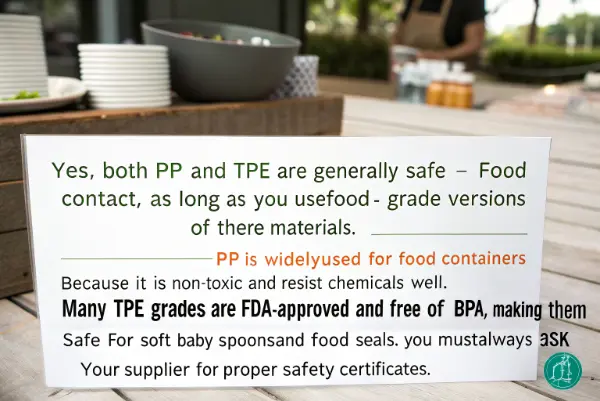
Yes, both PP and TPE are generally safe for food contact, as long as you use food-grade versions of these materials. PP is widely used for food containers because it is non-toxic and resists chemicals well. Many TPE grades are also FDA-approved and free of BPA, making them safe for soft baby spoons and food seals. You must always ask your supplier for proper safety certificates.
The Importance of Food-Grade Materials
Just because a material is called PP or TPE does not mean you can put food on it. In the factory, plastic pellets can have additives, colors, and mold release agents mixed in. Some of these extras are not safe to eat. When you design a product, you must tell the factory that you need "food-grade" material. This means the plastic meets strict rules set by groups like the FDA in the USA. Food-grade PP and TPE do not have BPA, phthalates, or heavy metals. They will not leach bad stuff into your water or food.
Cleaning and Long-Term Safety
Another big part of food safety is how you clean the product. PP is great because it has a smooth, hard surface. Food does not stick to it easily, and bacteria cannot hide in it. You can wash PP in warm soapy water without worry. TPE is soft, so it can sometimes get tiny scratches if you use a rough brush. Bacteria can hide in these scratches. So, you must design TPE parts without sharp inside corners. Make smooth curves so people can clean them easily. Overmolding TPE onto PP is a safe way to make airtight lids for lunch boxes. The TPE acts as a rubber seal to keep food fresh.
Food Safety Checklist Table
| Safety Factor | PP (Polypropylene) | TPE (Thermoplastic Elastomer) |
|---|---|---|
| BPA-Free? | Yes, naturally BPA-free | Yes, most grades are BPA-free |
| Toxicity | Very low, highly safe | Low, but depends on additives |
| FDA Approved Grades Available? | Yes, very common | Yes, easily available |
| Bacterial Resistance | High, hard surface | Medium, soft surface can scratch |
| Best Food Applications | Lunch boxes, cups, plates | Container seals, baby spoons, grips |
Conclusion
Choosing between TPE, PP, and silicone comes down to your product’s needs. PP gives you hard, safe, cheap structures. TPE gives you a soft touch that is easy to mold but has low heat limits. Silicone gives you the best heat resistance and safety but costs more. Understanding these facts will help you design better, safer, and more successful products.