
TPE, silicone and natural rubber can all be appropriate for baby products, but none is automatically “safest.” The correct choice depends on the product’s age grading, whether it is a toy or child-care article, mouthing or food contact, cleaning temperature, allergy considerations, mechanical hazards and the exact formulation.
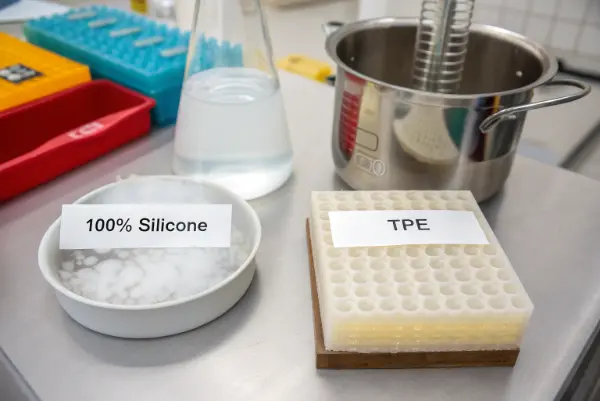
Compare the materials under the same use conditions
| Decision factor | TPE | Silicone elastomer | Natural rubber |
|---|---|---|---|
| Manufacturing | Thermoplastic molding; can support overmolding and short cycles | Often liquid or compression molding with a curing step | Compounding and vulcanization; process depends on formulation |
| Heat/cleaning | Varies widely by chemistry and grade | Many grades tolerate higher temperatures, subject to exact formulation | Heat, ozone and cleaning resistance depend on compound design |
| Softness and feel | Broad hardness range; thickness changes apparent feel | Can provide stable soft feel over a broad temperature range | Elastic feel with good resilience in suitable compounds |
| Allergy/ingredient questions | Check oils, additives, colorants and supplier declarations | Check catalyst, color and post-cure requirements | Natural-rubber latex proteins can matter for sensitized users |
| Bonding to rigid parts | Grade must match the substrate; mechanical retention may be needed | Often needs primer, compatible substrate or mechanical retention | Usually requires a specific bonding system or assembly method |
| End of life | Clean process scrap may be reprocessable; actual product recycling depends on the local stream | Generally not remelted in ordinary thermoplastic recycling | Not remelted; recovery options depend on the product and region |
These are family-level tendencies for screening. Final selection requires exact grade data and finished-product testing.
Regulatory questions come before material preference
In the United States, children’s toys and child-care articles can be subject to CPSC requirements for restricted phthalates, lead in accessible components, applicable toy rules and third-party testing. The CPSC explains that compliance is certified through a Children’s Product Certificate where applicable. A statement such as “BPA-free” or “food grade” does not replace this product-level assessment.
For feeding items or components that contact food, establish the food-contact regulatory basis for the exact formulation and use conditions. For other markets, identify the corresponding chemical and product-safety requirements before freezing the material.
Mechanical safety must be designed into the part
Material chemistry is only one part of safety. Also evaluate:
- small-part or detachment risk after bite, pull, drop and aging tests;
- tear propagation at thin lips, gates, knit lines and sharp transitions;
- bond retention on an overmolded rigid substrate;
- trapped liquid and cleanability in seams or undercuts;
- changes after boiling, dishwashing, steam or chemical cleaning;
- color transfer, odor and surface tack after aging; and
- sharp edges or rigid inserts exposed by wear.
A practical selection and validation sequence
- Classify the product. Record intended age, toy/child-care/feeding use, contact route and target markets.
- Define cleaning and abuse. Set temperatures, detergents, cycles, bite/pull loads and expected lifetime.
- Screen exact grades. Compare supplier documentation, not generic polymer labels.
- Review the design. Eliminate tear initiators, liquid traps and weak overmold boundaries.
- Mold representative samples. Use the production color, substrate and process window.
- Test the finished article. Use accredited laboratories for applicable regulatory tests and add functional aging/cleaning tests.
- Freeze controlled inputs. Specify grade, color, supplier, approved changes and traceability.
Information to include in a molding RFQ
- Product age grading and intended use
- Target countries and applicable testing plan
- Mouthing, food-contact or skin-contact conditions
- Cleaning method and maximum temperature
- Required hardness, color, texture and odor limits
- Rigid substrate and overmold bond requirement
- Annual volume, critical dimensions and acceptance tests
CKMOLD can review flexible-part geometry, overmold interfaces and tooling feasibility through DFM analysis and insert molding and overmolding. Submit the part information through request a quote; the brand owner or importer remains responsible for the applicable product-safety certification.