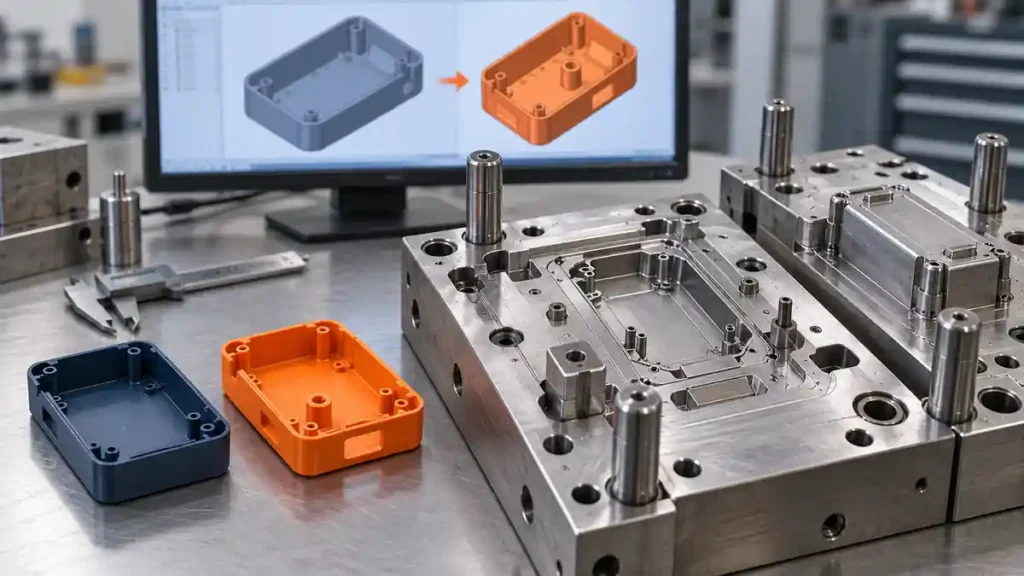
The design was approved, the tooling deposit was paid, and the mold maker began producing the mold. Then something changes. A test fails, the customer demands a new feature, or a fit problem is only discovered on the T1 samples. Now you need a different part, and the mold is already being built.
This occurs in many injection molding jobs. Design changes happen all the time, but they can cost a lot, delay the project, and may even require ordering new tooling. The feasibility of a change will depend on the tooling stage, the geometry being affected, and the type of mold being manufactured. The cost will be determined by three factors: 1) when it is requested, 2) the direction it will change the steel, and 3) how it is requested. This guide gives a description of each, allowing you to determine what a change will actually entail before you approach your supplier.
What Should I Do Immediately?
Before anyone cuts steel, follow these four steps:
- Inquire with the supplier on the real manufacturing and purchasing status: what has been designed, ordered, made or already fabricated.
- Decide what operations should be suspended and what unaffected work can be done.
- Submit CAD and drawing changes, current and proposed, with changes identified.
- Before authorizing the work, confirm the scope, cost, schedule and acceptance criteria of the modification in writing.
Why Do Product Designs Change After Tooling Starts?
Most late corrections are not necessarily a result of carelessness but rather the addition of new information. Common reasons include:
- Functional testing of prototypes or T1 samples reveals a weak boss, loose snap fit, or a warping part.
- During assembly, it is discovered that there is interference between the mating parts, the screw does not seat, or a gap is too large.
- A customer or retailer requests a new logo, texture, or color.
- A regulatory or safety review adds a rib, label area, or wall thickness requirement.
- The material changes, which can change shrinkage and affect part dimensions.
- Cost down work is the process of cutting material or combining two parts together.
All these are normal. It’s not about never making changes. Knowing the cost of each change beforehand is a good idea.
Does It Matter When the Change Happens?
Time is more important than anything else. At one time, the same change may be cheap; at another, it may be a new steel.
During DFM review. This is the time when you can change your mind for the lowest price. Nothing has been cut, machined, or made, but if something is changed, it will be updated through new CAD and a new review. CKMold’s detailed DFM analysis includes mandatory changes, advisory changes, and customer approval as the final step before releasing steel.
Following Mold Design Approval, before steel cutting. The mold design needs to be changed. The change, if it impacts the parting line, gate, or cooling layout, means real redesign time and paying engineering hours, not scrap steel.
After steel cutting. The change must now be made to existing cavity and core steel, which requires machining. It can be a quick re-cut, a weld repair, a new insert, or a new cavity.
After T1 samples. Changes here are common, as this is where one usually gets a real part for the first time. The mold is tweaked, re-trialed, and re-sampled, then approved.
After production approval. In addition to the tooling effort, the change now impacts approved samples and inspection records and may even impact the customer’s change control. The inventory of the old version has to be taken care of as well.
Does the Mold Actually Need to Be Modified?
Not all issues discovered on a part are addressed by steel cutting. First of all, you need to determine which situation you are in:
- A new customer requirement. The part is correct for the current drawing, but the design has been modified. This is a real design alteration.
- A uniform deviation in size. The same feature is out of tolerance on each shot. This frequently indicates the mold.
- Unstable molding results. The dimensions or appearance will vary from one shot to another. This is typically the process or material or machine and is not a mold geometry.
- An assembly or functional problem even though the dimensions are correct according to the drawing. The drawing or tolerance stack might be the wrong one, not necessarily the tool.
The team should review the following documents prior to cutting steel: approved drawing revision, measurement method, material lot and grade, molding conditions. A change of mold geometry will not automatically solve an unstable process and could leave you with the same problem, but with a different mold.
What Does "Steel-Safe" Mean, and Why Does It Matter?
A steel-safe change is one the toolmaker makes by removing steel from the mold. It is relatively easy to remove metal; the area is machined or EDM burned deeper. Adding metal is generally more difficult and may require welding or replacement of a mold component. because it is typically welding or replacement of a part of the tool.
The part is the inverse of the mold. The toolmaker removes steel from the mold where more plastic is needed. Where you want less plastic, steel has to be added. So:
- Generally, the thicker the wall, the taller the rib or the larger the boss, the more likely the change is steel-safe.
- Reducing the hole size is steel-safe, as the core pin can be reduced.
- Making the wall thinner or the rib shorter is not steel-safe. More often than not the larger hole will not be either, although if the hole is created by a removable core pin, it may be possible to replace the pin, subject to the surrounding tooling. It does not necessarily require welding or a major rebuild.
Steel-safe does not automatically mean simple or suitable. A thicker wall or taller rib may allow steel removal, but the steel remaining thickness, nearby cooling channels, ejection, sink marks, and the cooling performance still need to be reviewed.
This is part of the design planning for the experienced designer. For selected features that are likely to change, they begin with a version that provides a little more room for cutting, e.g. a rib that is a little thinner or a hole that is a little larger, and make adjustments after getting some initial samples. This is a choice for specific features, not a rule for every rib and hole on the part. Protolabs’ steel-safe design guidance describes the same principle.
What Do Common Design Changes Mean for the Mold?
| Design change | Steel-safe? | Typical tool work |
|---|---|---|
| Thicker wall or taller rib | Usually | Re-machine or EDM cavity/core; check remaining steel, cooling channels, ejection and sink marks |
| Thinner wall or shorter rib | No | Weld and re-cut, or replace insert |
| Smaller hole | Yes | Modify or replace core pin |
| Larger hole | Depends | Replace a removable core pin if the surrounding tooling allows; otherwise weld, re-cut, or new pin and pocket |
| New or moved logo/text | Depends | Raised text on part is easy; recessed text needs added steel. Moving a logo also means removing or filling the old marking |
| New texture or polish | Depends | Re-texture or re-polish affected surfaces; depends on draft, dimensional allowance, access and appearance requirements |
| New undercut or snap | Rarely | May need a slide or lifter, if the mold has room |
| Gate location change | Depends | Re-machine runner and gate; may affect cosmetics |
| Different resin (shrink rate) | Depends | Review exact grade, reinforcement, shrinkage behavior, processing conditions and tooling compatibility |
A material change needs special attention. The actual grade, glass or mineral reinforcement, shrinkage characteristics, processing conditions all must be reviewed as well as checking whether or not the mold is compatible with the new resin. Shrinkage is not necessarily consistent, causing some dimensions to shift more than others, and it’s difficult to predict without doing trial parts.
How Is an Existing Mold Modified?
There are a few techniques, and typically they are used in concert by the toolmakers:
- Re-machining or EDM. Used for steel-safe changes. It’s fast, with low risk to the surrounding steel.
- Welding. Applies metal to allow the area to be re-cut. It does work, but it has dangers. On textured or high-polish surfaces, weld areas can appear, as well as changes in the hardness of steel in the vicinity of the heat. The result depends on the steel grade, its heat-treatment condition, a compatible filler metal, and any required preheating or post-weld treatment, as Uddeholm’s tool steel welding guidance explains.
- Insert replacement. When the feature is separated from the rest of the cavity block, a new insert can be created without modifying the existing block. This is why a good mold design will incorporate features that are likely to change into inserts.
- Adding actions. Frequently, a new undercut requires a slide or lifter. It is possible or not, depending on available space, cooling lines, and ejection already built into the tool.
- New cavity or new mold. Rebuilding is often cleaner than patching when the change affects too much geometry.
The process of mold repair and modification with the mold maker CKMold is the same for each request: reading the drawings, samples and checking the condition of the mold, documenting the method and dimensional impact for approval, and verifying the result by re-trial and inspection. The modification is not complete until the revised parts have passed the agreed trials and inspections.
Don’t forget multi cavity tools either. When you change a four-cavity mold, you need to make it and then check it four times.
Should You Modify the Mold or Build a New One?
While it’s typically quicker and cheaper, it isn’t always the right option. When a new tool or new cavity inserts are more appropriate:
- Most of the part geometry is affected by the change.
- Multiple changes that aren’t steel-safe pile up in the same region.
- Several times the mold has been welded already in that area.
- A new resin alters the shrinkage throughout the entire part.
- The tool is near the end of its service life anyway.
The right choice depends on dimensional and cosmetic requirements, the remaining steel, cooling and ejection constraints, the tool’s condition, how much downtime you can accept, and future maintenance:
| Option | Usually suits | Watch for |
|---|---|---|
| Re-machining | Steel-safe changes with enough steel left | Thin remaining steel, cooling lines, sink |
| Welding and re-cut | Small, local non-steel-safe changes | Steel grade, heat treatment, cosmetic surfaces |
| Replacement insert | Features already in an insert, or likely to change again | Insert fit, shut-offs, lead time for steel |
| New cavity | Major changes in one cavity of a sound mold | Matching the other cavities |
| New mold | Large geometry changes or a worn tool | Full cost and lead time |
Also decide whether you still need the old version. If both revisions must stay available, interchangeable inserts or separate tooling may be better than permanently modifying the original mold.
A good supplier will give the reasons for recommending one route over the other and not just to offer the larger job.
How Much Will a Design Change Cost, and Who Pays?
The cost will vary based on the volume of steel to be treated, the method (re-cut steel, weld, insert, or new steel), the number of cavities, surface finish standards, and the number of re-trials. Costs also may be incurred before the steel cutting is done when mold steel and/or inserts and/or custom items like hot-runner parts are already ordered.
When comparing quotations, look for each to identify:
- The affected part, revisions, mold parts and cavities.
- Engineering and mold-design updates.
- Steel, inserts, pins or hot runner parts to replace.
- Machining, welding, heat treatment and surface restoration.
- Trial runs, material, sample quantities, inspection and shipping
- Any Production Cycle Time or Part Price Impact
- What work is included, and how additional changes will be handled.
Whose responsibility it is tends to depend on why the change is taking place:
- Normally, a change that is requested by the customer (e.g., new feature, dimension, or material change) will be quoted and charged as an extra job.
- Corrections needed to meet the approved drawing are typically paid for by the mold maker, since the mold was designed using the drawing.
The gray area is when the approved design was a problem, for example, a part that matches the drawing but warps in use. That’s why the DFM record is important: it documents what was identified, what was deemed a risk, and who approved it. Responsibility should follow the cause, the approved scope, and the project agreement, not simply when the issue was discovered. You should also discuss with your agreement how change costs will fit into the agreement for the mold project so there is no delay of the next milestone.
How Does a Design Change Affect Lead Time?
Each change adds three things: engineering review and quotation, the tool work itself and a re-trial with new samples for approval. How long each step takes depends on the change, the method, and whether new steel or components must be ordered. Changes which occur after the approval may also require updated inspection reports to be obtained prior to recommencing production.
When you ask for a schedule, ask for three separate dates: when the modification will be complete, when samples and inspection reports will be available, and when production can resume after your approval. Request a new schedule with your quote, in writing.
What Is the Right Way to Request a Design Change?
The majority of problems are due to informal changes. The instruction "make the hole 0.5mm bigger" isn’t adequate. An engineering change notice (ECN) should contain:
- Current and proposed 3D CAD and 2D drawings with a new revision letter.
- The modified features were easily identifiable, and old and new dimensions easily distinguished.
- The reason for the change, which assists the toolmaker to select the safest process.
- Which cavity/versions are involved.
- The consent of the quoted cost and schedule prior to work.
- A sample re-sampling plan, and how previous approved samples will be clearly identified, removed from current production reference locations, and retained or disposed of under the agreed retention requirements.
All mold design deliverables are maintained in a revision control system, and everyone is working on the same revision; also everyone knows what changes have been made to the deliverables.
How Are Revised Parts Validated and Released?
Once it has been modified, inspection should be conducted on the modified features and on any other characteristics the change may impact on. This may include assembly, sealing, snap fit, appearance, warpage, ejection and results from each cavity.
Document and record material, conditions of the trial, drawing revision, and sample identification; revise FAI / PPAP as required by the customer.
Next, decide on the revision cutover:
- The new revision is valid as of this batch or date.
- The treatment of old stock and work in progress
- Updated inspection documents
- Permission to make and send the new revision.
How Can You Reduce the Risk of Late Design Changes?
It isn’t possible to get rid of all the changes, but it’s possible to get smaller and cheaper changes:
- Complete DFM prior to steel release. Address wall thickness, draft, ribs and gate location all within the lines of CAD.
- If the design is not sure, prototype first. Prototype injection molding provides you with actual molded parts to experiment with before making a production steel.
- Design for steel safety where changes are likely to occur. For selected features, start with a little room to cut, and then fine-tune.
- Insert features that are not certain into inserts so that they can be swapped out without reworking the main tool.
- Do not use moldflow as a box-ticking exercise, only do so when warpage and/or filling is a serious possibility.
- Establish a design freeze before steel is released and go through an ECN from that point on.
- Think of T1 as a test and not a finish line. It helps to distinguish between tool and design issues by establishing mold testing and validation targets at each trial.
Example: How a Design Change Might Be Handled (Illustrative)
This is an illustrative example, not a specific CKMold project.
Two cavity housings pass dimensional inspection at T1 but are too tight to assemble in snap fit. The team verifies that the samples are from the same drawing revision and that the results are the same in both the cavities and with stable process conditions, which indicates the problem is a design requirement, not process variation. The customer makes changes to the drawing to lower the snap hook height, which means more steel needs to be added.
We considered re-cutting the hook region in both cavities and welding, as well as inserting new parts. The hook is positioned beside a textured cosmetic surface so that the inserts are selected to minimize weld marks. The T2 samples from each cavity are measured, assembled, and snap tested after the change, and the FAI is updated to the new revision, after which production of the new revision begins from an agreed batch.
Frequently Asked Questions
Can I keep producing parts while the mold is being modified?
Usually not from the same mold. The tool has to come out of the press for machining, welding, or insert work. In case parts are required during the change, stock up on parts in advance, as long as the old revision is still approved for use, or determine if a temporary insert or bridge is appropriate.
Will the weld repair impact the appearance of my part?
It can. If the surfaces are low- or high polish, or textured, a welded area may appear slightly different in shine or texture after re-cutting. If it is a cosmetic surface, communicate this to your supplier before the method is selected, as an insert might achieve a cleaner surface.
Can a change be made to just one cavity?
Yes, but the cavities would make different components. In most projects, each cavity is modified and verified to ensure that parts remain the same.
Is the life of the mold affected by changing the design?
A simple re-cut generally has little effect. Repeated welding in the same area, or thin steel left after a change, can weaken that section over time. Ask your supplier whether tool life will be impacted.
If there is a change, do I need to get new approval on samples?
Yes. The re-sample and re-check of modified features should be done with respect to the new revision of the drawing. New first article and/or PPAP documents may also be needed, depending on industry.
How CKMold Handles Design Changes
CKMold assesses manufacturability at the point of RFQ and carries out a thorough DFM, which is approved by the customer before the release of steel. Then the mold design is evolved through controlled approval gates. If a change is made thereafter, then the change, the method, and the dimensional effect are reviewed and approved before any machining is done, and the work is confirmed with a re-trial.
If your design has changed, or if you think it may change, send the engineering team both drawing revisions (current and proposed) with the changes marked, the material grade, the mold identification, the current tooling stage, and your required timing. You can reach them at jerry@ckmold.com or via the request a quote page so they can review the changes to see how it will affect the product before any is cut.