
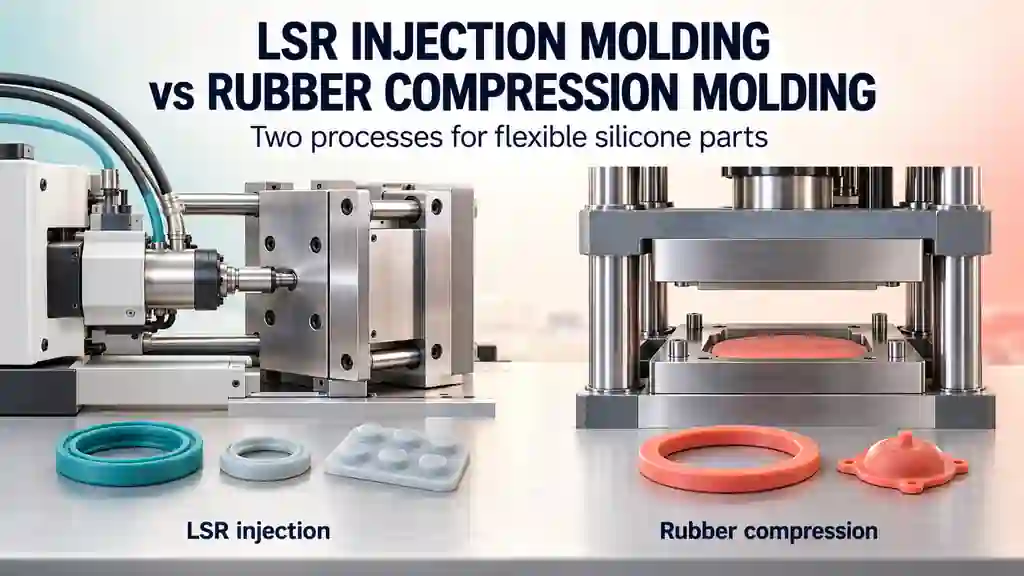
There is more than one way that silicone can be used for seals, gaskets, keypads, valves, and soft-touch parts. There are two predominant methods, namely liquid silicone rubber (LSR) injection molding and rubber compression molding. They both generate flexible, durable elastomer components but vary in material, tooling, speed, precision, and cost.
Selecting an incorrect process can result in the cost of an unnecessary mold or the problems of flash, slow cycles, and parts variation as volumes increase. In this guide, the two are compared side by side, the role of transfer molding is explained, and a practical approach is provided to determine which best fits your part!
What Is LSR Injection Molding?
Liquid Silicone Rubber is a two-part, platinum-cured silicone provided in low-viscosity liquid form. The two components are pumped from drums, metered in a fixed ratio, mixed in a static mixer, and injected into a closed, heated mold, a technique known as liquid injection molding (LSR injection molding). The material cures in the hot mold, and the part is ejected, sometimes automatically.
Due to its liquid nature, it enters thin walls and fine details, while the closed system maintains low levels of contamination.
The cold runner or valve gate process employed in LSR molding helps to minimize waste, as it allows material to be held in the runner to remain uncured. The downside is that it is more expensive, especially for the initial investment. These are the things that need to be controlled with LSR mold: a tight fit at the parts interface, careful temperature control, precision venting, etc., since the liquid can flash through very small gaps.
What Is Rubber Compression Molding?
Compression molding is one of the oldest processes used to mold rubber. A preform (or charge) is a preformed portion of uncured material that is inserted into an open heated mold cavity. The press closes, the material is pressed into the cavity, and the rubber will cure. The mold then separates, and the part is ejected, typically manually.
Compression molding is suitable for solid materials such as high consistency silicone rubber (HCR, also called HTV) and organic rubber like EPDM, nitrile (NBR), fluoroelastomer (FKM), neoprene, and natural rubber. The tooling is simpler and cheaper, but a slower, more manual process, and additional material is wasted as flash, which must be cut off.
LSR vs. Compression Molding: Side-by-Side Comparison
| Factor | LSR injection molding | Rubber compression molding |
|---|---|---|
| Material form | Two-part liquid silicone | Solid preform (HCR silicone or organic rubber) |
| Material choice | Silicone (LSR grades) only | Silicone and organic rubbers such as EPDM, NBR, FKM, natural rubber |
| Cure system | Platinum (addition) cure | Peroxide or platinum cure for HCR; varies for other rubbers |
| Tooling cost | Typically higher | Typically lower |
| Tooling lead time | Typically longer | Typically shorter |
| Cycle time | Typically short | Typically longer |
| Automation | High; closed, automated process | Mostly manual loading and unloading |
| Flash and trimming | Minimal with well-built tooling | Flash is common; trimming usually needed |
| Dimensional consistency | Typically high, shot to shot | More dependent on the operator and preform weight |
| Thin walls and fine detail | Strong | Limited |
| Overmolding / insert molding | Common; material pair and bond must be validated | Possible, e.g., with metal inserts |
| Two-shot molding | Possible with automated two-shot tooling | Rare |
| Post-cure | Depends on grade and end use | Often needed for peroxide-cured parts |
| Best-fit volume | Typically medium to very high; also used for prototypes and low volumes | Typically prototypes, low to medium |
Note: These are typical trends. Actual cost, lead time, cycle time, precision, and suitable volume depend on the part, material grade, cavity count, tooling design, automation, and supplier capability.
How Do the Processes Compare on Cost?
The first place most buyers begin is the cost, and the answer is based on volume.
Tooling. The compression mold is a relatively simple mold with a cavity, a core, and a flash overflow area, which may not have runners or complex gating. LSR molds are much more sophisticated, featuring cold runner or valve gates, exact venting, heating control, and tight shut-offs. This typically makes LSR tooling more expensive and time consuming to make.
Per-part cost. LSR cycle time is short, molds can be used to a large degree of cavities, and little labor is required for the entire process. Compression cycles are longer, loading and demolding is frequently manual, and parts might require trimming and post-curing. This results in a higher cost per part for compression molding as production volume increases.
Material cost. LSR material is in general more expensive than HCR or common organic rubbers in kg. Preform offcuts and flash, however, do not contribute to LSR waste since there is little flash and no preform offcuts, which helps to close the gap.
The crossover point. There is no standard volume at which LSR becomes cheaper. It relies on factors such as part size, the number of cavities, material grade, and quality specifications. The sure-fire method to do this is to compare total cost (tooling plus parts plus finishing) at a number of reasonable annual volumes: namely, your launch volume and your projected volume for years two and three.
Which Process Gives Better Quality and Precision?
Tolerances. Due to the metered closed process, parts produced using LSR are more repeatable with tighter tolerances due to the very consistent weights of shots produced. Compression molding relies more on the weight of the preform, placement, and handling of the operator, and dimensions fluctuate more from cycle to cycle and from cavity to cavity.
Flash. With compression molding, extra material is needed to fill the cavity completely, and it is lost at the parting line as flash. This is typically eliminated by trimming, deflashing through exposure to cold temperatures, or tumbling. With the right tooling work, LSR molds can produce parts that need no secondary deflashing, but the achievable flash limit should be agreed and verified for each part, as the liquid silicone will take any opening it can.
Complex features. LSR can be easily filled into thin structures, sharp details, micro features, and complex 3D shapes. Compression molding is suitable for simpler shapes, thicker sections, and parts that can have a visible parting line.
Cleanliness. LSR is processed in a closed system, with minimal handling, to facilitate clean production of parts for medical and food contact applications. There is a greater amount of open handling with compression molding, and the risk of contamination is increased, requiring stricter practices.
How Do the Materials Differ?
The choice between LSR and compression molding is really a choice of material.
LSR (liquid silicone rubber). Low viscosity silicone, available in a wide hardness range, in medical, food contact, optical, self-lubricating, and self-adhesive grades, cured with platinum. Silicone, in general, is recognized for having a broad service temperature range, excellent weathering resistance, UV resistance, and long-term flexibility. Post-curing requirements depend on the material grade, target properties, and end-use requirements. Platinum-cured LSR does not automatically eliminate the need for post-curing.
HCR (high-consistency rubber). Solid silicone, peroxide- or platinum-cured, compression or transfer molded, and gum-like. It has comparable general silicone characteristics, but peroxide-cured parts typically require a post-cure in an oven to remove byproducts.
Organic rubbers. The EPDM, NBR, FKM, neoprene, and natural rubber cannot be processed as LSR. For parts that require oil and fuel resistance (e.g., NBR or FKM), low-cost outdoor and water resistance (e.g., EPDM), or high resilience (e.g., natural rubber), compression or transfer molding may be a practical option. Some organic rubbers can also be injection molded.
See our guides on TPE vs. silicone and rubber vs. TPU for an in-depth understanding of elastomer selection.
What About Medical and Food-Contact Parts?
Both can be used for the production of medical and food contact parts, but both are different in their approach to the requirements.
- Requirements depend on the product, application, and market. Examples include FDA 21 CFR 177.2600 (rubber articles in repeated food contact), USP Class VI, ISO 10993 (medical biocompatibility), and NSF standards for drinking-water parts. These standards are not interchangeable or universal. For medical devices, material data alone does not establish biocompatibility; the final device and its manufacturing and sterilization conditions, if applicable, also matter.
- LSR’s closed processing, low flash, and repeatability make it suitable for high-volume, high precision medical and baby-care parts like valves, seals, nipples, and respiratory parts. Note that 21 CFR 177.2600 excludes rubber nursing-bottle nipples, so their compliance must be confirmed separately.
- Compression molding: For larger, simpler, or smaller volume medical parts, compression molding continues to be used when the process can be validated and controlled.
- The post-cure and cleaning are important for the peroxide-cured rubber since by-products and trimmed edges need to be handled.
Where Does Transfer Molding Fit?
The transfer molding process falls somewhere between the two. Uncured rubber is put into a pot, or chamber, above the mold, and is forced through runners into a closed cavity by a plunger. It offers better flash control and consistent filling and is suitable for parts incorporating metal inserts than compression molding. The tooling is typically simpler than LSR, but it is not as automated or fast.
Transfer molding is a possibility to consider if your part requires better consistency than compression molding can provide but uses an organic rubber or HCR.
When Should You Choose LSR Injection Molding?
For the most part, LSR will be a better option when:
- Volumes are medium to high; high tooling cost is distributed over many parts.
- Precision and consistency are important, such as with sealing surfaces, valves, and fitted components.
- The part’s walls are too thin or the details too fine to fill reliably with solid rubber.
- Parts that require over molding or 2-shot molding (like silicone bonded to a plastic housing). Bonding depends on the silicone and substrate grades, substrate preparation, cure conditions, and chemical adhesion or mechanical interlocking, so the combination should be validated for the application.
- The same holds true for clean processing, as in medical, baby-care, and food-contact components.
- Avoid the need for trimming to reduce labor and handling; post-curing needs depend on the material grade and end use.
When Should You Choose Compression Molding?
Compression molding is typically the preferred option when:
- Volume is either low or uncertain, or other prototypes are required to make a decision to build tooling, although LSR can also be used for prototypes and low-volume work.
- The cost of the tool is more important than the cost of parts, or a short tool lead time matters more.
- The part is large or thick walled like large gaskets, pads, or mats.
- The material isn’t silicone, for example, EPDM, NBR, FKM, or natural rubber.
- Simple design, with a visible parting line or cut edge, is OK.
- Part is a mature product that has already been compression molded.
Design Tips for Molded Elastomer Parts
Regardless of which process selected, a few design considerations make molding easier:
- To prevent sinking and uneven curing, maintain as balanced a thickness as possible at the walls.
- Avoid flash or witness lines by planning the parting line early, particularly on sealing surfaces.
- Avoid sharp corners; favor large radii for increased flow and tear resistance.
- Check undercuts with your molder. Small undercuts are easily stretched in elastomers, but large undercuts may require special tooling.
- Indicate clearly on the drawing the hardness (Shore A), grade, and compliance requirements.
- Determine the cosmetics and flash limits before the tool is made to ensure trimming expectations are understood.
By performing a DFM analysis before tooling, these problems can be caught in time to change them.
How to Decide: A Quick Checklist
- Should the part be made of silicone only, or should it be made of an organic rubber?
- What are your current and your two- to three year projected annual volumes?
- How tight are the tolerances, and how important is the absence of flash?
- Is the part thin walled, fine features or a plastic insert?
- Do there exist medical, food contact, or clean room needs?
- How much can you spend on the tooling, and how much time can you wait until it’s built?
If a lot of responses indicate high volume, silicone, precision, and overmolding, LSR is likely the way to go. When they refer to low volume, organic rubber, large or simple parts, and a limited budget, compression molding is probably the more suitable option.
Frequently Asked Questions
Can a compression mold be used for LSR?
Usually not. An existing compression tool is not usually a direct drop-in replacement for LSR injection; its feed system, shut-offs, venting, and cure-temperature control must be assessed for the specific LSR process.
Is LSR always more expensive than compression molding?
Not overall. The cost of LSR tooling is higher, but when it comes to medium to high volumes, the shorter cycle, level of automation, and lower trimming cost can result in lower overall cost.
Does compression molding always produce flash?
In most cases, some flash forms as additional material are required to fill the cavity. It is regulated by the mold design and preform weight and is taken off by trimming, tumbling, or cryogenic deflashing.
Can LSR replace EPDM or NBR rubber parts?
Sometimes. The temperature range, weathering resistance and other properties of LSR are comparable or superior to many organic rubbers; it may not equal NBR or FKM for resistances to oil and fuel. The material needs to be selected for the environment in which it’s going to operate first.
Is TPE an alternative to both?
Yes, for some parts. TPE is injection molded using conventional thermoplastic injection molding equipment, and can be overmolded onto plastic, but heat resistance and compression set vary across TPE families and grades, so they should be checked for the selected grade and service conditions. Learn about the pros and cons in our TPE vs. silicone article.
Getting the Right Process for Your Elastomer Part
The decision on which type of molding to use, LSR vs. compression molding, is dependent upon material, volume, precision, and budget. When comparing total costs—and not just tooling costs—at realistic volumes, the answer is frequently obvious.
Prior to tooling, CKMold will collaborate with your OEM and engineering team to select material, DFM, and develop the mold for flexible and overmolded parts while offering the option to compare elastomer choices and evaluate TPE alternatives.
For discussion of your part, please provide your CADs, material specifications, anticipated annual quantities, and compliance requirements to the request a quote page or to jerry@ckmold.com.