

Feeling overwhelmed by the complexities of ABS injection molding? You’re not alone. Getting it right, from picking the material to the final part, is a challenge. But what if there was a clearer path?
Advanced ABS injection molding is not about making ABS sound exotic. It is about controlling a familiar material well enough to meet cosmetic, dimensional, finishing and production requirements with fewer surprises.
Related CKMOLD resources: injection mold services, DFM analysis, mold design, insert molding and overmolding, and mold testing and validation.
Our advanced approach at CKMOLD ensures success by meticulously managing every stage: precisely selecting the right ABS grade for your application, fine-tuning the molding process for optimal efficiency and part integrity, designing robust molds for longevity and quality, and implementing rigorous quality control to meet your exact specifications.
So, you’re looking for top-notch ABS parts, the buyer, and you want to know how we at CKMOLD make sure that happens consistently. It’s a fair question! In my journey, from starting on the factory floor to building CKMOLD and helping businesses like yours grow, I’ve learned that “advanced” isn’t just about fancy machines. It’s about a deep understanding, a systematic approach, and honestly, a bit of an obsession with getting things just right. It’s about mastering molding, as our slogan says. We’re not just pushing plastic; we’re engineering solutions. This isn’t just theory; this is how we operate day in, day out.
How Does CKMOLD Nail ABS Material Selection for Your Specific Needs?
Decoding the World of ABS Grades
There’s general-purpose ABS, which is great for a lot of applications. Then you have high-impact ABS for parts that might take a beating. Heat-resistant ABS for components near motors or electronics. Flame-retardant ABS, which is critical for safety in many consumer electronics or automotive parts – something you might deal with a lot, the buyer. And let’s not forget plating grades if you need a shiny chrome finish, or even medical grades with specific biocompatibility requirements. Each has its own unique blend of Acrylonitrile, Butadiene, and Styrene, giving it different properties.
Matching Material to Mission: It’s All About the Application
Additives, Fillers, and the Finishing Touches
Sometimes, virgin ABS is suitable. Other times, we might discuss additives. Colorants are obvious, but what about UV stabilizers if the part is going to be outdoors? Or antistatic agents? Sometimes, fillers like glass fibers are added to ABS to boost stiffness and strength, though this changes its molding characteristics and surface finish. We present these options when they make sense for your application, explaining the pros, cons, and cost implications. Our goal is to empower you to make the best, most informed decision for your product. It’s not just about selling you plastic; it’s about providing a solution that works reliably in the long run.
What’s Our Secret to Optimizing the ABS Injection Molding Process for Peak Performance?
Are you battling inconsistent part quality, long cycle times, or high scrap rates with your ABS parts? These issues often stem from a poorly optimized molding process.CKMOLD’s secret to process optimization involves a scientific approach: meticulously controlling key parameters like melt/mold temperature, injection speeds/pressures, and cooling times, ensuring thorough ABS drying, and applying principles of decoupled or scientific molding to achieve a stable, repeatable process that minimizes defects.
Optimizing the injection molding process for ABS – this is where the real craft comes in, mixed with a healthy dose of science. It’s not just about loading pellets and hitting ‘start.’ I’ve spent countless hours on factory floors, tweaking parameters, observing results, and learning what makes a process sing. For your business, the buyer, a stable, optimized process means consistent quality, lower scrap, and better throughput – all good for the bottom line.
The Critical Variables: A Delicate Dance
There are several key players in the ABS molding game:
- Melt Temperature: ABS needs to be hot enough to flow easily but not so hot that it degrades. Different grades have different ideal melt temperature ranges. Too cold, you get short shots or poor weld lines. Too hot, you risk burning, splay, or reduced mechanical properties.
- Mold Temperature: This is super critical for ABS. It affects surface finish, shrinkage, warpage, and internal stresses. ABS generally likes a warm mold, typically between 40°C to 85°C (104°F to 185°F), depending on the grade and part geometry. Consistent mold temperature is key.
- Injection Speed & Pressure: How fast and with how much force the molten ABS is pushed into the mold. This affects fill pattern, gate blush, and potential for flash. We often use profiled injection speeds – starting slow, then speeding up.
- Holding Pressure & Time (Pack & Hold): After the mold is filled, pressure is maintained to pack out the part and compensate for shrinkage as the plastic cools. Getting this right is crucial for dimensional stability and avoiding sink marks.
- Cooling Time: As we discussed before, this is often the biggest part of the cycle. It needs to be long enough for the part to solidify and be stable for ejection, but not excessively long.
And one absolute non-negotiable for ABS: DRYING! ABS is hygroscopic, meaning it absorbs moisture from the air. If you try to mold undried or poorly dried ABS, you’ll get splay marks, silver streaks, and brittle parts. We ensure ABS is dried to the manufacturer’s recommendations, typically for 2-4 hours at around 80-90°C (176-194°F).Beyond Basic Settings: Embracing Scientific Molding
Why is CKMOLD’s Mold Design So Crucial for consistent ABS Parts?
Ever experienced production nightmares caused by a poorly designed mold? From parts sticking to excessive flash or short shots, a bad mold is a constant headache and money pit. Discover why superior mold design is non-negotiable for us.
CKMOLD’s mold design is crucial because it directly impacts part quality, production efficiency, and material usage for ABS. We focus on optimal gate/runner systems, effective cooling for minimal warpage, robust venting to prevent defects, and overall DFM to ensure your ABS parts are consistent and cost-effective to produce.
Ah, mold design – this is truly where the magic begins for successful ABS injection molding. As someone who founded CKMOLD with a passion for making great molds, I can tell you that the mold is the heart of the operation. A well-designed and well-built mold isn’t an expense; it’s an investment that pays you back over and over again with good parts, efficient cycles, and less scrap. For your business, the buyer, getting the mold right means fewer headaches and better products.
DFM: Designing Parts and Molds in Harmony
Gates, Runners, and Venting: The Pathways to Perfection
- Gating: The type and location of the gate (where plastic enters the cavity) are critical for ABS. We choose gates (e.g., tab, pin, sub, valve gates) to ensure smooth filling, minimize cosmetic issues like gate blush or jetting, and allow for easy degating. The gate also influences weld line location and strength.
- Runner Systems: For ABS, both cold and hot runner systems are used. Cold runners are simpler and cheaper upfront, but generate scrap (which hopefully gets recycled). Hot runners eliminate runner scrap, which is great for material cost and sustainability, especially with more expensive ABS grades. They can also offer better process control and faster cycles. We help you weigh the pros and cons for your specific part volume and material.
- Venting: Molten ABS displaces air in the mold cavity. If that air can’t escape efficiently through vents, you get trapped gas, leading to short shots, burn marks, or poor surface finish. Proper venting is subtle but absolutely essential, especially with faster-filling ABS.
Cooling and Construction: The Foundations of Quality
How Do We Ensure Every ABS Part Meets Your Exacting Quality Standards?
Are you tired of receiving inconsistent ABS parts, leading to assembly problems or customer complaints? This variability can be a nightmare. See how a systematic quality approach ensures every part is a good part.
We ensure every ABS part meets your standards through a multi-layered quality system: rigorous First Article Inspection, continuous in-process checks (dimensional and visual), advanced metrology, Statistical Process Control (SPC) to monitor consistency, and full traceability from raw material to final shipment.
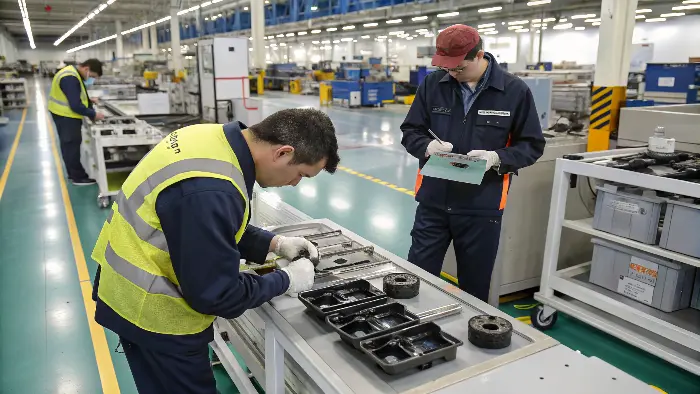
Quality control – for us at CKMOLD, this isn’t just a final inspection step; it’s a philosophy woven into every stage of the ABS molding process. We know that for you, the buyer, inconsistent parts can mean stalled assembly lines, product failures, and unhappy customers. That’s why our approach is about building quality in, not just trying to inspect defects out. “Master Molding Right” means getting it right every time.
Starting Strong: First Article Inspection (FAI)
Before we even think about full production, we conduct a thorough First Article Inspection. This involves molding a small batch of parts and meticulously checking them against your specifications – every dimension, every feature, every cosmetic requirement. We provide you with an FAI report, often with sample parts, for your approval. This ensures we’re all on the same page and that the mold and process are capable of producing what you need. I generally say, a good FAI prevents a lot of pain down the road!
Keeping an Eye on Things: In-Process Quality Checks
Once production is rolling, we don’t just set it and forget it. Our operators and quality team perform regular in-process checks. This includes:
- Visual Inspections: Looking for any cosmetic defects like splay, sink marks, flash, short shots, burn marks, or color variations.
- Dimensional Checks: Using calipers, micrometers, height gauges, and sometimes more advanced equipment like CMMs (Coordinate Measuring Machines) or optical scanners to verify critical dimensions at set frequencies.
We often establish control plans that define what to check, how often, and what the acceptable limits are.The Power of Data: Statistical Process Control (SPC)
For critical dimensions or process parameters, we often use Statistical Process Control. This involves tracking data over time to see if the process is stable and capable. SPC charts can help us detect trends or shifts in the process before they result in out-of-spec parts. It’s a proactive way to maintain consistency. It might sound a bit technical, but the peace of mind it brings is huge. It’s about knowing, not guessing, that your parts are good.
Traceability and Continuous Improvement
DFM Before Tooling Commitment
CKMOLD reviews wall thickness, ribs, bosses, gate location, cosmetic zones, snap fits and assembly loads before the mold is built. This helps identify sink, warpage, stress whitening and visible gate risks early, when changes are cheaper.
Grade Selection Based on Real Use
ABS grade selection affects impact, heat resistance, flow, gloss, plating, painting and flame rating. CKMOLD helps customers avoid treating ABS as one material. The chosen grade should support both the product function and the planned finishing process.
Mold Design for Stable ABS Production
For ABS parts, gates, runners, vents, cooling and ejection must work together. A mold that fills easily but creates sink or ejector marks is not production-ready. CKMOLD designs around quality targets, not only cavity shape.
Trial, Correction and Handover
Mold trials confirm dimensions, appearance, part weight, cycle stability and defect risks. For export tools, documentation is especially important because the customer’s production team needs a clear process baseline after the mold ships.
CKMOLD’s Advanced ABS Injection Molding Approach: Buyer Review Checklist
- Review ABS grade and finishing route before final mold design.
- Identify cosmetic and functional features separately.
- Validate gate, cooling and ejection decisions during mold trial.
- Use part weight and dimensional reports to confirm process stability.
- Prepare export mold records for future production support.
FAQ
What makes CKMOLD’s ABS molding approach advanced?
The approach combines DFM, grade selection, mold design, process validation and quality feedback instead of treating ABS as a simple commodity resin.
Can CKMOLD support cosmetic ABS parts?
Yes. Cosmetic ABS parts can be supported with proper surface planning, gate strategy, material selection and trial validation.
Conclusion
At CKMOLD, our advanced ABS approach means a deep dive into material science, precise process control, intelligent mold design, and unwavering quality assurance. This isn’t just talk; it’s our commitment to delivering you, the buyer, the best possible ABS parts, every single time.