Eco-Friendly Plastics Guide: Comparing Recyclability and Environmental Impact?

Are you struggling to choose the right eco-friendly plastic for your next project? Clients want green products, but picking the wrong material can ruin your design or spike production costs. In this guide, I will show you how to compare recyclability and environmental impact so you can make smart, sustainable choices.

Eco-friendly plastics include recyclable thermoplastics like PET and HDPE, and biodegradable options like PLA. To compare their environmental impact, you must look at their lifecycle, from raw material sourcing to end-of-life disposal. Recyclable plastics reduce landfill waste but require energy to melt and mold again. Bioplastics break down naturally but often need specific composting conditions. Choosing the right material means balancing mechanical needs, recycling rates, and carbon footprint for your specific product.

Finding the perfect balance between a strong part and a green footprint can feel like walking a tightrope. Let us dive into the details so you can design better, greener products without losing your mind.

What Are the Most Common Recyclable Plastics in Injection Molding?

Do you feel confused by the endless list of plastic recycling codes? Using unrecyclable resins can hurt your brand’s green image and upset eco-conscious clients. Let us look at the best recyclable plastics you can use in your daily mold designs.

The most common recyclable plastics used in injection molding are PET, HDPE, and Polypropylene (PP). PET is widely recycled and great for clear parts. HDPE offers high impact strength and chemical resistance. PP is flexible and perfect for living hinges. These materials have established global recycling streams, making them the safest choices for sustainable product design.

When I first started working in the mold factory, we rarely thought about what happened to a plastic part after it broke. Today, as designers like you know, the end-of-life plan is just as important as the wall thickness. Let us break down the big three common materials.

The Big Three Recyclables

Polypropylene (PP) is my absolute favorite for everyday items. It is tough, it handles heat well, and it is easy to mold. However, recycling PP can sometimes weaken its structure. High-Density Polyethylene (HDPE) is another workhorse material. It is the stuff milk jugs are made of. It flows beautifully into a mold and shrinks predictably. This saves you a lot of headaches during the trial phase.

Then we have Polyethylene Terephthalate (PET). You see PET in water bottles everywhere. It is fully recyclable. But injection molding recycled PET requires strict drying processes. PET loves to absorb moisture from the air. If you do not dry it well, your parts will end up brittle and weak.

Let us look at a quick comparison to help you choose the right material:

Material Best Use Case Recyclability Moldability
Polypropylene (PP) Living hinges, containers High Excellent
HDPE Tough parts, toys Very High Very Good
PET Clear parts, bottles Very High Good (needs drying)

Understanding these traits helps you avoid costly design flaws. You want a material that fits your mechanical needs but also fits easily into the blue recycling bins at home. This keeps the plastic out of the ocean and keeps your clients happy.

How Do Bioplastics Compare to Traditional Plastics for the Environment?

Are you thinking about switching to bioplastics to save the earth? Many designers jump into bioplastics only to find their parts warp or fail in the field. I will help you compare bioplastics and traditional plastics so you avoid this trap.

Bioplastics, like PLA, are made from renewable resources like corn starch, while traditional plastics come from fossil fuels. Bioplastics lower carbon emissions during production and can compost under industrial conditions. However, traditional plastics like ABS or PC offer much better heat resistance and mechanical strength. Bioplastics are not always easy to recycle in standard facilities and can contaminate regular plastic waste streams if mixed.

It is easy to think that the word "bio" means perfectly safe for the earth. I remember a client who insisted on using PLA for an outdoor electronic enclosure. I warned them, but they wanted the green label. Three months later, the parts melted in the summer sun. Bioplastics are wonderful, but they have strict limits.

The Reality of Bioplastics

Polylactic Acid (PLA) is the most famous bioplastic. It flows well and requires less energy to heat. But its glass transition temperature is very low. It gets soft at just 60 degrees Celsius. Traditional plastics like ABS or Polycarbonate (PC) will not even sweat at that temperature.

Another issue is the end of life. People think they can throw a PLA part in their backyard garden and it will turn into dirt. That is false. PLA needs an industrial compost facility with high heat and specific microbes to break down. If someone throws PLA into a normal plastic recycling bin, it ruins the batch of standard recycled plastic.

Here is how they stack up against each other:

Feature Bioplastics (e.g., PLA) Traditional (e.g., ABS)
Source Plants, renewable Oil, fossil fuels
Strength Moderate, brittle High, very tough
Heat Resistance Low High
End of Life Industrial compost Standard recycling

So, when should you use bioplastics? They are perfect for single-use items, packaging, or indoor products. Do not use them for products that see high heat or heavy impacts. For heavy-duty consumer electronics, traditional recyclable plastics are still your best bet for a long-lasting product.

How Does Recycling Affect the Mechanical Properties of Molded Parts?

Are you worried that using recycled plastics will make your product weak? Adding recycled material can cause part failure if you do not know how it changes the plastic’s strength. Let us explore how recycling alters mechanical properties and how to fix it.

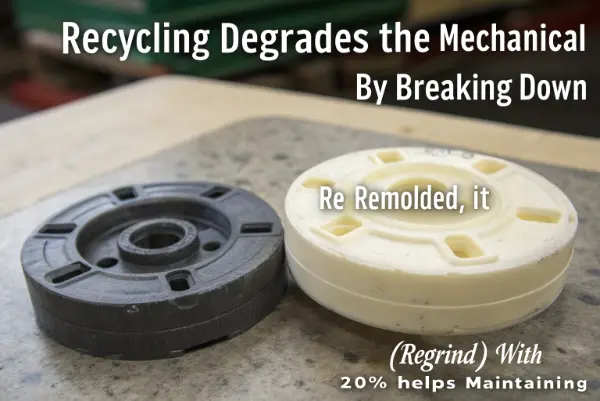
Recycling degrades the mechanical properties of plastics by breaking down their polymer chains. Each time plastic is melted and remolded, it loses impact strength, tensile strength, and flexibility. To prevent weak parts, designers must blend recycled material (regrind) with virgin resin. Usually, a mix of 10% to 20% regrind maintains the structural integrity of the part while still providing significant environmental benefits.

Recycled plastic mechanical properties

When I ran my CNC and mold trading company, we always had bins of plastic runners and rejected parts. Grinding them up and throwing them back into the hopper seemed like free money. But we quickly learned a hard lesson. A part made from 100% recycled plastic is often a broken part waiting to happen.

The Science of Degraded Chains

Think of plastic molecules like long strings of spaghetti. When you heat them up and push them through a mold, those strings get chopped up. The more times you melt the plastic, the shorter the strings become. Short strings mean weak plastic. This process is called thermal degradation.

If you are designing a snap-fit joint for a consumer electronic device, using too much recycled material is a bad idea. The clip will snap off completely. The flexibility is simply gone.

How do we solve this problem? We use the "virgin blend" method. We mix new plastic with old plastic.

Mix Ratio Impact on Strength Environmental Impact
100% Virgin Maximum strength High carbon footprint
80% Virgin / 20% Regrind Near maximum strength Moderate improvement
50% Virgin / 50% Regrind Noticeable drop in strength High improvement
100% Regrind Very weak, brittle Best for environment

As a rule of thumb, you should stick to a 20% regrind ratio. This keeps your wall thicknesses working as designed. It prevents unexpected shrinkage issues. Most importantly, it still keeps tons of plastic out of the landfill. It is the smartest way to be eco-friendly without risking your product’s quality.

What Are the Best Practices for Designing Sustainable Plastic Parts?

Are you finding it hard to design a product that is both profitable and green? Designing complex parts often leads to unrecyclable products that end up in the trash. I will share the best design rules to make your next mold truly sustainable.

The best practice for designing sustainable plastic parts is to use a single type of material for the whole product. Avoid molding metal inserts into the plastic, as this makes recycling very hard. Design parts with uniform wall thickness to reduce material waste and cycle times. Also, clearly mark the part with the correct recycling symbol so sorting facilities know exactly how to process it at the end of its life.

I have seen so many beautiful designs fail the sustainability test simply because the designer added a cool feature that ruined its recyclability. You might design an amazing casing, but if it has rubber over-molded onto a hard plastic shell, it is going straight to the landfill. The two materials cannot be separated easily.

Design for Disassembly

To make a product truly green, you must design it for disassembly. This means when the product breaks, the user or a machine can take it apart easily. Instead of using glue or sonic welding to join two halves, use snap fits or screws. If you must use screws, try to design the part so the screws can be easily removed. Better yet, design the entire assembly using only one type of plastic.

Let us look at a few simple design rules you can apply today:

Design Choice Bad for Recycling Good for Recycling
Joining methods Glue, over-molding Snap-fits, friction fits
Material types Mixed plastics (e.g., PC/ABS) Single pure plastic (e.g., 100% PC)
Additives Heavy dyes, metal flakes Clear or natural colors
Labeling No material code Large, clear recycling code

Another big tip is reducing the overall weight of your part. Use ribs to add strength instead of making the walls thicker. Thinner walls use less plastic. They cool faster in the mold. They also save energy during production. As a designer, your choices at the CAD screen dictate the environmental impact of thousands of parts. Keep it simple, keep it pure, and the earth will thank you.

Can We Truly Achieve Zero Waste with Eco-Friendly Plastics?

Do you wonder if zero waste in plastic manufacturing is just a dream? Many factories claim zero waste, but behind closed doors, a lot still ends up in the trash. Let us look at how close we can actually get to a zero-waste process.

We cannot achieve absolute zero waste with current eco-friendly plastics, but we can get very close through circular economy practices. This involves using 100% recyclable materials, grinding up all manufacturing scrap for reuse, and designing products for a long lifespan. While some material degradation and energy loss will always happen, optimizing mold designs to use hot runners can drastically cut down raw material waste.

During my years running a mold trading company, clients always asked for cheaper, faster, and greener molds. The absolute zero-waste facility is the dream of every factory owner. Is it possible? Honestly, no. Physics tells us that some energy and material are always lost. But practically, we can reduce waste so much that it almost feels like zero.

The Hot Runner Advantage

One of the easiest ways to stop wasting plastic is by changing your mold design. Traditional molds use cold runners. This is the channel that carries the plastic to the part. When the part cools, the runner cools too. This creates a large piece of scrap plastic every single cycle. Yes, you can grind it up and reuse it. But remember our talk about thermal degradation? It hurts the plastic.

Instead, you can use a hot runner system. A hot runner keeps the plastic melted inside the channel. Only the actual part solidifies.

System Type Material Waste Setup Cost Long-term Eco-Impact
Cold Runner High (runners are scrap) Low Poor
Hot Runner Near Zero High Excellent

Of course, hot runners cost more money upfront. But when you are shooting thousands of parts, the savings in raw material pay for the system very fast. Plus, you do not have to pay workers to grind up the scrap. You also save the electricity used by the grinding machine. Achieving zero waste is about looking at the whole system. By making smart tooling choices, you cut waste before the plastic even enters the mold.

Conclusion

Choosing the right eco-friendly plastic means balancing mechanical needs with real-world recycling limits. Whether you use common recyclables like PET, try bioplastics like PLA, or focus on mixing virgin resin with regrind, your design choices matter. By keeping materials pure and using smart mold designs, you can build great products that protect our planet.

Facebook
Twitter
LinkedIn

Request A Quote for Your Projects!

Hi there! I’m Jerry, a proud dad and passionate at CKMOLD. With years of hands-on experience in the injection mold and CNC industry, I’ve grown from managing the smallest details on the shop floor to leading international projects with clients across Europe and the U.S.

At CKMOLD, we specialize in precision molds, plastic parts, and CNC solutions that help bring bold product ideas to life. I love solving complex challenges, building long-term partnerships, and pushing the limits of what great manufacturing can do.

Let’s connect, exchange ideas, and grow together—whether you’re looking for a reliable manufacturing partner or just want to talk shop!

Start with the Project Basics

Use this short form for a general inquiry. For a quotation, complete the full RFQ and email any 3D/CAD files separately to jerry@ckmold.com.

Wait, We Have Something Special for You!

Join our mailing list and receive a 10% discount on your next mold or CNC project.