
Selecting the right plastic for car parts is stressful. If you choose the wrong material, components fail, customers complain, and safety is compromised. This decision is critical for the success of your manufacturing project.
Neither HDPE nor PP is inherently the safer choice for every automotive component. Safety is the result of selecting a grade whose temperature, impact, creep, chemicals, stiffness, hinge behavior, shrinkage and aging match the function. The comparison should start with the component’s failure mode and vehicle zone, then include molding and assembly variation.
Related engineering resources: DFM analysis | production injection molding | mold testing and validation
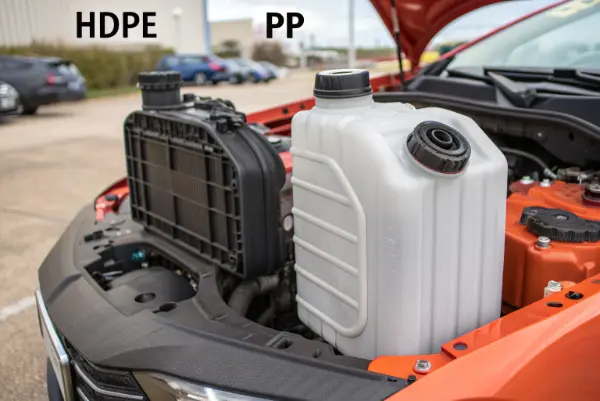
Polypropylene (PP) is generally safer for high-heat environments and moving parts due to its higher melting point and fatigue resistance. High-Density Polyethylene (HDPE) is safer for impact-prone exterior parts, especially in freezing weather, and for fuel tanks due to superior chemical resistance. Your choice depends entirely on whether the part faces heat, impact, or chemicals.
Which Material Offers Better Impact Resistance in Crashes?
Cars face bumps, scratches, and collisions every single day. If your plastic components shatter upon impact, the structural integrity of the vehicle is lost. You need a material that absorbs energy rather than breaking into sharp pieces.
HDPE is generally the winner for impact resistance, especially in cold weather climates. Its molecular structure allows it to absorb shock and dent rather than crack. PP is strong, but it can become brittle and shatter when the temperature drops below freezing. Therefore, HDPE is safer for exterior bumpers and parts that might face direct physical blows.
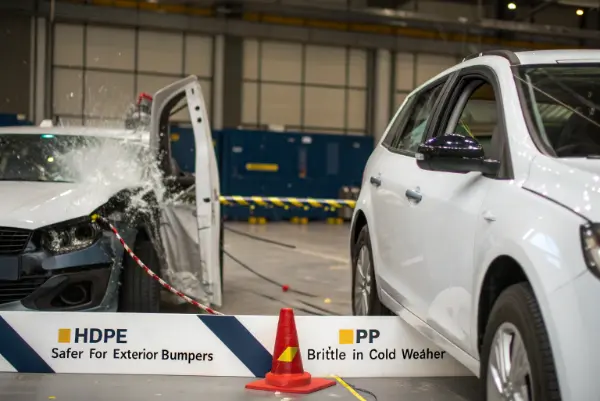
In the automotive world, “safety” often means how a material fails. You do not want a material that explodes into sharp shards during a crash. You want something that acts like a cushion.
On the other hand, standard Polypropylene (PP) can be tricky. While it is very tough at room temperature, it has a high “glass transition temperature.” This means in winter, say at -10°C, it turns glass-like. If a stone hits a cold PP bumper, it might crack. However, we can modify PP (using PP Copolymer) to help with this, but raw HDPE still holds the edge for pure impact toughness in the cold.
Here is a breakdown of how they compare in impact scenarios:
| Feature | HDPE | Polypropylene (PP) |
|---|---|---|
| Ductility | Very High (Stretches easily) | Medium (Stiff) |
| Cold Weather Impact | Excellent (Remains tough) | Poor (Becomes brittle) |
| Failure Mode | Dents or deforms | Cracks or Shatters |
| Typical Safety Part | Fuel Tanks, Fender Liners | Interior Trims, Bumpers (if modified) |
When you are designing parts that sit on the outside of the car, you must consider the worst-case scenario. If you sell cars in Canada or Northern Europe, HDPE offers a safety net that standard PP cannot match.
Can They Withstand High Engine Temperatures?
Engines get incredibly hot, and so do car interiors when parked in the summer sun. A melted part causes leaks, mechanical failures, and even potential fires. Ignoring thermal properties is a supported recipe for a product recall.
Polypropylene (PP) is significantly safer for high-heat applications near the engine. It has a higher melting point (around 160°C) compared to HDPE (around 130°C). This makes PP the standard choice for under-the-hood components, fluid reservoirs, and HVAC ducts where consistent heat exposure is a daily reality.
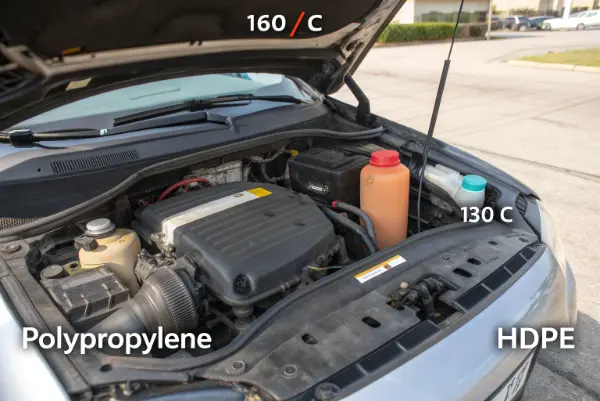
Temperature is usually the first thing I ask my clients about. “Where does this part live?” If the answer is “under the hood,” HDPE is often off the table.
Safety in the engine bay is about retaining shape. When plastic gets hot, it does not just melt immediately; it gets soft. This is called “creep.” If you bolt a heavy alternator cover made of HDPE to a hot engine, the plastic will slowly flow away from the pressure of the bolts. Eventually, the bolts come loose. Loose parts in an engine bay are dangerous.
PP handles this heat much better. Its crystalline structure is more stable at higher temperatures. This is why you see PP used for battery cases, fan shrouds, and fuse boxes. It stays rigid when hot.
We also need to think about the interior. A dashboard in Arizona can reach 80°C or more. HDPE might get too soft and warp, affecting the deployment of airbags. PP remains stable.
To help you visualize the thermal safety limits:
- HDPE: It starts to soften significantly around 120°C (248°F). It is risky to use near exhaust manifolds or engine blocks.
- PP: It holds up well until about 160°C (320°F). With glass fiber reinforcement, it can go even higher.
However, there is a trade-off. While PP handles heat, it burns easily if a fire actually starts (which we will discuss later). But for preventing mechanical failure due to operating heat, PP is the safer choice. If you use HDPE in a high-heat zone, you are gambling with structural failure.
How Do They React to Automotive Fluids?
Cars run on harsh chemicals like gasoline, oil, and brake fluid. If a container degrades, hazardous leaks occur. You cannot afford material failure when containing flammable or corrosive liquids.
Both materials offer excellent chemical resistance, but HDPE has a slight edge for fuel containment. HDPE creates a better barrier against hydrocarbon permeation, which prevents gas fumes from escaping. However, PP is also highly resistant to acids and bases found in batteries and cleaning fluids. The choice depends on the specific fluid you are holding.
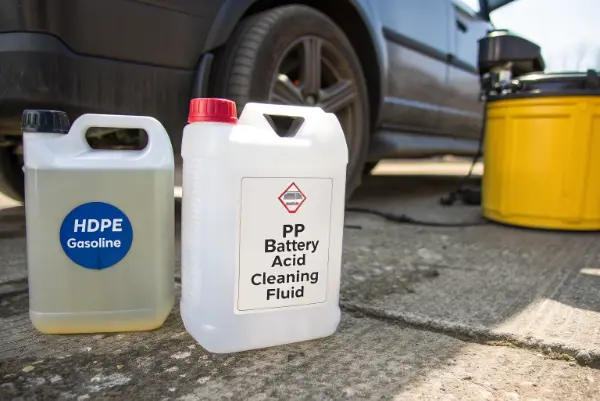
Chemical safety is invisible until it is too late. You might not see the plastic dissolving, but on a molecular level, the fluid might be soaking through.
HDPE is the king of fuel tanks for a reason. Gasoline is a hydrocarbon, and it likes to permeate (soak through) many plastics. HDPE has a very tight density that makes it hard for gas molecules to pass through. This is a huge safety factor. We do not want gas fumes leaking into the garage or the cabin. In the mold industry, almost every blow-molded fuel tank A common observation is is multi-layer HDPE.
PP is also excellent chemically, but it behaves differently. It is fantastic against stress cracking. Some plastics will crack if you put them under stress (like a tight cap) and then expose them to soap or oil. This is called Environmental Stress Cracking (ESC). PP is very resistant to this.
Here is how I break it down for my clients:
- Fuel and Oil: HDPE is the safest bet. It resists swelling and permeation better than most commodity plastics.
- Washer Fluid and Coolant: PP is great here. It handles the water/glycol mix well and resists the heat of the coolant better than HDPE.
- Battery Acid: PP is the standard. It does not react with sulfuric acid, making it the only safe choice for battery casings.
You also have to think about cleaning agents. Cars get washed. Some strong detergents can attack plastics over time. Both HDPE and PP are generally safe against car wash soaps, but if the part is painted, the adhesion of the paint to the plastic becomes the safety issue. PP usually needs a primer or flame treatment to hold paint, whereas HDPE is notoriously hard to paint. A peeling sensor cover isn’t just ugly; it can expose electronics to water.
Which Material Is Safer Regarding Flammability?
Fire is the ultimate nightmare for any vehicle manufacturer and driver. Standard plastics act like solid fuel when ignited. You need to know how these materials react to flames to meet strict automotive safety standards.
Both HDPE and PP are naturally flammable and burn like candle wax. However, PP is slightly easier to treat with flame retardants without losing its mechanical properties. For strict automotive safety standards like UL94, additives are required for both materials to ensure they stop burning when the ignition source is removed.
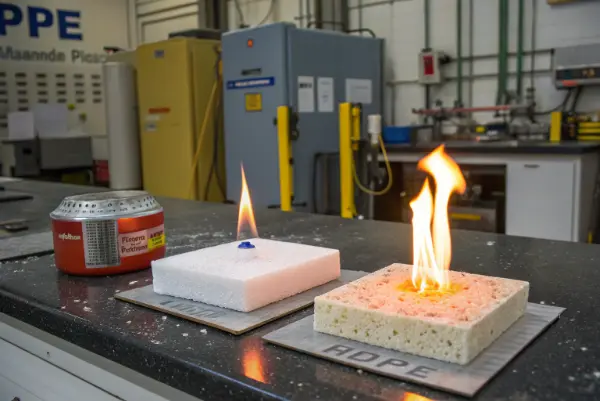
A relevant limitation is: neither of these plastics is naturally “safe” in a fire. They are both made from oil. If you light them, they burn. They drip flaming plastic, which can spread a fire to other parts of the car. This is a major safety concern.
However, in the manufacturing world, we do not use “raw” plastic for parts that might catch fire. We use additives.
PP accepts fillers very well. We can add magnesium hydroxide or other flame retardants to PP, and it still flows well into the mold. It retains its strength. This makes PP a flexible platform for creating fire-safe parts. You can make a PP part that is V-0 rated (meaning the fire goes out by itself within 10 seconds).
HDPE is harder to flame retard. Because it is so dense, adding large amounts of flame-retardant powder can make it brittle. You lose that impact resistance we talked about earlier. So, if you have a part that needs to be fire-safe and impact-resistant, HDPE becomes a difficult material to work with.
Critical Thinking on Smoke:
It is not just about the fire; it is about the smoke. When plastics burn, they release toxic fumes.
- PP Burning: Smells like burning candle wax. The smoke is generally less toxic than plastics like PVC.
- HDPE Burning: Also smells like wax.
For interior parts, the Federal Motor Vehicle Safety Standard (FMVSS 302) rules the burn rate. Both materials can pass this standard, but PP is often the preferred choice for interior trim because it allows us to add the necessary chemicals to slow down the burn rate without making the part look ugly or feel brittle.
Which Material Resists Long-Term Structural Fatigue?
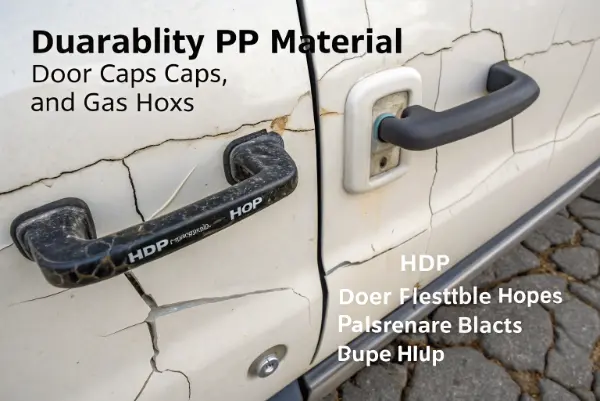
Door handles, gas caps, and glove boxes get used thousands of times over the life of a car. If a hinge snaps, the part becomes useless and potentially dangerous. Material fatigue leads to sudden breakage without any warning.
PP is the undisputed king of fatigue resistance. It is known as the “living hinge” material because it can bend repeatedly without breaking. HDPE will eventually fatigue and snap under repetitive stress. For moving parts, clips, or snap-fits, PP provides much higher long-term operational safety.
This is one of my favorite topics because it shows the magic of plastic engineering. Have you ever looked at the cap of a ketchup bottle? That thin piece of plastic connecting the cap to the lid is a “living hinge.” You can open and close it a million times, and it won’t break. That is often Polypropylene.
In a car, there are hundreds of clips, fasteners, and covers that need to flex.
- Snap-fits: When you assemble a car dashboard, parts “snap” together. The plastic must bend to let the hook pass, then snap back. PP is suitable for this. It is elastic.
- HDPE Failure: If you try to make a snap-fit out of HDPE, it might work the first time. But HDPE has poor “memory.” If it stays bent for too long, it won’t snap back. Or, if you bend it back and forth too many times, it gets white stress marks and tears.
Why is this a safety issue? Imagine a wire harness clip. It holds heavy electrical cables away from the hot engine. If that clip is made of HDPE and fatigues due to vibration, it snaps. The wires fall onto the engine, melt, and cause a short circuit.
PP has a spiral molecular structure that acts like a spring. It loves to move.
Comparison Table for Fatigue:
| Feature | HDPE | Polypropylene (PP) |
|---|---|---|
| Living Hinge Ability | Poor (Will crack) | Excellent (Millions of cycles) |
| Snap-Fit Retention | Low (Deforms over time) | High (Springs back) |
| Vibration Resistance | Good (Dampens sound) | Excellent (Resists cracking) |
For any part that moves, bends, or clicks, I generally tell the production team: “Go with PP.” It is the only way to ensure the part is still working safely ten years down the road.
Compare Released Grades, Not Polymer Family Labels
HDPE and PP family names are not sufficient for an automotive release. Impact-modified PP, mineral-filled PP, stabilized HDPE and unfilled grades can reverse a family-level comparison. Define the vehicle zone and compare the exact candidate grades after molding, conditioning and relevant aging.
| Decision | Evidence for both candidates | Why the comparison can change |
|---|---|---|
| Cold impact | Test method, temperature, notch/part geometry, conditioning and aged result | Modifier package, molding orientation and weld lines affect failure mode |
| Heat and load | Deflection or creep under the actual load, time and temperature | A short datasheet test does not predict a fastened part over vehicle life |
| Fluids and stress cracking | Exact fluids, concentration, temperature, stress and exposure sequence | Chemical resistance without molded stress can overstate suitability |
| Flammability | Applicable OEM or regulatory method for the released grade, color and thickness | A family name or supplier brochure is not a finished-component result |
| Dimensions and assembly | Shrinkage study, warpage, torque/retention and tolerance stack | Stiffness, orientation and thermal movement alter the interface |
Ask suppliers to identify the exact manufacturer, grade, color/additive package, data-sheet revision and change-notification commitment. Use the same geometry, test condition and acceptance limit for both candidates. If one result is unavailable, record it as an open risk rather than scoring the material from a generic property claim.
For a project comparison, submit the vehicle zone, CAD, current material, candidate grades, loads, temperatures, fluids, OEM specifications and annual demand through the engineering RFQ.
Compare Thermal and Mechanical Needs
PP grades may offer a different stiffness-to-weight and temperature balance, while HDPE may offer toughness and chemical or stress-crack advantages in some uses. Exact copolymer, filler and modifier choices can reverse a generic family comparison. Review retained properties across the service range.
Evaluate Impact, Flexing and Creep
Cold impact, repeated flexing, living hinges, sustained pressure and fastener loads require different property combinations. Condition and test specimens and finished components in the relevant direction. A stiff part can still fail from brittle impact or long-term relaxation.
Review Chemicals and Environmental Stress
Fuels, oils, cleaners, surfactants, salts and moisture interact with stress and temperature. HDPE and PP each have application-specific strengths and limits. Use the exact chemical mixture and imposed strain rather than a broad resistance chart alone.
Account for Molded Orientation and Shrinkage
Gate location, flow, cooling, fillers, weld lines and packing affect dimensions and strength. PP and HDPE may need different shrinkage and warp strategies. Compare the actual tool concept and CTQs before treating a resin change as drop-in.
Select With a Weighted Validation Matrix
Score vehicle environment, load, failure severity, process margin, tool impact, supply, cost and testing evidence. Prototype the credible candidates and test assemblies after aging. The safer material is the one with verified margin for the specific component.
HDPE vs. PP for Automotive Components: Buyer Review Checklist
- Define component failure mode, vehicle zone and temperature-time profile.
- Compare exact grades for stiffness, impact, flex, creep and relaxation.
- Test chemicals, stress cracking and aging under realistic strain and heat.
- Review shrinkage, gate, weld lines, cooling, fillers and tool implications.
- Use a weighted matrix and validate finished assemblies before selection.
Frequently Asked Questions
Is HDPE generally tougher than PP?
Family-level trends are not enough; copolymer type, additives, temperature, rate, conditioning and geometry can change the result.
Can PP replace HDPE in an existing automotive mold?
A substitution may change shrinkage, warpage, gate behavior, ejection, dimensions and performance. DFM and revalidation are needed.
Which material is better for living hinges?
Certain PP grades are commonly considered, but hinge geometry, orientation, radius, molding and cycle-life testing determine suitability.
Conclusion
Both HDPE and PP have their place in automotive safety. If you need a fuel tank or a bumper that can survive a crash in freezing weather, choose HDPE. If you need a part that lives in the hot engine bay, holds battery acid, or needs to flex repeatedly like a clip, choose PP. For a business owner like the buyer, the safe choice is simply matching the material properties to the specific stress the part will face.