
How Do You Choose the Right Plastic Prototyping Method for Your Budget?

Are you struggling to decide on a plastic prototyping method? The options seem endless, and each comes with a different price tag. You worry that picking the wrong one could mean wasting your budget on a prototype that doesn’t meet your needs, leading to costly delays and redesigns. This uncertainty can stall your project before it even starts.

To choose the right plastic prototyping method for your budget, you must balance three key factors: cost, quality, and quantity. For 1-10 highly detailed or functional parts, CNC machining and SLA/SLS 3D printing are best, despite higher upfront costs. For quick, low-fidelity models, FDM 3D printing is the cheapest. For 10-50 parts that need to mimic final production materials, vacuum casting offers an excellent cost-per-part value after the initial master pattern and mold costs are covered.

A collage of different plastic prototypes made with 3D printing, CNC machining, and vacuum casting.

Choosing a prototyping method isn’t just about finding the cheapest option. It’s about making a smart investment. The right choice gives you the feedback you need to move forward with confidence. The wrong choice can send you back to the drawing board with less money in your pocket. Let’s break down the real costs of each method so you can make an informed decision that pushes your project toward success.

When Does 3D Printing Offer the Best Value?

You need a physical model fast, but the quotes for different 3D printing technologies are all over the place. FDM seems cheap, but will it be strong enough? SLA looks great, but is it worth the extra cost? You’re stuck trying to figure out which method gives you the most bang for your buck without sacrificing the quality you need for a useful prototype.

3D printing offers the best value when you need speed and design flexibility for a low number of parts (1-5 units). Fused Deposition Modeling (FDM) is unbeatable for early-stage, low-cost form and fit checks. For prototypes requiring a smooth surface finish and fine details, Stereolithography (SLA) provides excellent value. For strong, functional prototypes that can withstand mechanical stress, Selective Laser Sintering (SLS) is a cost-effective choice, often cheaper than CNC for complex geometries.

Side-by-side comparison of FDM, SLA, and SLS 3D printed parts.

The term "3D printing" covers a lot of ground. It’s not a single process but a family of technologies, each with its own cost structure and ideal application. I’ve seen many designers default to the cheapest FDM print, only to find it breaks during a simple fit test. On the other hand, ordering an expensive SLS part for a simple visual model is also a waste of money. Understanding the cost-benefit of each type is key. Let’s dive deeper into what you’re actually paying for.

Fused Deposition Modeling (FDM) Costs

FDM is the most common and affordable type of 3D printing. It works by extruding a filament of plastic layer by layer. The main costs are the material and the print time. For simple prototypes where you just need to check the shape and size, FDM is fantastic. However, the layer lines are visible, and the parts aren’t as strong as those made with other methods. It’s best for early-stage concepts, not functional testing.

Stereolithography (SLA) and Digital Light Processing (DLP) Costs

SLA and DLP create parts by curing liquid resin with a light source. This results in a very smooth surface finish and intricate detail, making them perfect for visual models and patterns. The resin is more expensive than FDM filament, and the machines require more maintenance. Post-processing, like washing and curing, also adds to the time and labor cost. You get a beautiful part, but you pay a premium for it compared to FDM.

Selective Laser Sintering (SLS) Costs

SLS uses a laser to fuse powdered plastic, typically nylon. This method creates strong, durable parts that are great for functional testing. Because the part is supported by the unfused powder around it, you can create complex geometries without needing support structures. This reduces post-processing labor. The powder and machinery are expensive, but for complex, functional parts, SLS can be more cost-effective than CNC machining.

Technology Setup Cost Material Cost Best For Key Weakness
FDM Very Low Low Form/fit checks, early concepts Weak, poor surface finish
SLA/DLP Low Medium High-detail visual models Brittle materials, UV sensitive
SLS Medium High Functional testing, complex parts Rougher surface than SLA

Is CNC Machining Worth the Higher Initial Cost for Prototypes?

You have a design that needs to be strong and precise, maybe for a snap-fit or a load-bearing component. 3D printing feels like a gamble; you’re worried the part will fail during testing. But then you see the quote for CNC machining, and it’s significantly higher. It makes you wonder if the extra expense is really justified for just a prototype.

Yes, CNC machining is often worth the higher initial cost for prototypes that require superior strength, tight tolerances, and a final-product feel. Unlike 3D printing, CNC uses production-grade materials, so you can perform real-world functional and stress testing. This investment upfront helps you uncover design flaws that weaker prototypes might miss, preventing costly tooling changes and production delays later. It’s the most reliable way to validate mechanical performance before committing to mass production.

A precise plastic part being milled on a CNC machine.

I can’t count the number of times a client has come to me after a 3D-printed prototype failed. I remember one project for an automotive bracket. The team had used a tough 3D-printed material, but it snapped during vibration testing. We remade the part with CNC-machined ABS. It cost them three times more, but it passed the test. More importantly, it revealed a small design improvement we could make before cutting the steel mold. That single insight saved them over $10,000 in mold modifications. The initial cost of a prototype is small compared to the cost of fixing a mistake in production.

Programming and Setup Time

The biggest cost driver for a one-off CNC part is the human element. A skilled programmer has to create the toolpaths from your CAD model, which can take several hours for a complex part. Then, a machinist sets up the machine, secures the block of material, and calibrates the tools. This "make-ready" labor is a fixed cost, whether you’re making one part or a hundred. This is why the first CNC part is always the most expensive.

Material Costs and Waste

With CNC, you start with a solid block of plastic and cut away everything that isn’t the part. The cost of this raw material block can be significant, especially for engineering-grade plastics like PEEK or Ultem. You also pay for the material that becomes waste chips. In contrast, 3D printing is an additive process with very little material waste, which is one reason it can be cheaper for complex, hollow designs.

Machining Time

Once the machine is set up, the actual cutting begins. The time it takes is based on the part’s complexity, the number of tools required, and the required surface finish. A simple part might take 30 minutes, while a highly complex one could run for 8 hours or more. Machine time is expensive, so designers can reduce costs by simplifying geometry, avoiding deep pockets, and specifying looser tolerances where possible.

Cost Factor Description How to Reduce Cost
CAM Programming Creating toolpaths from the CAD file. Provide a clean, well-defined CAD model. Minimize complex 3D surfaces.
Setup Labor Securing the material and setting up tools. Design parts that can be machined from fewer sides (e.g., 3-axis vs. 5-axis).
Material Block The cost of the raw plastic block. Choose a standard, cost-effective material. Design to nest within a standard block size.
Machine Time The time the CNC machine is running. Loosen tolerances where not critical. Increase corner radii to allow for larger tools.

Could Vacuum Casting Be the Sweet Spot for Low-Volume Production?

You’ve validated your design with a CNC or 3D-printed master part, and now you need more. You need about 25 units for market testing, but setting up an injection mold for such a small run is financially impossible. 3D printing each one is too slow and doesn’t offer the material properties you need. You’re caught in the middle, needing a solution that bridges the gap between single prototypes and mass production.

Yes, vacuum casting is the ideal sweet spot for low-volume production of 10 to 50 parts per mold. It combines a high-quality surface finish with a wide range of material properties that closely mimic injection-molded plastics. While there is an upfront cost for the master pattern and the silicone mold, the cost per part is significantly lower than CNC machining or high-end 3D printing in this volume range. It’s the perfect method for creating a batch of high-fidelity, market-ready prototypes.

A technician pouring resin into a silicone mold inside a vacuum chamber.

Vacuum casting, also known as urethane casting, is one of my favorite processes for helping clients bridge this exact gap. I once worked with a startup developing a new handheld medical device. They needed 30 units for a clinical trial. CNC machining all 30 was too expensive, and 3D printing didn’t offer the biocompatible, sterilizable material they required. We took their single CNC-machined master pattern and created two silicone molds. Within a week, we had cast all 30 units in a medical-grade urethane. This allowed them to complete their trial successfully and secure the funding they needed for production tooling.

The Three-Step Cost Structure

Vacuum casting costs can be broken into three parts. Understanding them helps you see where the value comes from.

  1. Master Pattern: First, you need a perfect master pattern. This is typically made using a high-resolution method like SLA 3D printing or CNC machining. The cost of this first step is essentially the cost of a single, high-quality prototype. The better the master, the better the final parts.
  2. Silicone Mold: Next, a silicone mold is created by casting liquid silicone around the master pattern. The cost depends on the size and complexity of the part. A single mold is typically good for casting around 20-25 copies before it starts to degrade.
  3. Per-Part Casting: Finally, there’s the cost of the parts themselves. This includes the liquid urethane material and the labor to mix, pour, and demold each copy. Because the casting process is fast, this per-part cost is relatively low.

When Does It Make Financial Sense?

The magic of vacuum casting happens when the savings on the per-part cost outweigh the initial investment in the mold. For one or two parts, CNC or 3D printing is cheaper. But as you approach 10 parts, the total cost of vacuum casting often becomes lower.

Let’s look at a hypothetical cost breakdown for a medium-sized part:

Quantity CNC Machining (Total Cost) Vacuum Casting (Total Cost)
1 Part $400 $750 ($400 master + $350 mold)
10 Parts $4,000 ($400 x 10) $1,150 ($750 + 10 x $40)
25 Parts $10,000 ($400 x 25) $1,750 ($750 + 25 x $40)

As you can see, the total cost of CNC machining rises linearly. With vacuum casting, the high initial cost is quickly absorbed, and the total cost rises much more slowly. This makes it an incredibly powerful tool for pilot runs, user testing, and first-batch sales.

How Do You Compare the True Costs of Each Prototyping Method?

You have quotes for 3D printing, CNC machining, and vacuum casting, and the numbers are all different. It’s tempting to just pick the lowest price for the quantity you need right now. But a simple price comparison doesn’t tell the whole story. How do you account for lead time, material properties, and the risk of needing a redesign? Choosing incorrectly could mean paying more in the long run.

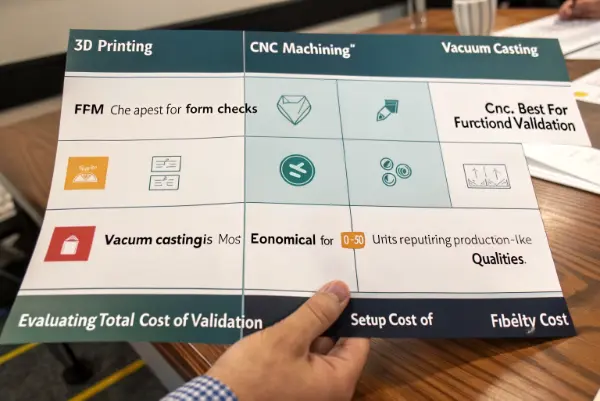
To compare the true costs, look beyond the price per part and evaluate the total cost of validation. This includes setup costs, material fidelity, lead time, and the cost of potential failure. FDM is cheapest for form checks. CNC is best for functional validation despite high unit costs. Vacuum casting is most economical for 10-50 units requiring production-like qualities. Your goal isn’t the cheapest prototype, but the most effective validation path for the lowest total project risk.

A chart comparing the cost-per-unit of different prototyping methods at various quantities.

Thinking about the "true cost" is something I’ve learned over decades in this industry. A cheap prototype that gives you bad information is the most expensive mistake you can make. I had a client who was developing a consumer product with a complex snap-fit lid. They spent weeks testing dozens of FDM 3D-printed designs because they were cheap to iterate. But the FDM material didn’t behave like the final injection-molded polypropylene. When they finally paid for a CNC prototype in real PP, they found the snap design was fundamentally flawed. All that time and money on FDM prints was wasted. They would have saved a month and thousands of dollars by starting with a more faithful, albeit more expensive, prototype.

Cost Per Unit at Different Volumes

The most critical factor in your decision is quantity. The economics of each process change dramatically with volume.

  • 1-5 Units: CNC machining and 3D printing (SLA/SLS) are your main contenders. CNC is best for strength and precision; 3D printing is faster and better for complex shapes. The cost is high per unit but there are no tooling costs.
  • 10-50 Units: This is the vacuum casting zone. The upfront cost of the master and mold is quickly offset by the low cost of each subsequent part. It’s almost always the most economical choice in this range.
  • 50-500 Units: As you need more parts, you might consider multiple vacuum casting molds or, for simpler parts, an inexpensive rapid injection mold made from aluminum. This is the bridge to true production.

Factoring in Lead Time and Material Fidelity

Time is money. A slow prototyping process can delay your product launch.

  • Speed: 3D printing is the fastest for a single part, often delivering in 1-3 days. CNC machining takes longer due to programming and setup, typically 5-10 days. Vacuum casting requires time for pattern making and mold curing, so the first parts take about 7-12 days, but subsequent parts are cast very quickly.
  • Material Fidelity: This is about how well the prototype material mimics your final production material. CNC machining is the king here, as you can use the exact same plastic. Vacuum casting offers a wide range of polyurethanes that can simulate properties like flexibility, clarity, and heat resistance. 3D printing materials are proprietary and rarely match production plastics perfectly.

Prototyping Cost Comparison at Volume

Method Best Quantity Lead Time Material Fidelity Typical Use Case
FDM 3D Printing 1-5 1-3 days Low Early shape/fit check
SLA/SLS 3D Print 1-5 2-5 days Medium Visual models, complex parts
CNC Machining 1-10 5-10 days Excellent Functional testing, high precision
Vacuum Casting 10-50 7-12 days (first parts) Good to Excellent Pilot runs, marketing samples

Ultimately, the "true cost" is the price of getting a reliable "yes" or "no" on your design. Choose the method that gives you the most reliable answer for your specific validation goal, within your project’s budget and timeline.

Conclusion

Choosing the right plastic prototyping method comes down to understanding your specific goal for each stage of development. Don’t just look at the price tag. By balancing cost per part, material properties, quantity, and lead time, you can make a smart, informed budget decision. This strategic approach ensures you get the valuable feedback you need from your prototypes, minimizing risk and paving a smoother path to successful mass production.

Facebook
Twitter
LinkedIn

Request A Quote for Your Projects!

Hi there! I’m Jerry, a proud dad and passionate at CKMOLD. With years of hands-on experience in the injection mold and CNC industry, I’ve grown from managing the smallest details on the shop floor to leading international projects with clients across Europe and the U.S.

At CKMOLD, we specialize in precision molds, plastic parts, and CNC solutions that help bring bold product ideas to life. I love solving complex challenges, building long-term partnerships, and pushing the limits of what great manufacturing can do.

Let’s connect, exchange ideas, and grow together—whether you’re looking for a reliable manufacturing partner or just want to talk shop!

Request a Quick Quote

Send your drawings and detailed requirements via:
Email: jerry@ckmold.com

Or fill out the contact form below:

We will contact you within one working day. Please pay attention to the email with the suffix “@ckmold.com”

Wait, We Have Something Special for You!

Join our mailing list and receive a 10% discount on your next mold or CNC project.