

Having a difficult time finding the ideal clear plastic for your new water bottle item? You are confronted with a multitude of decisions, and an incorrect choice might leave your customers complaining about the item’s cracking, staining, or even health concerns.
Tritan and polycarbonate are both considered for reusable water bottles, but they solve different combinations of clarity, impact, heat, chemical and appearance requirements. The right decision depends on the bottle’s cleaning method, temperature, drop exposure, wall design, transparency target, cap assembly, expected life and destination-market requirements. “BPA-free” alone is not a complete material selection or product validation criterion.
Related CKMOLD resources: mold design, production injection molding, mold testing and validation.
For reusable water bottles, Tritan is the better alternative to Polycarbonate (PC). It is first and foremost a safety issue: Tritan is BPA-free, a chemical in PC made from Bisphenol A that has been a cause for health concern. Aside from safety, Tritan performs superior in the long run since it does not retain stains, odors, or hazing common in PC bottles after they are repeatedly washed on dishes. It possesses glass-like clarity and durable impact strength, setting it as the contemporary standard for high-end, reusable plastic drinkware.
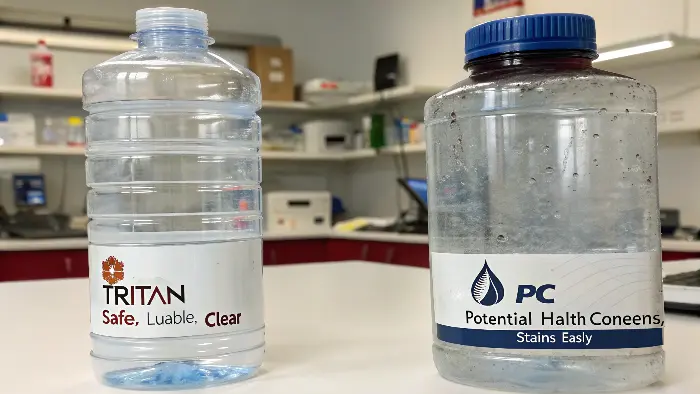
Is Tritan really better than polycarbonate?
Your designing a high-end product and require a plastic, which will appear like glass yet will not break. Polycarbonate has long been the preferred one, but everyone is currently talking about Tritan. Getting stuck is easy, as one wonders whether the change is worth the bother or it is merely marketing gimmicks. A misjudgment of the correct choice might imply the continued use of an obsolete material or the new material that is not reliably known in terms of its characteristics.
Absolutely, for consumer cups and foodware, Tritan is much superior to standard polycarbonate. The key benefit is that Tritan is produced without Bisphenol A (BPA), thereby negating the health-related issues in PC. From a functional standpoint, Tritan is also superior through having higher chemical resistance, such that it won’t retain flavors or aromas. It retains its water-clear appearance for hundreds of dishwasher cycles, but PC turns cloudy and yellow in the course of time, rendering Tritan the more durable and reliable choice for the long haul.

I usually when I collaborate with designers such as you, the discussion may begin on aesthetics but soon progresses to long-term performance and safety. One thing is having a product that appears great in the shelf, what maintains a brand reputation is a product that works reliably with the customer over an extended period of time. This is an ideal example of this in the selection of Tritan and PC.
The BPA Elephant in the Room
Health and safety was the single largest motivator to the PC to Tritan shift. The production of polycarbonate utilizes Bisphenol A (BPA) which is a chemical that may leak out of the plastic particularly in situations where the plastic is subjected to heat. The research has over the years associated BPA with numerous health problems, and as a result a huge number of consumers at large demand the BPA-Free products. Tritan is a product of Eastman Chemical created in direct response to this requirement. It is BPA-free, and it is also free of other related bisphenol compounds such as BPS. In the case of any item that will come into contact with food or drinks, particularly among children, the selection of a BPA free material such as Tritan is no longer an option but rather a must in order to be accepted by the market in most regions of the world.
Durability and Performance Showdown
Here’s a simple breakdown of their key properties:
| Feature | Tritan | Polycarbonate (PC) |
|---|---|---|
| BPA Content | None | Contains BPA |
| Impact Strength | Excellent | Very Good |
| Clarity | Excellent, long-lasting | Excellent, can yellow/cloud over time |
| Heat Resistance | Good (up to 100°C / 212°F) | Good (up to 120°C / 248°F) |
| Dishwasher Safe | Yes (top rack recommended) | Yes, but can degrade clarity |
| Odor/Stain Resistance | Excellent | Fair to Good |
| Chemical Resistance | Excellent | Good (vulnerable to some oils/sunscreens) |
For designers, this table tells a clear story. While PC has a slight edge in heat resistance, Tritan wins in almost every other category that matters for a reusable water bottle.
The Advantages of Tritan Water Bottles
Tritan water bottles are becoming popular all over the world thanks to their distinctive features of safety, durability, and usefulness. Tritan is a high-performance and lightweight material, and unlike traditional plastics or fragile glass, is a modern solution that gives people the performance and the peace of mind. Below are the key advantages:
Safe and BPA Free
Tritan is also one of the safest. These are entirely BPA, BPS and other dangerous bisphenols-free bottles. They have also been tested to make sure they do not emit hormone-like chemicals hence making them a healthier option to both adults and children.
Exceptional Durability
Tritan water bottles are durable. They are break-resistant and can resist accidental drops that would otherwise shatter glass or break normal plastic. This renders them ideal for activities, travelling or sports.
Lightweight and Convenient
They have a similar appearance, but Tritan bottles are a lot lighter and therefore easier to carry around. They can also be washed in the dishwasher, which provides convenience on a daily basis and easy cleaning.
Crystal-Clear Appearance
Tritan does not lose its glass-like clarity as many other reusable plastics do. The bottles remain transparent, smooth, and attractive even after washing and use.
Odor and Stain Resistance
Tritan is purposely made to withstand odors and stains. Drinks such as coffee, tea, or juices will not have any lingering smells or tint, which make drinks clean and fresh with each use.
Green Option.
Due to their longevity and durability, Tritan bottles will eliminate the use of disposable plastics. By using Tritan as an option, it will sustainability reduce plastic waste.
Tritan water bottles are safe, strong, and stylish, so they become a convenient every-day hydration tool and green.
What are the disadvantages of Tritan water bottles?
Tritan appears to be the ideal substance, right? It’s safe, durable, and clear. Still, as a professional designer, you understand that there is no such Weakness to perfection of a material that has no trade-offs. The assumption that Tritan has no disadvantages may result in unpredicted budget increases or processing nightmares in the future. To make a real informed decision you must know the full picture, with its limitations.
While Tritan is an excellent material, it has three main disadvantages. First, it is more expensive than other common plastics like Polypropylene (PP) and even PC, which can impact the final product cost. Second, its heat resistance is slightly lower than that of polycarbonate, making it less suitable for applications requiring high-temperature sterilization. Finally, like many plastics, it is classified under recycling code #7 (Other), which can make it more difficult for consumers to recycle in some municipal programs.

Project teams should look at the total cost of ownership, not just the raw material price. A slightly more expensive material that results in a better, longer-lasting product can be more profitable in the long run.
The Cost Factor
Processing and Environmental Profile
From a manufacturing standpoint, Tritan requires careful handling. It’s a hygroscopic material, meaning it absorbs moisture from the air. Before it can be injection molded, it must be dried thoroughly in special industrial dryers. If not dried properly, the moisture turns to steam during molding, causing cosmetic defects like splay marks on the surface of the part. This adds an extra step and requires specific equipment in the factory.
On the environmental side, its recycling code #7 is a challenge. While Tritan is a durable material designed for long-term reuse, which is inherently sustainable, its end-of-life disposal is less straightforward than materials like PET (#1) or PP (#5). Some specialized recycling streams can handle it, but it’s not as widely accepted in curbside programs. This is an important consideration for brands focused on a circular economy story.
Which is better, PP or Tritan water bottles?
Now that we have determined Tritan to be better than PC, how does it compare to one more BPA-free option that is growing in popularity Polypropylene (PP)? You can find PP in yogurt containers to car bumpers, and it is a popular material to make water bottles (especially shaker cups and bottles that kids use). The two decisions may be tricky since they suit various market segments and users.
The choice between PP and Tritan depends entirely on the desired product characteristics. Tritan is better for a premium, glass-like water bottle due to its crystal clarity, high rigidity, and excellent stain resistance. Polypropylene (PP) is the superior choice for lightweight, flexible, and budget-friendly bottles. PP is naturally opaque or translucent and has incredible fatigue resistance, making it suitable for features like integrated flip-top lids. For a high-end product where clarity is key, choose Tritan; for an economical and functional product, choose PP.

Aesthetics, Feel, and Market Position
Their appearance and their feeling are as different as planets.
- Tritan: Appears and feels like glass. It’s stiff, high-gloss, and implies high quality and high value. It’s ideal for minimalist designs where the material’s clarity is the focal point.
- Polypropylene (PP): Is inherently translucent (milky) or opaque. It’s softer and warmer in feeling and is tough. It’s commonly applied in colorful products, sport bottles, and kids’ products where a non-shatter, lightweight material is a concern.
This variation affects your product’s price point and target market directly. A Tritan bottle goes against glass and stainless steel, while a PP bottle goes against value and functionality.
A Head-to-Head Functional Comparison
Let’s put them side-by-side to see how they perform in key areas for a water bottle.
| Feature | Tritan | Polypropylene (PP) |
|---|---|---|
| Clarity | Transparent (Glass-like) | Translucent to Opaque |
| Feel | Rigid, hard | Softer, flexible |
| Cost | Higher | Lower |
| Impact Strength | Excellent (can crack on severe impact) | Excellent (tends to dent, not crack) |
| Fatigue Resistance (Hinges) | Poor | Excellent |
| BPA-Free | Yes | Yes |
| Odor/Stain Resistance | Excellent | Fair (can retain strong odors/colors) |
| Use Case | Premium bottles, blenders, food storage | Budget bottles, shaker cups, caps, lids |
As you can see, neither is “better” in a vacuum. The best choice depends on the design intent. Do you need a crystal-clear body? Choose Tritan. Do you need an integrated, unbreakable hinge for the cap? Choose PP.
If you want to learn more about Custom Injection Molded Parts read our complete article Can I Get Custom Injection Molded Parts Anywhere in China?
What is the best material for a reusable water bottle?
Having compared Tritan to PC and PP, the final question is as follows: what is the best material in all cases? You have a whole variety of options, such as plastics, metal and glass. They all have ardent followers and what is best might appear to be subjective. This is a very important decision, because it determines the weight, lifespan, cost and user experience of your product.
There is no single “best” material for every water bottle; the ideal choice depends on the user’s top priority. For the best balance of clarity, durability, and safety in a plastic bottle, Tritan is the top choice. For maximum insulation to keep drinks hot or cold, stainless steel is unmatched. For the purest taste with zero flavor transfer, glass is ideal, though it’s heavy and fragile. For a lightweight and highly affordable option, Polypropylene (PP) is excellent. For most everyday users, Tritan offers the best overall package.

One of the most crucial aspects of my work is to help clients through this last choice. That is just a matter of aligning the soul of the material to the purpose of the product. We are not simply selecting a polymer but we are determining how the customer is going to touch the product on a daily basis. To simplify this final decision, let’s make a little guide.
The Top Contenders and Their Strengths
Let’s quickly summarize the leading options and where they shine.
- Tritan: The modern champion of plastics. It offers the beauty of glass without the fragility. It’s safe, durable, dishwasher-friendly, and doesn’t hold on to odors or stains. It’s the all-around performer.
- Polypropylene (PP): The workhorse plastic. It’s incredibly cost-effective, lightweight, and flexible. While it’s not clear, it’s suitable for functional, colorful designs, especially for kids or sports applications where cost and durability are paramount.
- Stainless Steel: The king of insulation. If your primary goal is to keep water cold for 24 hours or coffee hot for 12, nothing beats a double-walled, vacuum-insulated stainless steel bottle. Its main drawbacks are its weight and susceptibility to denting.
- Glass: The purist’s choice. Glass is completely inert, meaning it is unlikely to impart any flavor to your water. It looks and feels premium. However, it’s the heaviest and most fragile option, making it less than ideal for travel or active use.
A Material Selection Guide for Your Project
To simplify your decision, think about what your primary selling point will be. What one feature will you highlight on the packaging?
| If Your Priority Is… | Then Your Best Material Is… | Because… |
|---|---|---|
| Crystal Clarity & Safety | Tritan | It offers a glass-like look, is shatter-resistant, and is BPA-free. |
| Temperature Control | Stainless Steel | Its vacuum insulation provides the best thermal performance. |
| Lowest Cost & Weight | Polypropylene (PP) | It’s the most affordable and lightest option, great for bulk or promo items. |
| Purity of Taste | Glass | It’s completely inert and offers the cleanest drinking experience. |
| A Balanced Performer | Tritan | It successfully combines safety, durability, and premium aesthetics. |
By using this framework, you can confidently select a material that not only works on a technical level but also aligns reliably with your brand’s promise to the customer.
Compare Clarity and Appearance
Both material families can support clear or transparent-looking bottles, but clarity, haze, color, stress marks and surface quality depend on the exact grade and process. Gate position, weld lines, drying, contamination, mold polish and residual stress can matter as much as the resin label.
Evaluate Impact and Temperature Together
Bottle users may drop, squeeze, wash, fill with warm liquid or leave the product in a hot environment. Compare impact retention, heat exposure, dimensional stability, stress relaxation and cleaning cycles at the actual use conditions. A material that performs well in one test can behave differently after repeated thermal or chemical exposure.
Check Chemical and Cleaning Compatibility
Water bottles can contact detergents, beverages, flavor oils, acidic liquids and sanitizing solutions. Review the exact grade’s chemical guidance and test molded parts with the intended cleaning method. Stress from threads, handles, press fits or tight corners can increase the risk of cracking under chemical exposure.
Design the Bottle and Mold as a System
Wall thickness, ribs, shoulder transitions, thread, neck, handle, base and gate all influence stress, shrinkage and clarity. Cooling balance is important for roundness and cap fit. Ejection and handling should avoid marking or distorting the warm bottle.
Validate the Finished Bottle
Test impact, leakage, pressure, cap torque, drop, thermal cycling, cleaning, odor, appearance and dimensional retention as appropriate. Confirm material, color, additive and food-contact documentation for the destination market. The final bottle and closure assembly should be evaluated together.
Tritan vs. PC for Reusable Water Bottles: Buyer Review Checklist
- Define clarity, impact, temperature, cleaning, chemical, odor and expected service-life requirements.
- Compare exact grades, not only the generic names Tritan and PC.
- Review wall, neck, thread, base, handle, gate, cooling and residual-stress risk.
- Test chemicals and cleaning under the actual assembly and stress condition.
- Validate the finished bottle, closure and material documentation for the target market.
FAQ
Which is more suitable, Tritan or PC?
Neither is universally better. Choose the exact grade from clarity, impact, temperature, chemical, cleaning, stress and market requirements.
Can a clear bottle crack even when the resin is impact-resistant?
Yes. Residual stress, sharp geometry, press fits, threads, chemical exposure, processing history and repeated cleaning can contribute to cracking.
Conclusion
The selection of the right material to use in a reusable water bottle is a very important design consideration. Polycarbonate may have been the popular choice; however, Tritan has evidently become a better, safer, and robust preference than polycarbonate in the clear drinkware. It brings the performance and peace of mind that consumers in the modern world need. Knowing the peculiarities of the strength of Tritan, PP, stainless steel, and glass, you will be able to create the product that will suit your project objectives reliably and will satisfy your end-users.
FAQs
What is Tritan?
Tritan is a high-performance tough polymer from Eastman. It is extensively popular in bottles, packaging, and home textiles for safety, clarity, and durability.
Is Tritan safe?
Actually, Tritan is safe for daily use. It was thoroughly tested in independent labs and complies with international safety regulations for food contact and drinking water products.
How do you know a plastic is safe?
Check packaging for product labels or ratings such as FDA-approved, BPA-free, or food-grade symbols. Research the composition of the material and check for compliance with safety regulations for contact with food.
Is Tritan BPA-free?
Indeed, Tritan is BPA-free. It does not leach toxic chemicals, such as some plastics, hence it is safe for water bottles, storage containers, and infant products.
Is there estrogenic activity (EA) and androgenic activity (AA) in Tritan-free?
Yes, it was tested and validated for the absence of estrogenic and androgenic activity. Hence, it does not release hormone-like chemicals when brought into use.
For how long does Tritan last?
Properly maintained, Tritan products can remain durable for years. Its durability, scratch-proof properties, and clear appearance make it a lasting alternative to usual plastic or glass.