
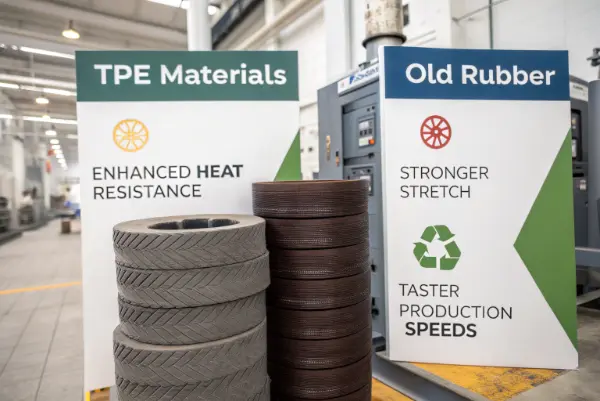
“Next-generation TPE” is not a standardized material class. It is a useful market description for thermoplastic-elastomer grades developed for a particular improvement—such as recycled or bio-based content, adhesion to a selected substrate, lower density, softness, weathering or a demanding mechanical property. No grade improves every property at once. Select the exact grade from the application’s failure modes, process and evidence, then validate molded parts.
The practical question is not whether a TPE is “advanced,” but whether its data and trial results meet your heat, chemical, UV, compression, tear, appearance, bonding, regulatory and environmental requirements. Start with the chemistry-family screening in our TPE, TPR, TPU and TPV comparison, then compare manufacturer grade data and molded samples.
How Do Next-Gen TPEs Offer Major Performance Gains?
A newer TPE grade can solve a defined weakness, but improvement is application-specific. Heat resistance, oil resistance, soft touch, tensile strength, tear resistance and compression set do not automatically rise together. A formulation optimized for adhesion or recycled content may have different mechanical, color or processing limits from a virgin general-purpose grade.
Better Stretch and Strength
Elongation alone does not prove durability. For a flexible hinge, seal or grip, review tensile and tear behavior, permanent set, cyclic loading, notch sensitivity and the service temperature. Mold test bars are useful for screening, but the final geometry can concentrate strain differently. Define the actual load cycle and inspect molded parts after conditioning.
Extreme Heat and Chemical Safety
Thermal and chemical resistance are grade-specific. Request test conditions—not only a statement such as “oil resistant.” Identify the fluid, concentration, exposure time, temperature and acceptable change in mass, dimensions, hardness and strength. For heat, separate short excursions from continuous service and evaluate compression set or sealing force after aging. Do not substitute a family name such as TPU or TPV for exact-grade evidence.
Making Parts Just for You
TPE compounds can be adjusted for hardness, color, feel, density, UV stability, flame performance or bonding, but each adjustment can change flow, shrinkage, surface, properties and documentation. Buyers should freeze the manufacturer, grade, color system and approved alternatives before tool qualification. Any later material change should trigger a defined comparison plan.
| Requirement | Evidence to request | Common purchasing error |
|---|---|---|
| Repeated flex or stretch | Tensile, tear, set and cyclic results at relevant temperature, followed by part testing | Choosing by Shore hardness or elongation alone |
| Heat or sealing | Continuous/short-term temperature basis, compression set and aged dimensions | Assuming every TPV or “high-performance TPE” has the same limit |
| Chemical contact | Exact fluid, concentration, time, temperature and acceptance criteria | Using a generic chemical-resistance statement |
| Soft-touch overmold | Exact substrate pair, conditioning, peel/pull test and mechanical-lock review | Assuming all TPEs bond to all rigid plastics |
Can Advanced TPEs Really Speed Up Your Manufacturing?
Compared with a thermoset elastomer that requires curing, a thermoplastic grade can enable melt processing and remelting during manufacture. That does not guarantee a shorter cycle, lower energy use or higher accepted output. Drying, melt temperature, screw recovery, cooling, insert handling, overmold sequence, scrap and quality limits determine the production result.
Fast Cycle Times
Compare processes on accepted parts per hour using the same cavity count, uptime and inspection rules. For the candidate TPE, establish a stable window for drying where required, residence time, injection/hold profile, mold temperature, cooling and ejection. A fast nominal cycle that raises bond failures, warp, sink, contamination or handling damage is not a saving.
Better Sticking Power
Overmold adhesion depends on the exact TPE, rigid substrate, additives, colorants, surface condition, melt and mold temperature, time between shots and interface design. Some grades are formulated for selected substrates; others require mechanical locks or a different joining route. Review our insert-molding and overmolding comparison, then validate peel, pull, torque, leak or aging performance that matches the product risk.
Functional Additives Need a Test Plan
Conductive, flame-retardant, low-friction, antimicrobial or color-changing formulations may be available, but the functional claim belongs to a specific grade and test method. Additives can affect flow, color, bonding, mechanical properties and compliance. Record the required function, method, specimen and acceptance limit before treating the feature as a production benefit.
| Manufacturing question | What to compare | Release evidence |
|---|---|---|
| Will the process be faster? | Cycle by step, cavities, uptime, scrap and accepted output | Representative run with stable dimensions, appearance and function |
| Can assembly be removed? | Tooling, substrate handling, bond/mechanical retention and inspection | Conditioned interface tests on molded parts |
| Can regrind be used? | Grade guidance, contamination control, percentage, appearance and property risk | Approved regrind rule plus comparison data |
What Are the Real Environmental Benefits of New TPEs?
Environmental improvement must be demonstrated for the exact grade and product system. Thermoplastic processing, recycled content and bio-based content are different claims. None of them alone proves curbside recyclability, lower product carbon footprint, lower energy use or regulatory compliance.
Manufacturing Scrap and Reprocessing
Some clean in-process TPE scrap can be reground and reused, but the permitted percentage depends on grade guidance, contamination, color, bonding, property limits and customer requirements. Medical, appearance-critical or tightly controlled applications may restrict or prohibit regrind. Post-consumer recyclability also depends on material identification, part construction, collection and an available recycling stream; remeltability alone is not proof.
Bio-Based Content
Verify bio-based content by exact grade and test basis. KRAIBURG TPE’s bio-based TPE fact sheet, for example, lists different renewable-carbon percentages and substrate adhesion by product series and refers to ASTM D6866 measurement. Avient likewise publishes a grade-family range for its reSound BIO TPEs. Bio-based content does not by itself establish lower lifecycle impact; request the supplier’s product carbon-footprint or life-cycle evidence and confirm the comparison boundary.
Recycled Content
Recycled-content TPEs also vary by grade. Avient’s reSound REC selection guide lists different recycled-content percentages, hardness, density, mechanical properties and intended overmold substrates. Use this type of grade-level evidence instead of describing all recycled TPEs as equivalent. Confirm source category, content percentage, chain-of-custody basis, lot consistency and whether the final application accepts that feedstock.
| Claim | Evidence needed | What the evidence does not automatically prove |
|---|---|---|
| Bio-based content | Exact-grade percentage, method and supplier documentation | Lower lifecycle emissions or finished-product compostability |
| Recycled content | Exact-grade percentage, source category and traceability basis | Equivalent properties, recyclability or suitability for a regulated use |
| Lower manufacturing waste | Approved regrind rule and actual scrap/yield data | That every reject can be returned to the same product |
| Lower energy or carbon | Comparable process data or product-level life-cycle/carbon study | A benefit based only on the words “TPE,” “bio” or “recycled” |
Where Do These TPE Materials Matter Most?
TPEs are useful where elasticity and thermoplastic processing solve a defined product problem. The application name is only a starting point; exact service conditions and validation determine suitability.
Automotive and Transportation Parts
Potential uses include seals, grommets, soft-touch surfaces, boots and vibration-control features. Specify heat, weathering, odor, fogging, chemical exposure, compression set, flammability and customer requirements as applicable. “Automotive grade” is not a substitute for the vehicle maker’s material and component approval.
Medical and Healthcare Components
A soft feel does not make a TPE medically suitable. Define contact type and duration, sterilization or disinfection exposure, extractables/leachables strategy, material-change control and finished-device validation. Use our medical TPE selection and evidence guide to prepare exact-grade questions; manufacturer test data supports risk assessment but does not approve the finished device.
Consumer, Electronics and Appliance Parts
Grips, protective edges, feet, seals and overmolded interfaces can benefit from feel, friction, impact protection or sealing. Confirm skin contact, cleaning agents, color transfer, UV, odor, electrical or flame requirements, substrate bonding and long-term compression. A phone case and a refrigerator seal can require very different chemistries even if both are called TPE.
Practical Takeaway
Before requesting a quote, provide the part CAD and drawing, intended function, rigid substrate if overmolded, target hardness, color and surface, service temperature, chemicals, UV/aging exposure, annual volume, applicable regulatory/customer requirements and the evidence needed for approval. Ask suppliers to identify the exact manufacturer and grade, proposed processing route, material-change controls and the tests used to release samples.
| Decision stage | Buyer action | Supplier evidence |
|---|---|---|
| Screen | Define failure modes and non-negotiable requirements | Candidate grade, current TDS and relevant declarations |
| Design | Confirm wall, draft, gate, interface and mechanical retention | DFM and grade-specific processing assumptions |
| Trial | Approve measurement, conditioning and functional test plan | Molded samples, settings and results by cavity |
| Release | Freeze grade, color, approved alternatives and change control | Material records and agreed production evidence |
Conclusion
Next-generation TPEs can create useful performance, processing or material-sourcing options, but the label itself is not evidence. Choose an exact grade against the product’s failure modes, compare trade-offs, validate the molded part and document any environmental claim on the same system boundary.
For an engineering review, submit the application, CAD, substrate, service conditions, quantities and approval requirements through the RFQ form. If drawings or CAD files are available, send them separately to jerry@ckmold.com with the company and project reference.