
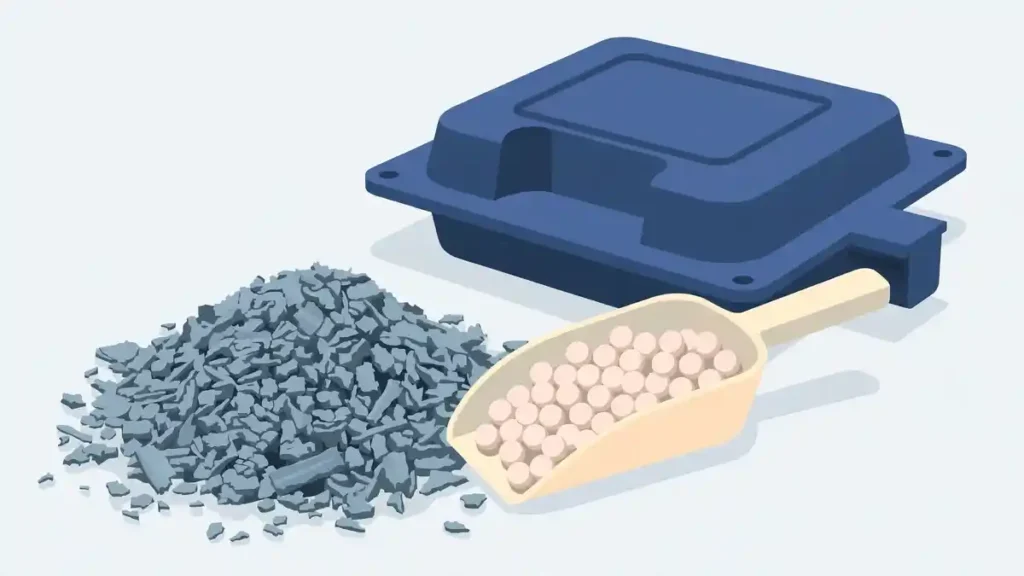
Every injection molding job produces scrap: the sprue, the runner, the rejected parts. Grind that scrap up, blend it back into virgin resin, and you have regrind — material you already paid for, doing a second shift. The question buyers actually need answered is not whether regrind works. It does. The question is how much of it a part can take before the part stops being the part you approved.
The short answer: for most non-critical parts, 15–25% regrind by weight of the total shot is a safe starting point, with commodity resins such as PP and PE tolerating 20–30% and engineering resins such as POM and glass-filled grades capped at 10–15%. Food-contact, medical, optical, and structural parts usually take 0%. No single percentage fits every part — the real number is set by the resin, the part’s job, and a trial at the percentage you intend to run, not by a rule of thumb.
That last clause matters more than the numbers. A supplier who quotes you a regrind percentage without asking what the part must do is guessing. This guide shows you how to set the number yourself, test it, and write it into your RFQ so it is a specification rather than a hope.
What Counts as Regrind — and What Does Not?
Regrind is ground-up thermoplastic scrap blended back into virgin resin. But not all scrap is the same material, and the distinction decides both the risk and what you can honestly claim about the part.
| Regrind stream | What it is | Contamination risk | Typical ceiling |
|---|---|---|---|
| In-house runner regrind | Sprues and runners from the same job, same grade, same color, same run | Low | 15–30% depending on resin |
| In-house rejected parts | Parts from the same job that failed inspection | Low to medium | 10–20%, after inspection of why they failed |
| Bought post-industrial regrind (PIR) | Scrap from another factory’s production, single grade, certified | Medium | 10–15%, only with full traceability |
| Bought post-consumer recyclate (PCR) | Material collected after use — bottles, crates, housings | High | 10–35% for packaging and automotive, with tight inspection; 0% for regulated parts |
| Mixed or uncertified regrind | Unknown grade, unknown color, unknown history | Very high | 0% for production parts |
The first two rows are what this article is mostly about: your own scrap, ground and fed back into your own job. That is the lowest-risk regrind there is, because its grade, color, and heat history are known. Everything downstream of it needs more testing and more paperwork.
One distinction buyers get wrong: regrind and recycled content are not the same claim. Only post-consumer material normally counts toward a recycled-content target or regulation. Feeding your own runners back into your own job is good manufacturing practice and good economics, but it does not make the part a "recycled product" in the sense a regulator or a retailer means. If your customer needs a recycled-content percentage on the part, say so in the RFQ — it changes the material stream entirely. Our broader guide to recycled plastics covers the sourcing and quality side of that decision.
A second distinction: regrind is not the same as reprocessed or repelletized material. Repelletizing melts the ground scrap, filters it, and cuts it back into uniform pellets. That removes contamination and evens out the granule size, but it adds roughly $0.12–0.20 per pound, according to plastics expert John Bozzelli writing for UL Prospector — and it adds another heat cycle of its own. For most jobs, well-handled ground regrind is enough; repelletizing is the answer when contamination or granule consistency is the problem.
What Does Regrind Do to the Part?
Every time a thermoplastic is heated, injected, cooled, and ground up again, its polymer chains get shorter. That process has a name — heat history — and it is the whole story of regrind. Shorter chains mean lower molecular weight, and lower molecular weight changes the part in a specific pattern rather than all at once.
The pattern is worth knowing, because it explains why regrind failures are usually invisible at incoming inspection:
- Impact strength goes first. A part with 20% regrind can pass every dimensional check and still crack in the field when it is dropped or snapped into place. Published molding guidance puts impact loss at roughly 10–25% at typical blend levels, and tensile strength down roughly 5–15%. Molecular weight falls roughly 3–8% with each heat cycle.
- Stiffness mostly holds. The part still feels solid, which is exactly why the problem is easy to miss. A regrind part rarely feels weak; it feels brittle.
- Elongation falls with impact. The part stretches less before it breaks. That is what kills snap fits and living hinges first — both are features that survive by bending. If your part has a living hinge, treat regrind as a hinge decision, not a material decision.
- Weld lines suffer more than the bulk material. Regrind lowers weld-line strength faster than it lowers the rest of the part, so a boss or a rib that sits on a weld line is the first place a regrind problem shows up.
- Shrinkage shifts a little. Regrind changes shrinkage by a small amount, and a small amount is enough to move a tight feature out of tolerance. If you validate a mold on virgin resin and then run production at 20% regrind, you have not validated the production process.
- Color and gloss drift. Each pass adds a little yellowing and a little variation. On a white, clear, or textured cosmetic surface, that drift shows before any mechanical property fails.
None of this means regrind is bad material. It means regrind is different material, and the difference has to be measured against what the part must do — not against the virgin data sheet.
How Much Regrind Can Each Resin Take?
There is no universal percentage, and any supplier who quotes one without asking about the part is guessing. The table below gives working ceilings that several independent molding guides converge on. Treat them as starting points for a test, not as numbers to put on a drawing.
| Resin | Working ceiling (% of total shot) | Watch first |
|---|---|---|
| PP, PE | 20–30% | Color drift, odor |
| ABS | 15–20% | Impact strength, gloss on textured surfaces |
| PC | 15–20% | Yellowing, drying — regrind picks up moisture faster |
| PC/ABS | 15% | Weld-line strength at bosses |
| PA6, PA66 | 15–20% | Moisture pickup, drying to the virgin specification |
| POM | 10–15% | Yellowing, formaldehyde odor if over-processed |
| Glass-filled grades | 10–15% | Fiber breakage at every pass — stiffness and warpage shift |
| Food, medical, optical | 0% | Validation and traceability rules usually exclude regrind |
Two things about this table need emphasis. First, the percentages are a share of the total shot, not of the virgin share: 20% regrind means one part ground material to four parts virgin, and it needs to be dosed by weight or by a calibrated volumetric feeder — not by eye into the hopper. Second, these are ceilings, not targets. The molding community generally targets 20–25% or less for blending regrind into virgin resin, in Bozzelli’s words, and most material manufacturers agree that up to 30% of compatible regrind can be mixed with virgin resin without lessening the mechanical properties the material is supposed to have. Kaysun, a US molder, notes that running 30% regrind translates to roughly a 15% material cost saving — but the same article warns that regrind is not ideal for highly critical applications, where the precision the project needs cannot tolerate the slight variability regrind introduces.
The resin is only half the decision. The part’s job is the other half. A non-critical internal bracket in PP at 25% regrind is a routine decision. The same 25% in a snap-fit latch, a living hinge, or a housing that must survive a drop test is a different decision — and it needs a test, not a table.
Does Your Job Even Generate Enough Regrind?
Here is a question buyers almost never ask, and it decides whether the regrind percentage in your RFQ is even achievable: does the job generate as much regrind as it consumes?
A cold-runner mold produces scrap on every shot. If the runner is a large share of the shot, the job is nearly self-sustaining at a moderate blend. If the runner is small — a hot-runner mold, or a large part with a small gate — the job cannot feed its own blend rate, and the supplier must either buy regrind in or draw down stock. That changes the price and the traceability of the material. The check below is a simple balance calculation, and it is worth doing before you write a percentage into an RFQ.
Worked example — the regrind balance check (illustrative, stated assumptions). Take a PP enclosure: the part weighs 48 g, the cold runner weighs 12 g, so each shot totals 60 g and the runner is 20% of the shot. Rejects are ignored for this check.
| Blend rate | Regrind used per shot | Regrind generated per shot | Balance per shot | Over 100,000 shots |
|---|---|---|---|---|
| 15% | 9 g | 12 g | +3 g surplus | 300 kg of regrind accumulates |
| 20% | 12 g | 12 g | 0 g — closed loop | Nothing accumulates, nothing is bought |
| 30% | 18 g | 12 g | −6 g deficit | 600 kg must come from stock or bought regrind |
The arithmetic is simple — 15% of a 60 g shot is 9 g, 20% is 12 g, 30% is 18 g — but the conclusion is not. At 20% this job is a closed loop: every gram of runner goes back into the next shot, and no regrind is bought or stockpiled. At 15% the supplier accumulates 300 kg of ground PP per 100,000 shots, which has to be stored, kept dry, kept segregated by grade, and eventually used or sold. At 30% the job needs 600 kg of regrind it does not generate, so the supplier is buying regrind from somewhere — and you should ask where, and with what certification.
Two practical consequences follow. First, the regrind percentage you specify should be compatible with the runner share of your mold: a percentage far above the runner share is a promise to buy outside material, and a percentage far below it is a promise to stockpile. Second, a hot-runner mold changes the calculation completely — it generates almost no runner scrap, so any regrind in the blend is bought-in or carried over from another job, and the traceability question becomes sharper. Bozzelli makes the same point from the shop-floor side: you can save money by running virgin resin in hot-runner tools and using the regrind for cold-runner tools, where the scrap is generated anyway.
When Is the Answer Zero?
Some parts should not contain regrind at all, at any percentage. Saying so in the RFQ is not being difficult — it is the specification. The cases are:
- Food-contact and medical parts. Validation, traceability, and regulatory rules usually exclude regrind outright. A medical housing or a food container is validated on a defined material; changing that material to a blend is a change to the validated product.
- Optical and clear parts. Every regrind pass adds yellowing and haze. A lens, a light pipe, or a clear cover has no tolerance for it.
- Structural, load-bearing parts. Where the part carries load, the impact-strength loss and the weld-line weakness are the failure modes, and the safety margin is the product.
- Snap fits and living hinges. Both survive by bending, and bending is exactly what regrind degrades. A snap-fit arm or a hinge that passed on virgin resin can fail after a few hundred cycles on a blend.
- Tight-tolerance parts. Regrind shifts shrinkage. If the part has a feature held to ±0.05 mm, validating on virgin and producing on a blend is validating the wrong process.
- True white and critical cosmetic surfaces. Color drift and black specks from fines show on a white or textured face before any mechanical test fails. Burned or discolored sprues should never be ground at all.
- Customer-specified virgin-only parts. Some customers specify virgin resin in their own drawings or specifications. If yours does, the RFQ should say so — the supplier cannot know otherwise.
It is also worth knowing that not every supplier will run regrind at all. Protolabs, for example, states plainly on its customer-supplied resin page that it never runs regrind resin and that virgin resin is required. That is a rapid-prototyping and low-volume position, and it is a legitimate one: at low volumes, the cost of validating a blend is larger than the material saving. The regrind decision belongs to volume production, where the saving is real and the validation can be amortized over the run.
How Do You Test a Regrind Blend Before Approving It?
A regrind percentage is only a specification if it is tested at that percentage. The most common failure in regrind programs is validating the mold on virgin resin, then quietly starting production at 20% regrind and discovering the difference in the field. The trial protocol below is the minimum that makes the percentage real.
1. Test the regrind lot before it is blended. Melt flow index (MFI, ASTM D1238) is the cheapest useful gate. Measure the regrind lot against the virgin baseline for the same grade. A common shop rule is to retire or downgrade a lot when its MFI is more than 20% above the virgin value — rising MFI means shorter chains, which means lower impact strength.
Worked example — the MFI gate check (illustrative, stated assumptions). Virgin PP, grade MFI 12.0 g/10 min (ASTM D1238, 230 °C / 2.16 kg). Two regrind lots arrive:
| Lot | Measured MFI (g/10 min) | Change vs virgin | Decision |
|---|---|---|---|
| Lot A | 14.8 | (14.8 − 12.0) / 12.0 = +23.3% | Fails the 20% rule — downgrade to a less demanding part or discard |
| Lot B | 13.1 | (13.1 − 12.0) / 12.0 = +9.2% | Passes — approved for blending at the specified ratio |
The arithmetic is the whole point: 23.3% is above the 20% line, 9.2% is below it. A lot that fails the gate is not "bad regrind" — it is regrind that belongs in a less demanding application, or in no application at all.
2. Mold the trial at the blend rate you intend to run. Not at 0%, not at a "safe" 10% with a plan to raise it later. The trial shot must be the production shot: same mold, same machine, same blend percentage, same drying. If the percentage changes later, the process has to be re-validated — Kaysun makes the same point: once a percentage is set and the process is tuned to it, changing the percentage means adjusting the process again.
3. Test the properties that regrind attacks, not the ones it leaves alone. Tensile strength and stiffness will usually pass; they are the wrong test. The trial needs notched Izod impact (ASTM D256), elongation at break, and a drop or snap test on the real geometry — plus dimensional measurement of the tightest features, and a cosmetic check on the visible faces. Compare every result against the virgin baseline molded the same day, in the same mold. A comparison against the data sheet is not a comparison.
4. Count the passes. Regrind does not reset. Material from the first blend still contains some of the first pass, and the second blend contains some of the second. Ask the resin supplier how many times their grade can go through the molding process before properties fall by more than 10%, and ask which properties degrade first — Bozzelli’s advice, and the right question to put in the RFQ. Common practice retires regrind after a small number of passes, typically three to five depending on the resin; the supplier’s answer, not a rule of thumb, is what goes in the process sheet.
5. Record the trial as a first article inspection. The trial parts, the blend ratio, the MFI readings, and the impact results belong in the first-article file. If the blend rate ever changes, the first-article record is what tells the next person what was actually approved.
What Should the Regrind Clause in Your RFQ Say?
A regrind clause does not need to be long. It needs to be specific enough that two suppliers quoting against it are quoting the same material. These ten points are the clause, in checklist form.
| # | State in the RFQ | Why it matters |
|---|---|---|
| 1 | The maximum regrind percentage, as a share of total shot weight | Without this, "some regrind" can mean anything from 5% to 50% |
| 2 | The regrind stream allowed: in-house runner only, or bought PIR/PCR as well | Bought material changes traceability, price, and risk |
| 3 | Resins and grades excluded from regrind (e.g., glass-filled, clear, white) | Some grades degrade faster; some surfaces show it first |
| 4 | Whether regrind is allowed at all for this part — or 0% | Food, medical, optical, structural, and tight-tolerance parts usually need 0% |
| 5 | The MFI gate: maximum MFI rise vs virgin, and the test standard (ASTM D1238) | The cheapest objective check on a regrind lot |
| 6 | Maximum number of regrind passes, per the resin supplier’s guidance | Heat history accumulates; the count has to be capped |
| 7 | Drying requirements for the regrind, stated to the same specification as virgin | Regrind picks up moisture faster — PC and PA must be dried again, not assumed dry |
| 8 | The trial requirement: molded at the specified blend rate, same mold and machine | Validating on virgin and producing on a blend is not validation |
| 9 | The acceptance tests: Izod impact, elongation, dimensional, cosmetic — against a virgin baseline molded the same day | Tensile and stiffness alone will pass and hide the real risk |
| 10 | Who owns the regrind, and what happens to surplus or deficit | A 15% blend on a 20% runner job stockpiles material; a 30% blend buys it in |
If you do not want to write the clause yourself, send the supplier this article’s table and ask them to confirm each row or explain the exception. A supplier who can answer all ten rows is a supplier who has actually run regrind before. A supplier who cannot answer them is telling you something too.
Note that the same discipline applies to ABS recycling programs, where the resin is more sensitive to heat history than PP and the ceiling is lower. If your part is ABS, start at 15% and prove the step up — do not start at the ceiling.
FAQ
Can I use 100% regrind?
Sometimes, for non-critical parts — Bozzelli notes that running 100% regrind avoids the blending problem entirely, since there is no virgin stream to contaminate and no blending equipment to calibrate. But the part still has to pass the same tests, and fiber length in glass-filled grades and color matching are still problems. 100% regrind is a decision, not a shortcut.
Does regrind save money?
Yes, on material — roughly 15% on the material bill at a 30% blend, per Kaysun’s figures — but the saving is partly offset by drying, testing, grinding, and handling. The saving is real at volume; at low volumes the validation cost can exceed it. That is one reason low-volume services often refuse regrind entirely.
Why did my parts pass inspection and fail in the field?
That is the classic regrind failure. Dimensional inspection passes because stiffness holds; the part fails in use because impact strength and elongation fell. If you suspect regrind, test notched Izod impact on parts molded at the production blend rate, and compare against virgin parts from the same mold.
Can I use regrind in a hot-runner mold?
The mold itself does not prevent it, but a hot-runner mold generates almost no runner scrap, so the regrind must be bought in or carried over from another job. Ask where it comes from and how it is certified — and consider running virgin resin in the hot-runner tool and saving the regrind for cold-runner work.
How many times can the same material be reground?
Ask the resin supplier for the specific grade: the question is how many passes before the critical properties fall by more than 10%. As a planning assumption, most grades tolerate only a small number of passes — typically three to five — before the material is retired to a less demanding application. The supplier’s data sheet, not a rule of thumb, decides.
The Percentage Is a Specification, Not a Guess
Regrind is not a compromise and it is not a free saving. It is a material stream with known behavior: impact strength and elongation fall first, stiffness holds, weld lines weaken, shrinkage shifts, and color drifts. The resins that tolerate it best are the commodity ones; the parts that tolerate it worst are the ones that bend, carry load, hold tight tolerances, or face the customer.
Set the percentage by resin and by the part’s job, check whether the job even generates that much regrind, test the blend at the rate you intend to run, and write all of it into the RFQ. Done that way, regrind is what it should be: material you already paid for, used once more, with the evidence to prove the part is still the part you approved.
If you are preparing an RFQ and want the regrind clause reviewed against your part — resin, geometry, tolerances, and annual volume — send us the drawing and the quantities. Tell us the material grade, the critical features, and whether regrind is allowed at all for your application, and we will confirm what blend rate the part can actually support. Start with a request for a quote and include the STEP file or 2D drawing, the material, the quantities, the key tolerances, the surface finish, and the delivery region.