Month: September 2026

Blog

How do I transfer my mold to a different manufacturer?

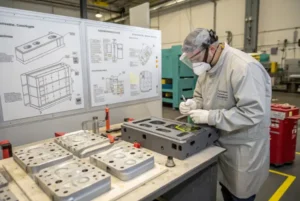
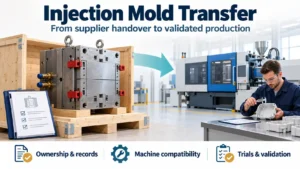
A mold transfer is a controlled engineering and logistics project, not simply a shipment. Verify ownership and release terms, preserve the current production baseline, confirm the receiving press and utility interfaces, document condition before transport, then run an incoming trial and the validation required by the customer. The main risks
Read More »
Material

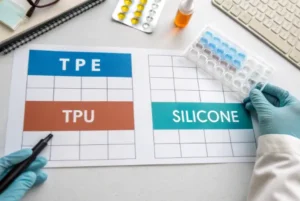
How Do Heat-Resistant and Food-Safe Materials Compare: TPE vs PP vs Silicone?

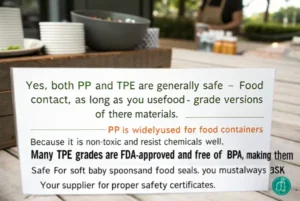
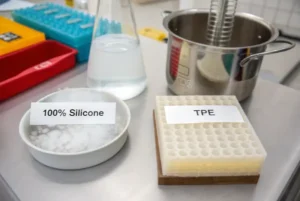
PP, TPE and silicone cannot be ranked with one “heat-safe and food-safe” score. PP may be efficient for rigid containers and hinges, TPE for flexible seals and overmolds, and silicone for flexible parts exposed to higher temperatures—but the exact grade, food type, time/temperature and cleaning cycle determine suitability. Compare the

Read More »
Material

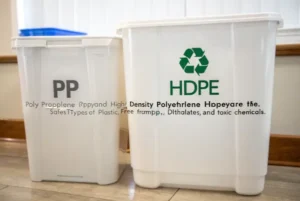
Toxicity Assessment of Common Plastic Materials: Which is Safest for Your Application?

There is no universally “safest plastic.” A material is appropriate only when its exact formulation, intended contact, temperature, service life, manufacturing process and applicable market rules are considered together. Resin identification codes describe polymer categories for sorting; they are not toxicity rankings. Start with the exposure, not the resin name

Read More »
Material

Comparing Material Safety: TPE vs TPU vs Silicone for Consumer Products?

TPE, TPU and silicone are material families, not safety ratings. For a consumer product, compare exact grades under the same skin/food contact, temperature, chemical, mechanical and market requirements. Safety documentation and functional durability must both be verified. First separate chemistry from product claims TPE is an umbrella term that includes

Read More »
Injection Molding

What is Medical-Grade TPE and Why is it Used in Healthcare Devices?

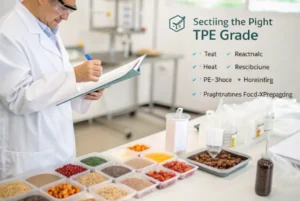
“Medical-grade TPE” is a supplier and application specification, not a universal regulatory category. It generally describes a TPE family offered with tighter formulation controls, traceability, change-management support and selected test documentation for healthcare uses. Suitability still has to be established for the exact grade and finished device. What buyers should

Read More »
Injection Molding

What is Overmolding with TPE and How to Do It Right?

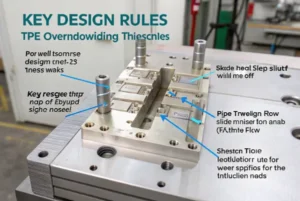
TPE overmolding succeeds when the exact TPE and rigid substrate are compatible, the interface is designed against peeling, and the process delivers a clean, hot flow front to that interface. Hardness alone does not predict adhesion, and a texture cannot make an incompatible material pair bond. Choose between insert molding

Read More »
Injection Molding

Not Satisfied with Your Injection Molding Samples? What to Do

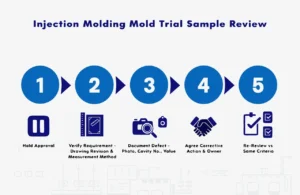
When a mold trial sample comes back and it does not meet what you expected, you have a fixed sequence of steps that keeps the project moving without turning a normal correction cycle into a dispute. Hold the relevant production approval until the issue is settled. Verify the requirement you

Read More »
Material

TPE Types Explained: Are SEBS, SBS, TPO, TPV, and TPC Different?

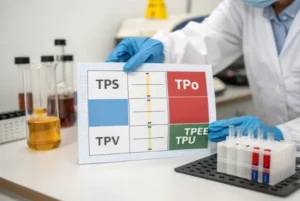
SEBS, SBS, TPO, TPV and TPC are different thermoplastic elastomer families with different temperature, weathering, compression, processing and cost profiles. The right choice begins with service conditions and component function; the family name only narrows the search to exact grades. Family-level comparison Family What it is Typical selection strengths Limits

Read More »
Material

How Do We Design for End-of-Life Material Selection Strategies for Recyclable Products?

Design for end of life by choosing the intended recovery route before the material stack is frozen. Then reduce material variety, make incompatible components separable, provide accurate identification and verify compatibility with the actual collection and reprocessing system. Step 1: choose a realistic recovery route Possible routes include reuse/repair, remanufacture,

Read More »
Design

What Is the Best Way to Communicate Design Changes to a Molding Factory?

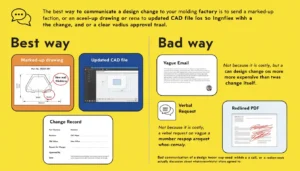
Send one controlled change package: updated CAD, a marked drawing and a short change record that identifies the part, current and new revisions, old and new requirements, reason, affected cavities, approval owner and required verification. This prevents verbal or chat instructions from becoming an ambiguous machining decision. “Communicate early” is

Read More »
Material

What Are the Advanced Recycling Technologies for PLA and TPU?

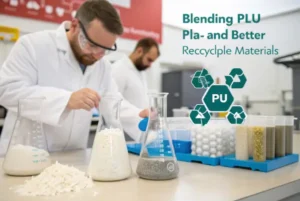
PLA and TPU can be mechanically recycled under controlled conditions, and both have chemical-recycling routes under development, but the feasible option depends on grade, additives, contamination, collection volume and local infrastructure. Laboratory depolymerization results do not prove that a mixed post-consumer part has a commercial recycling route. Why PLA and

Read More »
Material

Circular Economy Solutions for Plastic Manufacturing: How Can We Choose Materials and Design Better?

A circular plastics program connects product life, material choice, factory yield, repair/reuse and a verified end-of-life route. Switching to a material labelled “green” without changing design, supply controls or recovery logistics is not a complete circular-economy strategy. Set a product-system objective Choose a measurable objective before choosing a resin: longer

Read More »
Material

Bio-Based Resins for Injection Molding: Selection, Limits, and Validation

Bio-based resins can reduce reliance on fossil feedstocks, but “bio-based,” “biodegradable” and “compostable” describe different attributes. None of those labels proves that a resin is suitable for an injection-molded product. Product teams still have to qualify heat resistance, impact, dimensional stability, moisture behavior, chemicals, appearance, processing, supply and the intended

Read More »

Start with the Project Basics

Use this short form for a general inquiry. For a quotation, complete the full RFQ and email any 3D/CAD files separately to jerry@ckmold.com.

Wait, We Have Something Special for You!

Join our mailing list and receive a 10% discount on your next mold or CNC project.